
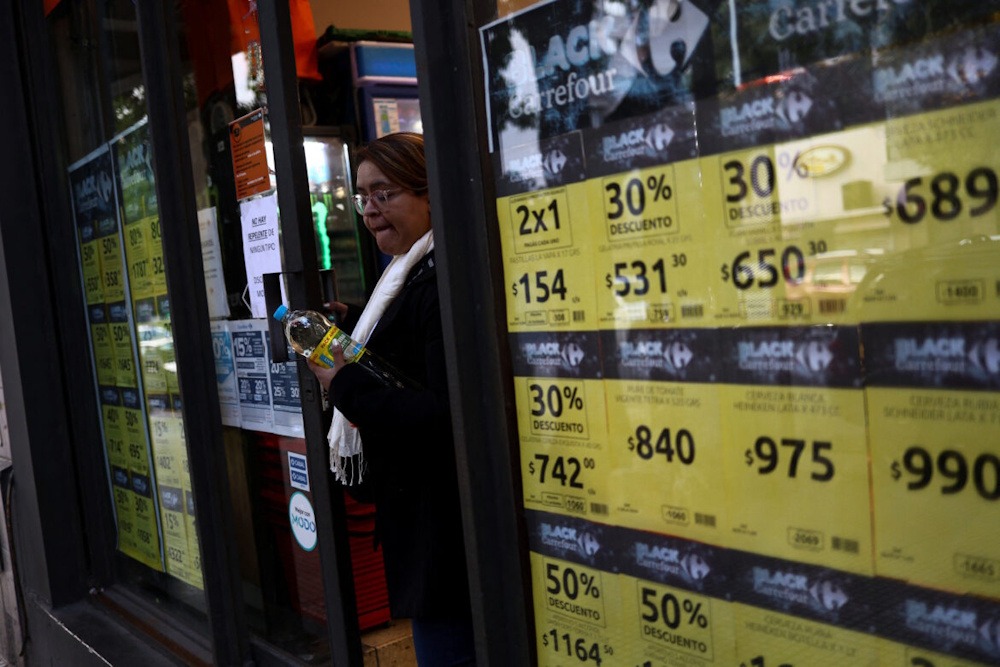
In April, inflation in Argentina decreased to 2.6%, as reported by the statistics agency INDEC on Thursday. The figure indicated a decrease relative to March’s 3.4%, signifying the inaugural instance in eleven months where the inflation rate has decelerated. The current figure represents the lowest level observed in the past five months, exceeded solely by the 2.5% noted in November 2025. Core inflation registered at 2.3%, reflecting a notable deceleration from the prior month’s 3.2% and marking the lowest level since October of the previous year. Prices increased by 32.4% compared to the same period last year. “Returning to normalcy.” President Javier Milei wrote on his official X account “Despite coup attempts by politicians [and their partners in the ‘red circle’] and the external shock, inflation is back on a downward trajectory.”
Economy Minister Luis Caputo expressed his approval of the news. “Excluding 2020, which was heavily influenced by the temporary increase in money demand during the pandemic, the rise in the overall level was the smallest for the month of April in the entire historical series, which begins in 2017,” he stated on X. The sector exhibiting the most significant monthly growth was transportation, which experienced a 4.4% increase, propelled by rising fuel prices. The second-largest increment occurred in education, registering a growth of 4.2%. Brokerage firm Balanz reports that the inflation figure was predominantly influenced by regulated components, which experienced a month-over-month increase of 4.7%. Seasonal prices exhibited stability.
Brokerage firm Puente observed that the figure was recorded despite “a challenging environment due to the conflict in Iran and its impact on energy prices.” Cumulative inflation for the initial four months of 2026 was recorded at 12.3%. This represents a notable divergence from the 10.1% inflation target that the government had anticipated in the sanctioned 2026 budget. Christian Buteler, an economist, informed that although the data aligned with market expectations, the forthcoming challenge lies in overcoming the inflationary inertia. He elucidated that one of the contributing factors to this phenomenon is the adjustment of utility rates based on historical inflation, which serves as a constraint when monthly inflation dips below 2%.
“One may not perceive the impact as significantly when reducing inflation from 6 or 7% to 2 or 3%, yet the transition from that point to 0% reveals that inflationary inertia, stemming from rate adjustments based on historical inflation, ultimately serves as a hindrance,” he elucidated. The most recent Market Expectations Survey conducted by the Argentine Central Bank indicates that May inflation is anticipated to be approximately 2.3%, with projections suggesting a decrease to 1.8% by October.
