
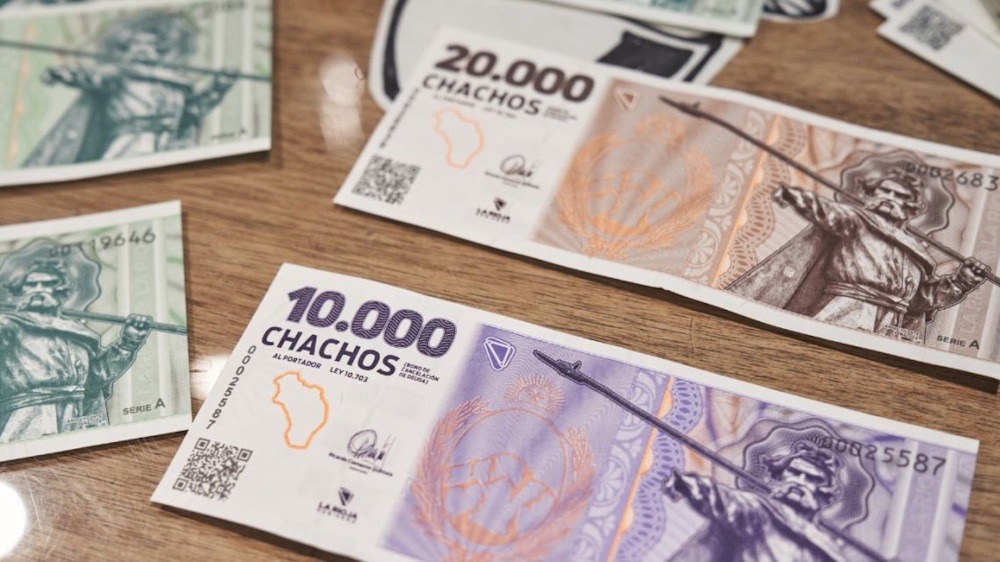
La Rioja Governor Ricardo Quintela has declared that his administration will reintroduce quasi-currency as a means to finance forthcoming wage increases. The news arrives as the provincial economy continues to be in default with international markets and confronts a contraction in federal revenue transfers. In 2024, La Rioja introduced quasi-currency for the first time in over two decades. The bonds were officially called Debt Cancellation Bonds (in Spanish, BOCADE) but were quickly nicknamed Chachos, referencing Ángel Vicente “Chacho” Peñaloza, the 19th-century Riojan leader whose image appears on the bill. Quintela acknowledged on Wednesday that the province is experiencing “difficulties” in raising the necessary funds to disburse the year-end bonus, yet he maintained that the payment would be made. In response to enquiries from reporters, he affirmed that “the Chachos were back” and indicated that they could be utilised beginning in August to disburse salaries for July.
The governor, however, clarified that the quasi-currency will not be utilised to cover the year-end bonus. “Perhaps they could be utilised for an enhancement,” he stated. Despite the commotion generated at the time, the “Chachos” were in circulation for merely six months — from mid-2024 to December of that year. Alejandro Pegoraro, an expert on provincial economies and director of the consultancy Politikón Chaco, informed that La Rioja “is one of the three provinces most dependent on revenue-sharing transfers [from the federal government].” Data from the Argentine Institute of Fiscal Analysis indicates that revenue-sharing transfers to the provinces have decreased by 2.4% thus far this year. “The decline is uniform in relative terms across all provinces; however, it has a significantly greater impact on La Rioja’s financial statements,” Pegoraro stated.
In recent days, the La Rioja government requested AR$85 billion from Javier Milei’s administration, which is approximately US$58 million at the official exchange rate, as an advance on revenue-sharing transfers. The federal government has not yet provided a response. Pegoraro emphasised that the fundamental issue is that La Rioja has been excluded from the international debt market for two years, as it stands as the only province in default within the country. “If it sought to penetrate the local market, it would encounter a rate that would be detrimental to its viability.” He added that the move comes as the La Rioja government anticipates that revenue will not experience a substantial recovery in the forthcoming months. “[They] require a financing channel to maintain the payment chain and address its operating expenses.”
Quintela’s administration was compelled to implement a 13.6% reduction in spending during the first quarter of 2026 to counterbalance an 8.3% decline in revenue for the same timeframe — a strategy that enabled the province to achieve a fiscal surplus, as reported. “Instead of borrowing on the capital markets, as other provinces are doing, La Rioja opted for domestic debt by issuing quasi-currency, thereby maintaining control over its financing costs,” he added. In February 2024, La Rioja defaulted on a US$16 million principal payment related to a US$300 million foreign-currency bond issued in 2017 for the purpose of financing a wind farm, which was subsequently divested. It subsequently ceased interest payments on the bond as well. Since then, La Rioja has also disregarded rulings from a New York court, which mandated that Quintela’s administration pay US$39.9 million following a motion for summary judgement filed by a group of creditors.
