
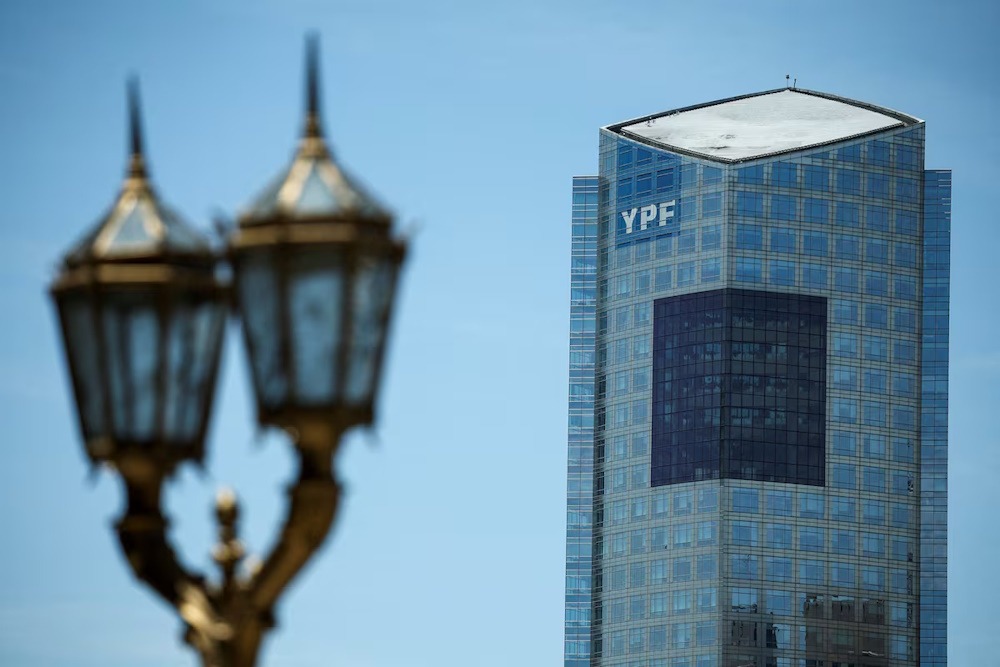
The United States Court of Appeals for the Second Circuit in New York denied Burford Capital’s petition to revisit the decision in the YPF expropriation case following Argentina’s successful overturning of the US$16 billion judgement at the end of March. Shortly after the announcement was made, President Javier Milei responded to the development: “Another victory for YPF in the New York courts,” he shared on X. The Argentine Treasury Attorney General’s Office, the agency that led the legal strategy, characterised the decision as “another endorsement of the legal strength of the position consistently maintained by the Argentine Republic.” The agency added “This outcome represents another milestone in the defence of the interests of the national state and underscores the importance of maintaining an international legal policy grounded in technical rigour, institutional coordination, and the sovereign defence of the public interest.”
YPF President Horacio Marín expressed approval of the decision. “For YPF, this represents a crucial development as it enables us to strengthen our 4×4 plan, enhance exports, progress towards our 2031 vision, and establish Argentina as a dependable energy supplier on the global stage.” In light of this decision, Burford is afforded a 90-day period to pursue a review before the U.S. Supreme Court, which represents the final legal recourse available within the United States. There is a 99.99% chance that the Supreme Court will not even agree to hear the appeal because the case involves only Argentine law and does not raise any constitutional issue or matter of major constitutional significance under U.S. law’, stated Sebastián Soler in a post on X. In a statement released following the March ruling, Burford indicated the potential for initiating a claim with the World Bank’s International Centre for Settlement of Investment Disputes.
According to Soler, Burford would likely contend that the ruling contravenes the bilateral investment treaties established between Argentina and the United States during Carlos Menem’s administration in the 1990s. However, he added that Argentina “has very strong arguments to defend itself against such an untimely claim.” The YPF expropriation lawsuit commenced in 2015; however, the initial unfavourable ruling was not issued until 2023, when a U.S. court mandated Argentina to compensate over US$16.1 billion in damages along with interest. At that time, Judge Loretta Preska of the U.S. District Court for the Southern District of New York determined that Argentina had breached YPF’s bylaws in the course of its 2012 nationalisation.
Her reasoning was that the rights of minority shareholders, including Eton Park, Petersen Energía, and Petersen Inversora, had not been respected. The latter two companies had previously entered bankruptcy proceedings and sold their litigation rights against Argentina to Burford. Preska’s ruling was appealed, and in October 2025, a hearing took place before the Second Circuit Court of Appeals. Of the three appellate judges, two ruled in favour of Argentina. They concurred that New York constituted the appropriate venue for the dispute; however, they determined that Preska had misinterpreted Argentine law and its application. They maintained that Argentina’s expropriation law explicitly forbids third-party lawsuits that disrupt an expropriation process. They also observed that a corporation’s bylaws do not form a bilateral contract among shareholders that would permit claims for damages of this nature.
