
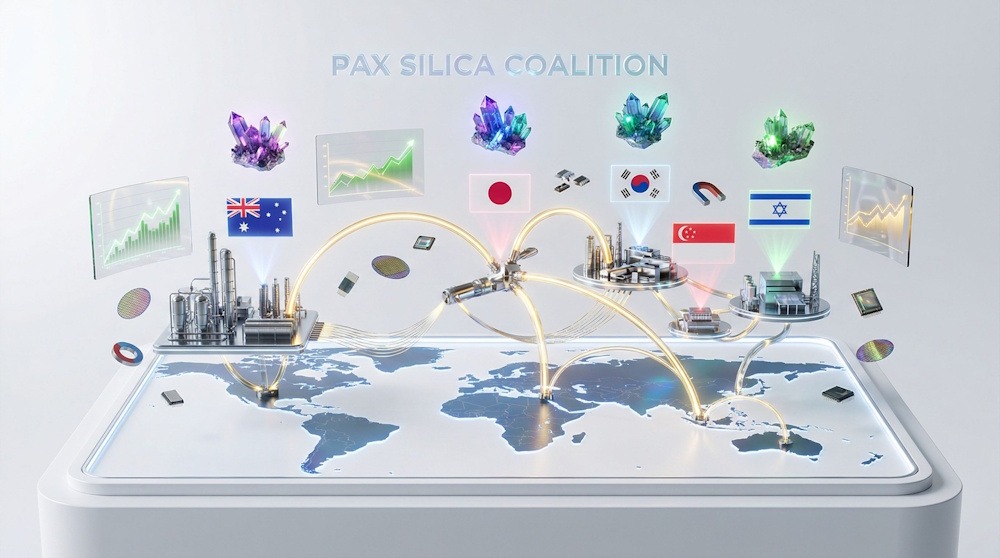
Argentina has joined Pax Silica, the strategic alliance advocated by U.S. President Donald Trump. The objective is to establish a strategic alliance in artificial intelligence that enhances the supply chains for advanced technologies. Foreign Minister Pablo Quirno disclosed the decision via social media. “This initiative will allow Argentina to take part in joint efforts to secure investment, build infrastructure and create incentives at every level of the global artificial intelligence supply chain,” he posted on X. Quirno linked the decision to the trade agreement signed in February aimed at enhancing the supply and processing of critical minerals, which he believes “reinforces the strategic relationship between Argentina and the United States.” Pax Silica is an international coalition established in response to the ongoing trade and technology conflict between the United States and China. The primary objective is to ensure the stability of supply chains that support artificial intelligence, encompassing critical minerals, rare earth elements, power generation, data-processing infrastructure, and semiconductor production. The initiative was formally launched on December 12, 2025, in Washington, D.C., establishing a framework for economic and technological cooperation. In addition to Argentina and the United States, the declaration has been signed by Armenia, Australia, Bahrain, Chile, Costa Rica, Denmark, El Salvador, Estonia, Finland, Germany, Greece, India, Israel, Italy, Japan, Kazakhstan, Latvia, Lithuania, the Netherlands, New Zealand, Norway, Panama, Paraguay, the Philippines, Poland, Portugal, Qatar, the Republic of Korea, Singapore, Sweden, Turkey, the United Arab Emirates, and the United Kingdom.
Federico Vaccarezza, an economist and Europe specialist at the Institute of International Relations at the Universidad Nacional de La Plata, stated to the Herald that the opportunity for Argentina to become a supplier in the global technology value chain at the beginning of the 21st century is one that “rarely presents itself this way.” He articulated that penetrating those technology supply chains was an issue of urgency “not only for Argentina but for all of Latin America.” He contended that during the 1960s, it was imperative for countries such as Argentina to cultivate the manufacturing sector to bridge the divide with developed economies. Today, that economic development signifies the enhancement of the technology sector. “The current gap between the most advanced countries and the ones lagging behind is technology,” he emphasised, noting that the competition between China and the United States presents a unique opportunity for Argentina that is unlikely to recur.
He posed a query concerning the position Argentina will hold within that global chain. “Whether the country is going to be solely a supplier of raw materials and natural resources or whether it will strategically focus on developing a competitive knowledge economy,” he stated. He emphasised that the knowledge economy constitutes Argentina’s third-largest export cluster. Participating in Pax Silica presents an opportunity to enhance a segment of the economic sector that contributes significantly to the generation of hard currency for the nation’s treasury. According to a report, the chamber that unites the sector’s leading companies indicates that foreign sales of knowledge-based services reached US$10 billion from March 2025 to the same month this year. The figure indicates a year-on-year growth of 11.7%, solidifying the sector’s position as the third-largest export complex in the country, following farming and energy. The latter is experiencing rapid growth, driven by unconventional oil and gas production at Vaca Muerta.
The Pax Silica news emerged following the approval of the incentive regime referred to as “Super RIGI” by the lower house. Formally known as the Incentive Regime for Large Investments in New Industries (RIGI for New Industries), this initiative provides a range of benefits—including tax, customs, foreign-exchange, and regulatory advantages—for a duration of 30 years, specifically targeting investments exceeding US$1 billion. While the bill does not delineate which foreign companies it aims to target, the document references the goal of attracting “industries of the future,” which the government characterises as “genuinely new” to Argentina. It also highlights strategic technological and digital infrastructure, activities that remain in a “experimental or pilot” phase within the country, along with sectors that necessitate “anticipated macroeconomic solutions” for development.
