
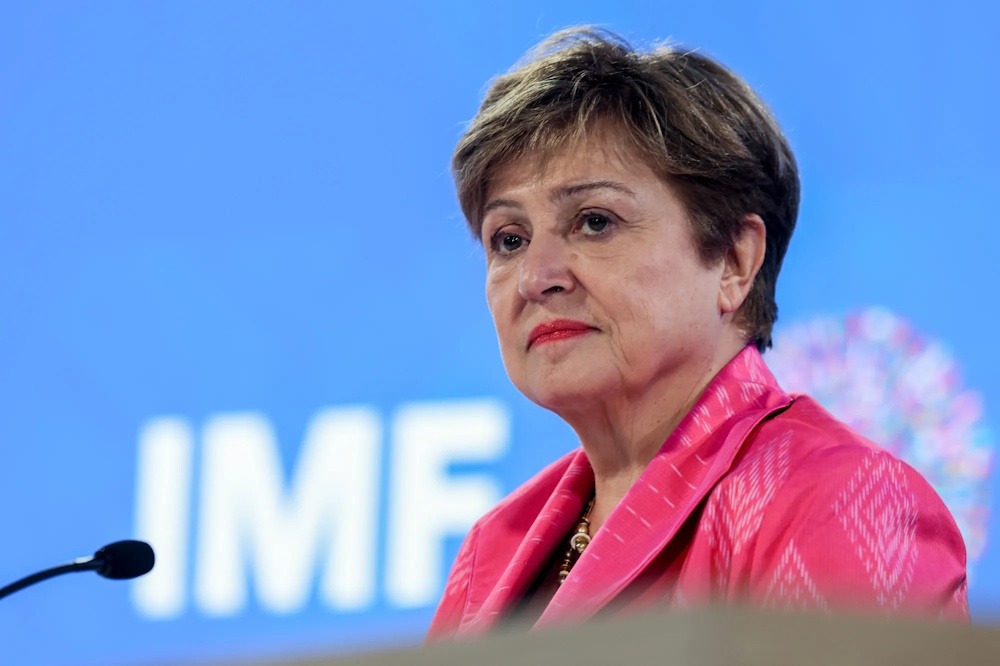
International Monetary Fund Managing Director Kristalina Georgieva addressed various facets of the Argentine economy during a conference held on Monday, where she was accompanied by Economy Minister Luis Caputo upon her arrival in Buenos Aires. Georgieva acknowledged the challenges confronting the country, yet she conveyed a generally positive perspective, asserting that she “didn’t foresee the need for Argentina to go to the Fund for additional financing.” She explained “Why am I saying that? Because we look at the worst-case scenario and how Argentina would prepare for it. And we see a very determined buildup of reserves and a very comprehensive strategy on how to secure Argentina’s viability through 2027.” Georgieva added that the country was on a “good track to join the club of emerging markets that have borrowed from the fund, reformed their economies, and borrowed no more.” During the conference, Georgieva acknowledged that the transformation Argentina is undertaking is “hard.” The head of the IMF drew parallels between the current situation and the economic transition that her native Bulgaria underwent in the 1990s. “The country had to go through very tough times. But perseverance in putting in place strong macroeconomic and financial stability, as well as openness of the economy and injection for growth, pays off,” she explained. She observed that Bulgaria is currently a member of the European Union, entered the Eurozone in January, and its per capita income “has increased eightfold.”
Georgieva stressed that “we do have to recognize that transformation is hard, but when successful, it brings confidence.” Georgieva recognised the robust performance of Argentina’s agriculture, mining, and energy sectors; however, she also noted that the underperformance of other sectors—such as construction, services, and logistics—demands attention, especially regarding small and medium-sized enterprises. “What can we do to get growth in Argentina to be more broadly shared? That was the main topic of discussion today. What can we specifically support Argentina to do to further ease financial conditions so small businesses and households can borrow and then turn this into a broader, shared prosperity in the country?” she emphasized. She highlighted that SMEs account for most employment in Argentina, although informality has become increasingly widespread. “Unemployment is not high by comparison; it is under 8%. But a big chunk of it is in informal employment.” While she characterised the labour reform approved by the government earlier this year as “very healthy” in addressing that problem, she noted that further action is necessary. “Whenever we look at countries that gain in employment, SMEs play a very important role,” she said. She also noted that Argentina has an additional advantage: “It is energy security in a world of artificial intelligence.” According to Georgieva, energy security could help “diversify the economy.”
Georgieva highlighted three critical areas that need attention for Argentina to evolve into an economy comparable to those of Finland, Sweden, or South Korea: infrastructure, education, and the rule of law. “Sticking to the rule of law, addressing the deficiencies that have been in place, being relentless in the fight against corruption. That is the way to cure the fear that comes from the past,” she said, concluding with a direct appeal to the country. “Are you guys ready for it? The Argentines in the room. It’s not going to be me; it’s you. Can you persevere to do it?” Georgieva’s two-day visit to Argentina commenced with a conference, followed by a meeting with President Javier Milei at 2:00 p.m. She subsequently participated in a cabinet meeting at 2:30 p.m. The agenda also encompasses meetings with Economy Minister Luis Caputo, Central Bank Governor Santiago Bausili, and various government officials, alongside discussions with academics, students, and leaders from the private sector. The visit will also encompass a stop in Vaca Muerta, where she is set to engage with workers and executives from the energy sector. Georgieva’s visit precedes the third assessment of Argentina’s arrangement with the IMF, set for September. If approved, the review could unlock a disbursement of US$860 million. This marks Georgieva’s inaugural visit to Argentina since assuming the role of IMF managing director seven years prior, and it is also the first occasion in eight years that the Fund’s highest-ranking official has visited Buenos Aires.
The most recent visit of this nature was conducted by France’s Christine Lagarde in July 2018, occurring merely weeks after the agreement of US$45 billion was signed between then-President Mauricio Macri and the IMF. Argentina stands out as the IMF’s most significant debtor by a considerable margin. As of July 24, it had $57.7 billion in outstanding credit at the Fund’s prevailing exchange rate. This represents 34.6% of all outstanding IMF lending and is nearly four times larger than Ukraine’s debt, making Argentina by far the Fund’s largest borrower. Much of that debt originated from the agreement signed in 2018 under Macri, which was refinanced in 2022 during the Alberto Fernández administration. In April 2025, President Javier Milei’s administration finalised a new agreement with the IMF amounting to US$20 billion, representing the 23rd program established between Argentina and the Fund.
