
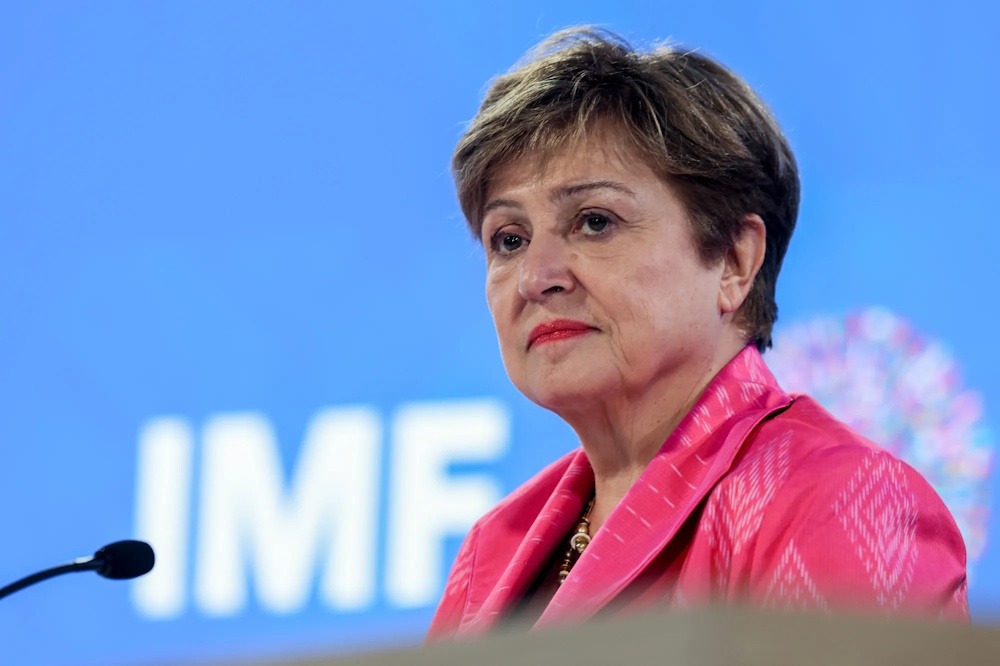
The International Monetary Fund on Tuesday adjusted its growth forecast for Argentina downward and increased its inflation projection, underscoring a decline in the nation’s internal and external circumstances. The latest edition of the Fund’s World Economic Outlook report, published biannually, indicates that the IMF has revised its forecast for Argentina’s gross domestic product, now anticipating an expansion of 3.5 percent in 2026—a downgrade of 0.5 points. In 2027, the economy is projected to expand by four percent. The reduction in Argentina’s forecast is primarily attributed to a deceleration in economic activity anticipated in the latter half of 2025, as reported by Petya Koeva-Brooks during a conference in Washington DC on Tuesday. The timeframe aligned with the currency volatility preceding the midterm elections in October of the previous year. Similar to numerous other countries, the consequences of the conflict will manifest in both advantageous and disadvantageous ways. Elevated oil prices have the potential to enhance revenue streams in export sectors such as energy; however, they simultaneously pose challenges to inflation control, escalate logistics expenses, and create a more complex environment for investment activities. In light of persistent apprehensions regarding price increases amid energy volatility and conflict in the Middle East, IMF analysts have revised their forecasts, projecting that Argentina’s inflation rate will reach 30.5 percent by year-end—a significant 10-point increase from earlier predictions.
According to the Fund, consumer prices are anticipated to increase by 15.7 percent in 2027. Analyzing the labor market, the IMF forecasts that Argentina’s unemployment rate will reach 7.2 percent by year-end. In light of the more challenging outlook, Argentina still seems to be relatively well-positioned within the region. The country is projected to surpass all the region’s prominent economies, notably Brazil at 1.9 percent in 2026 and Mexico at 1.6 percent, with the sole exceptions being Paraguay at 4.2 percent and Venezuela at four percent. The International Monetary Fund forecasts a growth rate of 2.3 percent for Latin America and the Caribbean in the current year, with an anticipated increase to 2.7 percent by 2027. The IMF’s report indicated that Brazil stands to gain from the conflict, given its position as a net energy exporter. Venezuela, having undergone a leadership change following the capture of Nicolás Maduro by the United States in January, is an oil producer that stands to gain from the prevailing instability in the Persian Gulf. The IMF indicated that a deceleration in global demand, escalating input costs (notably for fertilisers), and more stringent financial conditions will be significant factors influencing the South American giant’s economy in the coming year.
The International Monetary Fund has projected a growth rate of 3.1 percent for the global economy this year. That represents a decline from the 3.3 percent projection made in January prior to the onset of hostilities in the Middle East. “We were planning to upgrade growth for 2026 to 3.4 percent” if not for the war, said IMF chief economist Pierre-Olivier Gourinchas on Tuesday. While the adjustments to global growth and inflation seem limited, the IMF warned that the conflict has had a more significant impact on the Middle East and “vulnerable economies” in other regions. “The impact on emerging market and developing economies would be almost twice that on advanced economies,” the Fund stated. Latin America and the Caribbean continues to exhibit significant economic disparities, as evidenced by Venezuela’s inflation forecast: 387 percent in 2026, marking a considerable increase from the 252 percent noted in 2025, as reported by the Fund. In contrast, Bolivia’s economic outlook is significantly less favorable. Following a contraction of 1.2 percent in 2025, the economy is projected to experience an additional decline of 3.3 percent this year.
Colombia is projected to experience a growth rate of 2.3 percent, Chile is anticipated to grow by 2.4 percent, whereas Uruguay is expected to maintain a steady growth rate of 1.8 percent from 2025. Peru is projected to experience a growth rate of 2.8 percent, while Ecuador is anticipated to grow by 2.5 percent, with both figures falling marginally short of their respective 2025 levels. The Fund consolidates Central American nations and maintains their growth projection at 3.7 percent, with an anticipated increase to four percent by 2027. The Caribbean is poised to achieve the highest growth in the region, with projections of 5.7 percent in 2026 and 8.6 percent in 2027.
