
Javier Milei’s administration has redefined the framework of Argentina’s nuclear policy, aiming to emphasise foreign investment and promote high-value-added exports, in alignment with the Nuclear Plan introduced by the president in late 2024. The shift was announced on Sunday during a ceremony commemorating the 76th anniversary of the National Atomic Energy Commission. At the event, the Nuclear Affairs Secretariat Federico Ramos Nápoli presented a comprehensive 54-page document articulating the rationale for a shift in Argentina’s nuclear development strategy. “Argentina has consistently produced world-class nuclear science and technology, but it hasn’t managed to turn that output into an industry of comparable scale,” the official text stated. The rationale for the new policy, it argued, “stems from that asymmetry: the sector holds assets whose capitalisation was never completed, and the political task is to close the gap between available capacity and actual results.” Argentina was the first Latin American country to construct nuclear reactors for power generation in the 1970s, partnering with the German firm Siemens. It stands as a regional leader in nuclear technology, in conjunction with Brazil, operating three nuclear plants: Atucha I, Atucha II, and Embalse, which collectively generate 1,641 megawatts.
The government noted that Argentina “belongs to the restricted group of countries — around 15 worldwide — that have command of the entire nuclear fuel cycle.” According to the Nuclear Affairs Secretariat, that constitutes a structural comparative advantage, a scarce asset within the Argentine economy. Consequently, the secretariat established four prioritised objectives for the sector. The first is the advancement of high-value-added nuclear exports. Energy security is the second priority. Third, the preservation and development of national technological capabilities. Lastly, the focus shifts to regional leadership and geopolitical positioning. In practical terms, this indicates that the primary criterion for advancing projects and investments in the nuclear sector is their ability to produce revenue. The document itself clarifies that when two of those objectives are in conflict, the one with the higher rank takes precedence.
“Argentina must position itself as a significant participant in the global supply chain for nuclear technology. This objective leads the sector hierarchy and serves as the guiding criterion for the full set of investment and resource allocation decisions,” stated the office led by Ramos Napoli. The secretariat also previewed on Sunday the priorities for the next 18 months: operating the nuclear plants and extending the working life of Atucha I; bringing the RA-10 multipurpose reactor online; positioning the country in the nuclear fuel cycle; modernising the regulatory framework; training professionals; and regional leadership. Argentina possesses companies that span every stage of the nuclear energy value chain, with the exception of uranium mining, which ceased operations in the late 1990s following a collapse in the international price of the commodity. A week earlier, Caputo himself posted on X that “there can’t be many things more important for the history of our nation than pulling out the 300,000 tonnes of uranium we have underground.” That figure was subsequently contested by mining experts, who asserted that the actual amount is an order of magnitude smaller. The presidential adviser also stated that Chubut — the province where the uranium reserves are situated — “could be the next Neuquén,” referring to the gas and oil deposits of Vaca Muerta.
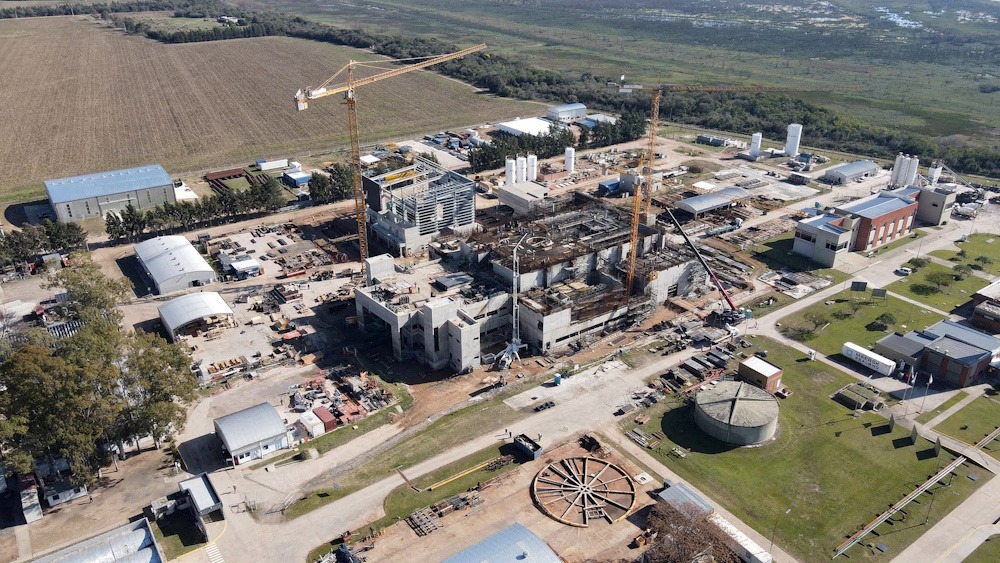
The guidelines, however, fail to materialise into tangible projects. The text itself clarifies that it “does not constitute a nuclear plan in the specific sense the word ‘plan’ takes on in public management: a timetable of executive actions with assigned resources, set deadlines and clear responsibilities.” The document was released a year and a half following Milei’s presentation of the Nuclear Plan, which he introduced alongside Rafael Grossi, the director general of the International Atomic Energy Agency. The objective was to construct four small modular reactors at Atucha, utilising the ACR-300 design developed by the technology firm INVAP. That earlier announcement, which included a “nuclear city” to supply power to artificial intelligence data centers in Patagonia, has not demonstrated any observable operational advancements. The new document does not explicitly reference either the original Nuclear Plan or the nuclear city project. The initiative was propelled by Demian Reidel, president of the state-owned company Nucleoeléctrica Argentina, who resigned in February of this year amid allegations of overpricing at the company he led.
