
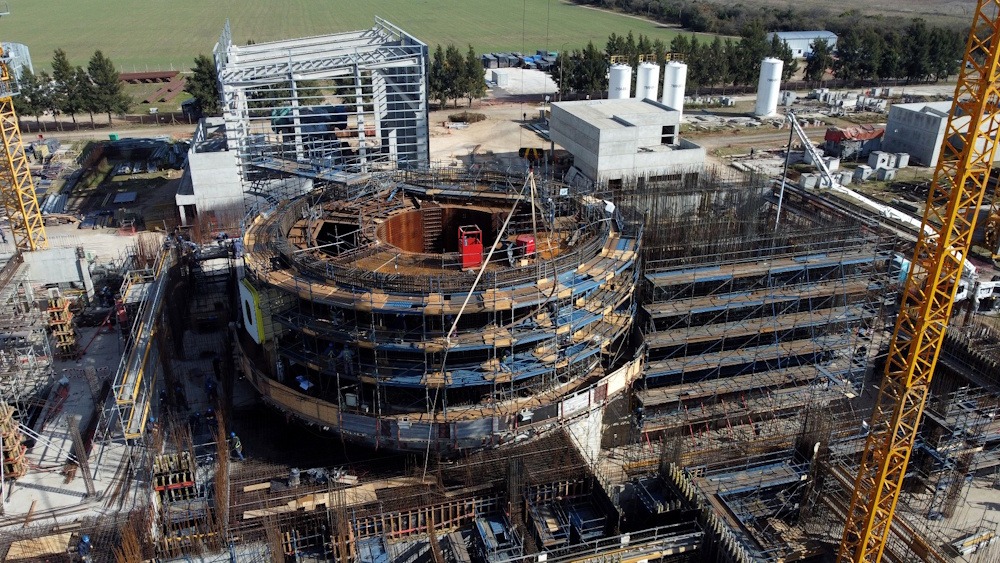
Economy Minister Luis Caputo announced that a private company based in the United States intends to invest US$1.2 billion to construct a small modular reactor at the Atucha nuclear complex. The reactor, an ACR-300, was designed in Argentina. The project was presented by Meitner Energy, a firm with capital from both the United States and Argentina. The firm announced in May their intention to construct the reactor, although they did not furnish additional details at that time. Reports indicate that 60% of the company is owned by the Ansari Group, a corporation under the control of Iranian businessman Hamid Ansari. The remaining stake is held by Black River Technology, a U.S. firm that is managed by the Argentine state-owned technology company INVAP.
Designed by INVAP, the ACR-300 is set to be the inaugural reactor of its type upon completion. Caputo stated that Meitner Energy Latam’s CEO, Teófilo Lacroze, along with Pablo Franzetti, the company’s head of external affairs and new business in Argentina, formally presented the proposal to construct the reactor at Atucha utilising private U.S. capital on Thursday. “This project will create approximately 2,000 direct jobs during the development, construction, commissioning and operation stages,” Caputo stated. “We continue to work to advance nuclear technology that promotes Argentina’s energy development,” he added. Presidential spokesman Adrián Ravier emphasised in an X post that “for the first time, a private company will expand Argentina’s energy infrastructure” and push the country’s technological boundaries.
“The changes spearheaded by President Javier Milei have built the confidence needed for an international company to choose our country to build a 100% privately owned nuclear reactor,” Ravier wrote. Given the scale of the investment, the project could qualify for the government’s new incentive regime for emerging industries, known as “Super RIGI.” The initiative has received approval from the Lower House; however, it still awaits the Senate’s endorsement. Projects approved under the regime receive 30 years of tax stability and foreign exchange benefits, contingent upon investments of at least US$1 billion in sectors deemed new or in the nascent stages of development in Argentina. Argentina’s public nuclear sector had previously been developing the CAREM-25 SMR, the nation’s inaugural nuclear power reactor conceived entirely within its borders. Construction was suspended when the project was allegedly around 85% finished due to layoffs and reductions in funding.
The National Atomic Energy Commission (CNEA, by its Spanish acronym) subsequently stated that the CAREM-25 project lacked commercial viability. The Milei administration instead shifted its focus to INVAP, which had patented the ACR-300 design in the U.S., a move critics viewed as part of a broader push toward privatising Argentina’s nuclear sector. In March 2025, the government unveiled intentions to construct four INVAP-designed ACR-300 reactors at Atucha; however, there has been no public disclosure of further advancements until this point. The Meitner Energy announcement follows closely on the heels of the government’s decision to dismiss 61 employees from the CNEA, a move that includes the departure of highly specialised professionals and technicians.
