
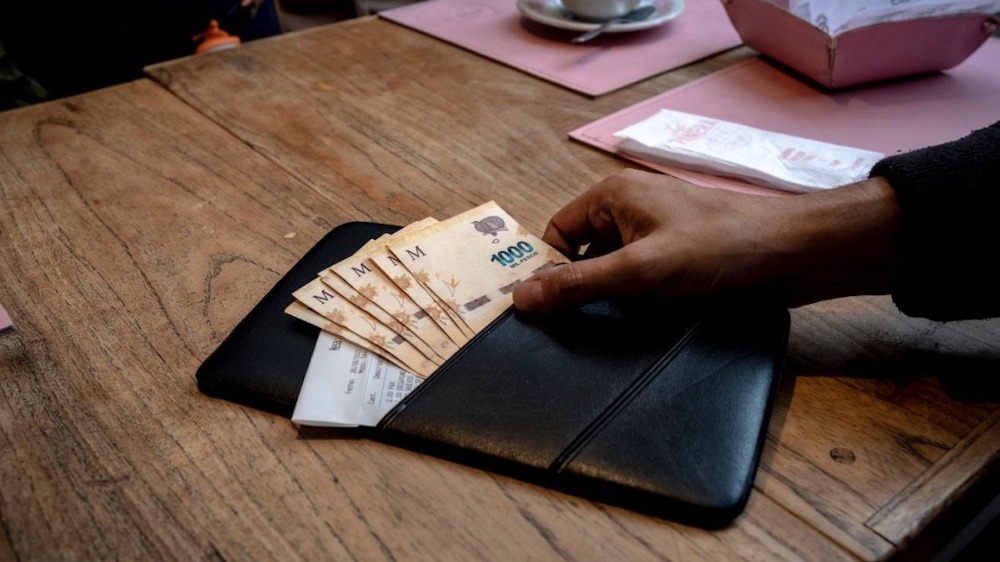
The Argentine minimum wage has served as a historic benchmark for salary negotiations within both the formal and informal sectors of the economy. That benchmark, however, has undergone significant alterations since President Javier Milei assumed office in December 2023. Since then, the SMVM has undergone a consistent decrease in purchasing power and is presently at its lowest point since the 1990s. Estimates from the Center for Studies on Education in the Argentine Republic, linked to the Argentine Workers’ Central Union, indicate that the minimum wage has experienced a cumulative decrease exceeding 40% in purchasing power since the libertarian administration assumed office. “The severe impact of inflation in the first few months [of the Milei administration] caused an initial 30% decline that was not reversed; on the contrary, consecutive monthly contractions have been recorded for the past two years,” the study noted.
With a nominal value of AR$367,800 (US$243.5 at the official exchange rate), the purchasing power of the minimum wage is presently 60% diminished compared to 2015 and 20% lower than the levels observed in the 1990s. “To directly gauge the magnitude of this decline, it is worth noting that if minimum wage had kept pace with inflation since 2015 without losing purchasing power, it would stand at around AR$955,000 [US$632.40] today,” CIFRA noted. The SMVM is established by the National Minimum Wage Council, a tripartite entity consisting of representatives from labour unions, businesses, and the government. The CIFRA report, however, states that under Milei, the body began to function in an “unusual manner” that left it “blurred and stripped of substance.”
In the absence of agreements, all increases were determined by the labour ministry. This resulted in figures “aligned with business proposals that effectively endorsed the loss of purchasing power.” Furthermore, the intervals between the council’s most recent meetings expanded significantly, “leaving months without updates and resulting in a minimum wage that was revised less frequently.” Year-to-year inflation, meanwhile, persists at levels exceeding 30%. This decline in purchasing power is evident in the challenges faced by domestic consumption — a fundamental component of the Argentine economy — in achieving a sustained recovery. According to the latest official data from INDEC, supermarket sales experienced a month-over-month increase of 0.9% in May; however, they remain 0.7% lower than the figures recorded in May of the previous year. In the initial four months of 2026, the decrease is recorded at 2.8%.
A comparable scenario was noted in the sales figures at wholesale supermarkets, serving as an indicator for the sales performance of small retail enterprises. Despite an increase of 2.3% on a month-over-month basis, there was a decline of 2.3% when compared year-over-year, with the year-to-date data indicating a decrease of 3%. Another indicator reflecting this stagnation is the Consumer Confidence Index published by Torcuato Di Tella University. The CCI registered 40.67 points in July, reflecting a monthly decline of 4.78% and a decrease of 12.30% relative to July 2025.
