
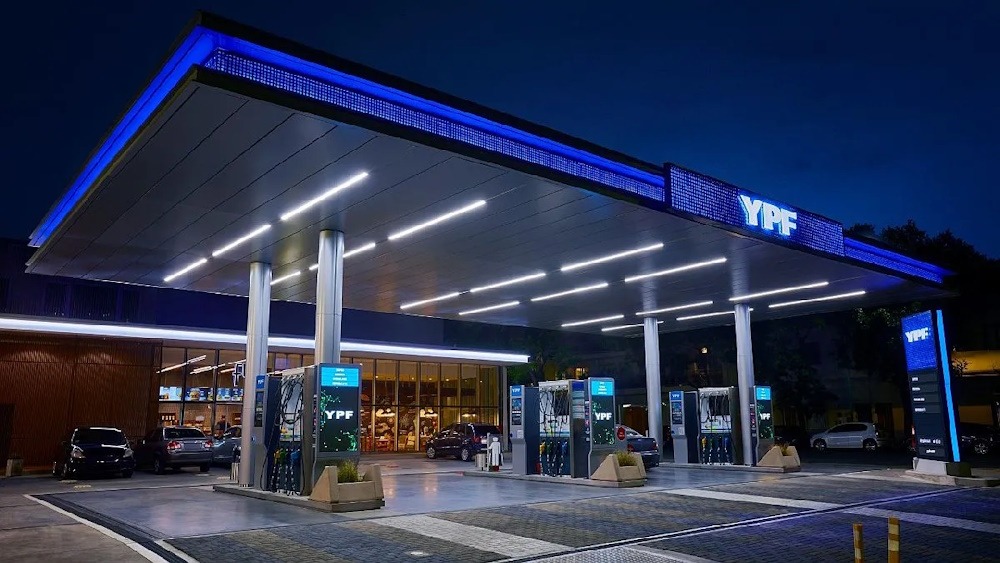
YPF, the state-owned oil company, has entered into a letter of intent with Tesla, the automaker, to investigate the potential establishment of a fast-charging network for electric vehicles in Argentina. The announcement was made by YPF President Horacio Marín, who, on Monday, visited Tesla’s Gigafactory in Texas with Michael Snyder, the vice president of energy at the company owned by Elon Musk. “During the visit, we signed a letter of intent to explore opportunities for collaboration in fast-charging infrastructure, energy storage, and technological innovation — areas that will play a central role in the evolution of energy and mobility in the coming years,” Marín tweeted. While the letter of intent serves as a framework agreement that facilitates formal negotiations, it does not impose any binding financial obligations.
Executives refrained from disclosing specific investment amounts or definitive timelines for the execution of the projects. YPF stands as the foremost fuel retailer in Argentina. It operates 1,660 petrol stations, representing over 30% of the nation’s total. Tesla, conversely, finds itself at a disadvantage. Electric vehicles hold a marginal position in Argentina, where the market is predominantly occupied by Chinese-manufactured automobiles. In the initial five months of the year, sales of electric vehicles exceeded 3,000 units, as reported by the Argentine Automobile Dealers Association. This signifies a 760% increase on a year-over-year basis when compared to the corresponding period from the previous year. The BYD Dolphin Mini dominated the segment with 1,695 units sold, trailed by the BYD Yuan Pro at 585 units, the Chevrolet Spark EUV with 167 units, the Jmey Easy at 126 units, and the BAIC EU5 with 77 units. The current lineup in the EV segment comprises 24 models, with an average monthly sales figure of 600 units. Tesla’s electric vehicles are conspicuously absent from the list of the top twenty best-selling models in the local market.
Experts noted that, although the ascent of Chinese electric vehicles represents a regional trend, Argentina’s situation was significantly influenced by an incentive from the Milei administration. In December, the Argentine government implemented a quota permitting the importation of up to 50,000 hybrid, electric, and fuel-cell vehicles at a 0% tariff, which will remain in effect until the conclusion of 2026. However, there was one key requirement that made all the difference: the vehicle’s FOB value — the price of the goods excluding the cost of ocean freight — must not exceed 16,000 US dollars. “Traditional brands, including Tesla, do not meet that FOB price, whereas Chinese brands do,” stated Ernesto Cavicchioli. He articulated that the duty-free importation of cars from China renders them “very competitive.” He noted that, in contrast to Tesla, Chinese companies had already established a foothold in the country due to Chery’s entry in 2007.
Federico Bernini stated that Chinese manufacturers were able to provide more competitive pricing than their rivals due to two key factors. On one hand, he observed that there is superior integration regarding batteries, as exemplified by BYD’s use of domestically produced batteries. Conversely, it is suggested that “they likely receive substantial subsidies from the Chinese government” — a claim that remains plausible yet challenging to substantiate. “They’ve successfully integrated competitive pricing with superior product quality, particularly regarding design and comfort, and are increasingly achieving brand recognition, despite currently being in a position of catching up,” he concluded.
