
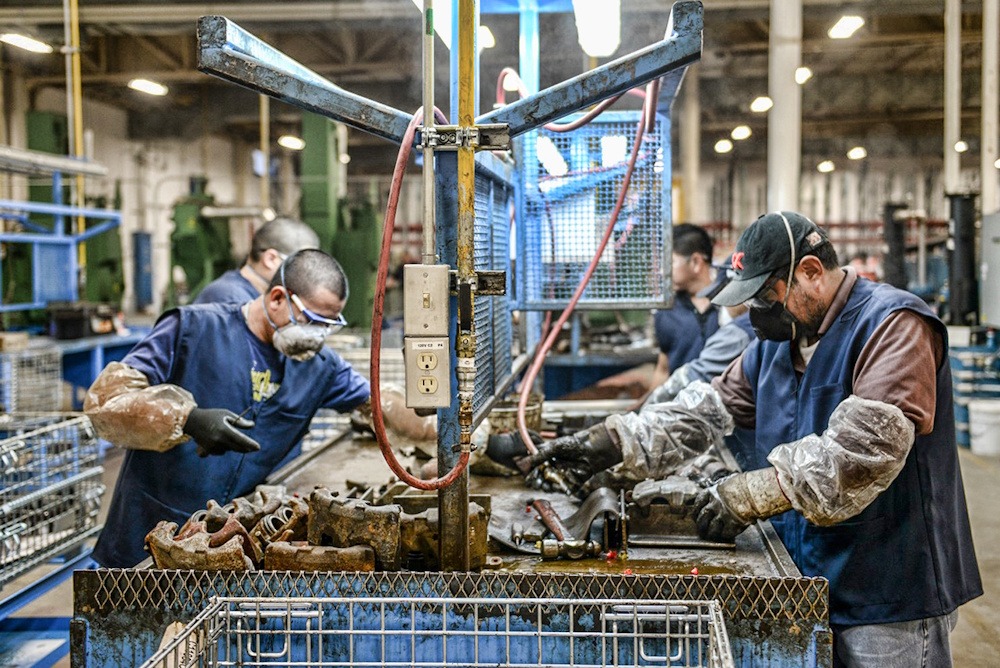
One of the industries most severely impacted since President Javier Milei assumed office, the manufacturing sector is continuing to fall. Research firm Orlando Ferreres & Asociados reports that industrial activity in July experienced a decline of 0.4%. This decline has accelerated over the first seven months of the year, with activity now 2% below the same period last year. Similar declines were projected by the Argentine Industrial Union, which recorded a monthly loss of 0.6%. They also calculated a 1.4% year-over-year increase in July, which they attributed to “a low baseline.” Accumulated decline for 2026 was recorded at 2% relative to the same period in the previous year. In comparison to the years 2022 and 2023, the decline observed this year is notably more pronounced, reaching a figure of 10%. The most pronounced monthly decrease occurred in automotive production, which experienced a decline of 6.8%.
Exports experienced a decline, as the UIA pointed out a reduction in exports to Brazil, which fell by 12%. This is a significant concern, given that Brazil serves as Argentina’s largest trading partner, accounting for nearly 40% of its manufactured goods, predominantly from the automotive sector. Looking ahead, the consulting firm noted that the industry will continue to be marked by the duality between “sectors oriented toward the foreign market and sectors weakened by low domestic demand.” They added that improvement in the industry’s lagging sectors is tied to “a recovery in retail consumption driven by an increase in household income.”
However, that does not yet seem to be occurring. According to the latest official data from the statistics institute INDEC for June, wages for registered workers in the private sector were 3.6% lower than the level recorded in November 2023 — the month preceding Milei’s assumption of office. Even according to labour ministry data, which is gathered and processed with a different methodology, wages are 0.6% below the levels of three years ago. A report by the Argentine Center for Political Economy, utilising official data, estimated that nearly 1,700 industrial companies have ceased operations since Milei assumed office.
This sector ranks as the sixth largest in terms of closures during this period, trailing behind professional, scientific, and technical services; construction; retail trade and repair of motor vehicles and motorcycles; as well as real estate and transportation services. In terms of job losses, the industrial sector occupies the fourth position, with a total of 39,000 jobs lost. Completing this ranking are transportation and storage services, which decreased by nearly 55,000, followed by construction with a decline of 80,000, and public administration, defence, and mandatory social security, which saw a reduction of 98,000.
