
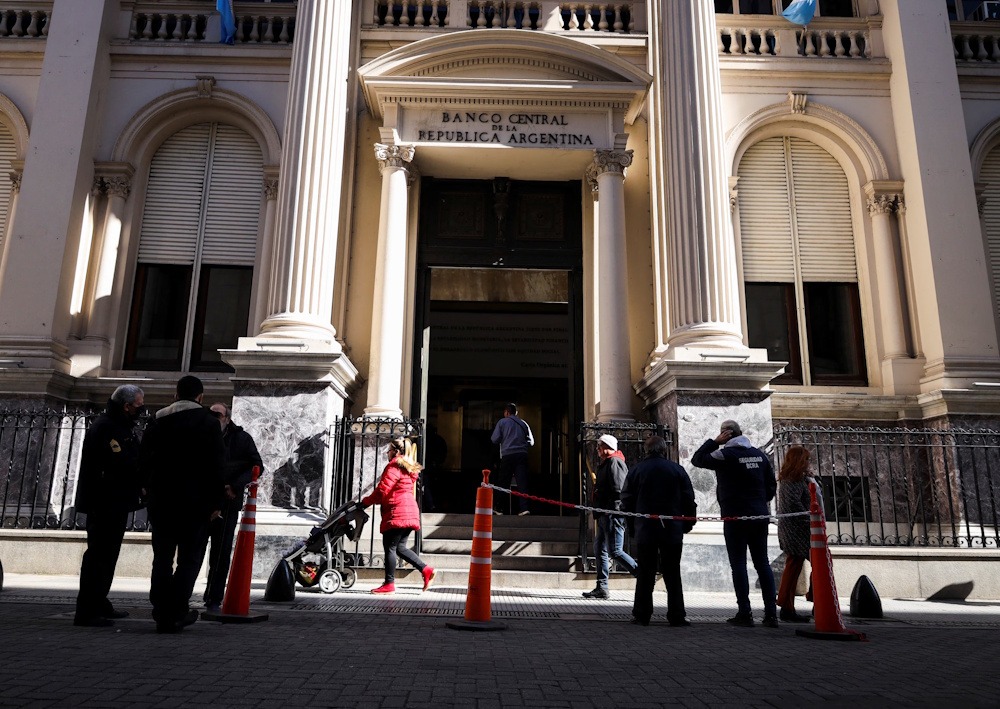
A push by President Javier Milei’s administration to get Argentine banks “banking again” is losing momentum, as lenders are once again relying on government bonds for profit. This shift occurs amid a slowing economy and elevated delinquency rates that are impacting their traditional business operations. Earnings from government securities at commercial banks constituted approximately 56 percent of operating income in July, as indicated by the most recent financial-system data released by Argentina’s Central Bank. That figure exceeds three times the 17 percent produced by net interest income from private-sector lending, which represents the interest accrued on loans after deducting the interest disbursed on deposits and the provisions allocated for nonperforming loans. “Banks are still prioritising liquidity,” said Juan José Vázquez. “In an uncertain environment, holding liquid financial instruments allows them to react much faster than a loan portfolio.” It represents yet another concerning indicator for Milei, with a year remaining until Argentina’s forthcoming presidential election. The challenges of uneven economic growth and elevated unemployment continue to impact his popularity, even as he has managed to control triple-digit annual inflation. The President’s stringent monetary policy and elevated interest rates – instruments aimed at curbing inflation and mitigating currency depreciation – are compelling banks to revert to government debt as economic activity decelerates, in part due to a scarcity of credit.
The encouraging trend in banking that developed during the initial phase of Milei’s administration has encountered a standstill over the past year. Private-sector credit experienced a significant increase following the libertarian’s assumption of office; however, lenders continued to generate a substantially greater portion of their operating income from public-sector securities rather than from the conventional interest spread between earnings and payments. By the conclusion of 2023, the traditional banking sector had diminished to a mere shadow of its former self. Net interest income registered a negative figure, whereas earnings derived from government securities consistently surpassed total operating income. The turnaround from 2024 was remarkable. Bank credit to the private sector has experienced a significant increase, now accounting for approximately 12.5 percent of gross domestic product, up from around 5.3 percent at the conclusion of 2023, as reported by Central Bank data. Economy Minister Luis Caputo celebrated that transformation in a May 2025 speech in Buenos Aires. “Banks are starting to work as banks again,” he said. “For years, they took deposits and lent the money to the public sector. Now they see a better business in financing the private sector again.”
However, that positive momentum has encountered a significant obstacle. Faced with increased losses due to a rise in delinquencies, net interest income declined to a mere three percent of operating income in January, while it was around 17 percent in July. Securities, in contrast, have accounted for over fifty percent of operating income for the entirety of 2026 to date. “Credit is stagnant,” said Marcelo de Gruttola. “There are factors on both the supply and demand sides: Banks have tightened lending standards, while demand has also weakened.” The credit boom is beginning to exhibit signs of fatigue as economic activity decelerates and household incomes find it challenging to keep up with rising prices. High interest rates, meanwhile, are deterring more creditworthy borrowers while heightening the risk that those most inclined to borrow are experiencing financial strain. In this context, government securities present banks with a compelling and easily accessible option, a choice that has been increasingly promoted by the government itself. Given the ongoing challenges in accessing international capital markets, which remain both difficult and costly for Argentina, the Treasury has opted to secure funding domestically, placing significant reliance on banks for the refinancing of its peso debt.
The Central Bank has, on occasion, bolstered that demand. In August 2025, reserve requirements were increased, permitting banks to satisfy a portion of the additional requirement through the acquisition of government securities at Treasury auctions. Regulators subsequently expanded the spectrum of public bonds eligible for meeting those requirements. While those measures assist in establishing a captive source of demand for government debt, they concurrently elevate the cost of money domestically and introduce an additional barrier to credit expansion. For banks, this presents an additional incentive to maintain pesos in public-sector securities. That strategy may gain attractiveness as Argentina nears the presidential election next year. Loans persist on banks’ balance sheets until they are repaid by borrowers, whereas liquid securities can be swiftly liquidated should circumstances shift. “The peso can be extremely volatile. We saw that even around last year’s midterm election,” Vázquez said, referring to the surge in investor anxiety that preceded Milei’s decisive victory in the October 2025 congressional vote. “Ahead of a presidential election like the one we expect in 2027, it makes sense for banks to be even more cautious.”
