
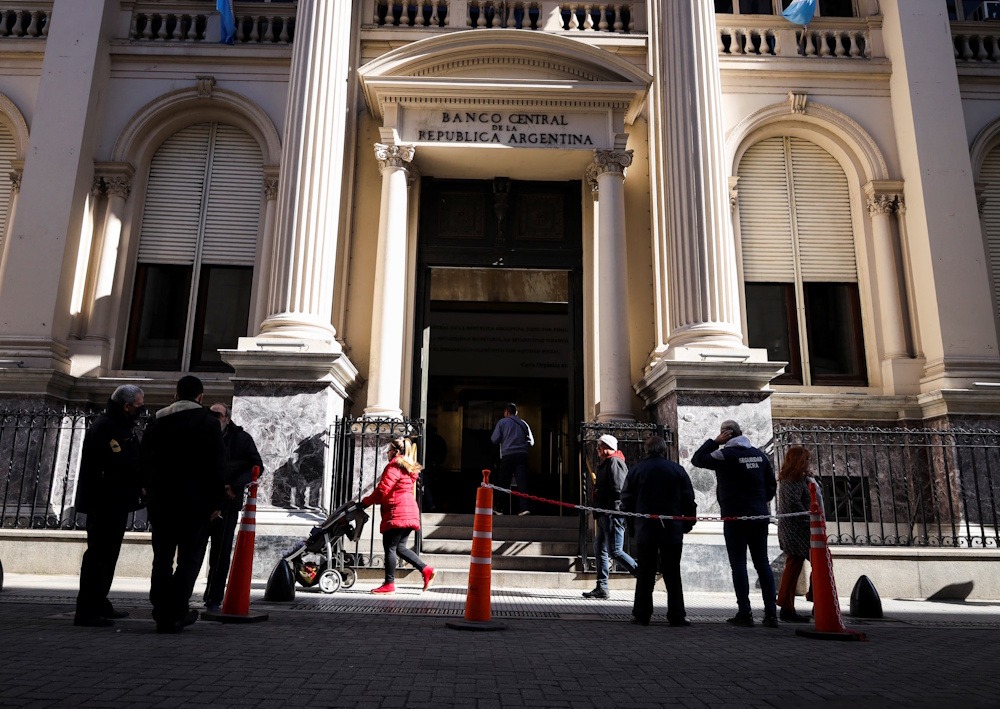
Argentina’s Central Bank confirmed on Monday that it disbursed US$17.7 million in interest following the activation of its swap line with the United States, a move made in anticipation of the legislative elections scheduled for October 2025. Officials indicated their intention to extend the swap line with China, while simultaneously dismissing the prospect of any immediate relaxation of currency controls for corporations. The announcements were made during a press conference conducted by BCRA President Santiago Bausili and Vice President Vladimir Werning at the bank’s headquarters, where they unveiled the First-Quarter 2025 Monetary Policy Report. The BCRA’s 2025 financial statements, released last week, indicated that the bank disbursed US$17.7 million to the U.S. Treasury Department in interest related to the bailout. The filings did not clarify whether that figure encompassed the total cost of the operation.
Argentine markets had anticipated that the interest on the portion of the swap that was utilized would be elevated. Milei’s administration declared on January 9 that Argentina had fulfilled its obligation regarding the swap, amounting to a total of US$2.5 billion. U.S. Treasury Secretary Scott Bessent remarked that the operation enabled Washington to “generate tens of millions of dollars in profits for the American people.” In response to an inquiry, Bausili affirmed that the total expenditure for the operation amounted to US$17.7 million. Bausili informed that the BCRA is considering an extension of its swap line with China for an additional three years. “We’re in discussions with the People’s Bank of China to maintain the current arrangement,” he stated. The BCRA’s 2025 financial statements indicate that the amount accessed from the swap decreased from 21 billion yuan at the end of 2024 — approximately US$3 billion — to 7 billion yuan at the end of 2025, translating to about US$1.032 billion. Bausili has dismissed the prospect of any immediate relaxation of the current restrictions, referred to as the cepo, for businesses. The existing arrangement, he contended, “doesn’t appear to be holding back exports.”
Currently, it does not rank high on the agenda. The priority is ensuring the economy functions effectively,” he added. In response to inquiries regarding a potential unwinding of dollar positions and the prospect of foreign capital flight, Bausili remarked: “Our measure of holdings by non-resident foreign investors in the local capital market is very marginal.” The most recent estimate I encountered suggests a range of approximately US$2 billion to US$2.5 billion, within a capital market estimated to be around US$60 billion. It is not perceived as a concern. Bausili expressed skepticism regarding the potential for the BCRA’s monetary policy to gain greater independence from Javier Milei’s administration. “Today, the BCRA lacks independence in coordinating the economic program; it is entirely aligned with the Economy Ministry.” That is significantly more critical than attempting to establish a scenario in which an individual opposes funding the Treasury via monetary expansion.
Bausili also noted that the elevated delinquency rate in consumer credit has begun to decline. “The impact of delinquency on banks’ results is becoming increasingly marginal,” he asserted, dismissing any possibility of a bailout for borrowers in default. “We will refrain from making decisions involving external capital, and I have confidence in the banks to address the situation independently.” Individuals will exhibit significantly greater creativity in determining the allocation of their personal finances. The conference represented a departure from the Central Bank’s typically cautious stance towards media engagement. Bausili and Werning indicated their intention to conduct the briefings on a quarterly basis, coinciding with the release of the IPOM. In response to a reporter’s inquiry regarding whether the alteration had been prompted by the International Monetary Fund in pursuit of enhanced transparency, the officials clarified that it was their own initiative, while also conceding that the IMF is “happy” with the development.
