
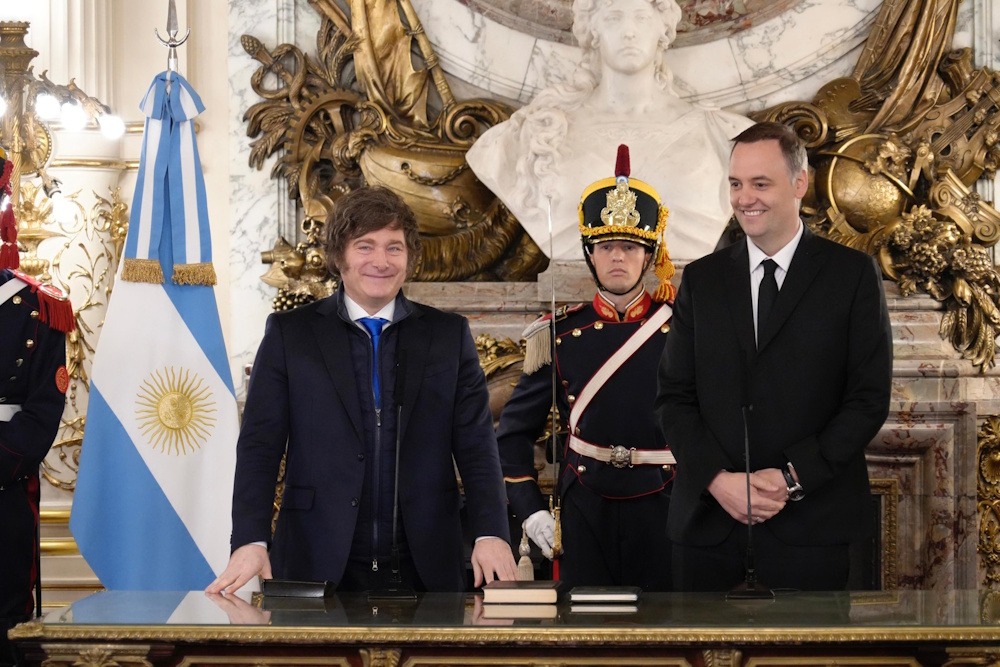
Cabinet Chief Manuel Adorni and his fellow Cabinet ministers are currently receiving a gross monthly salary of 7,272,091 pesos, approximately US$5,210, as a result of a decree enacted by President Javier Milei. The data originates from a government report, which Perfil obtained through a request submitted under Law 27,275 (Access to Public Information). This report specifies that the total amount comprises a basic salary of 3,300,233 pesos and an additional complement of 3,971,858 pesos attributed to the responsibilities of the position. The document clarifies that this pay scale encompasses the Cabinet chief, all ministers, and senior government authorities across various positions (Decrees 838/94, 1716/92, and 140/07), including secretaries, undersecretaries, and officials of equivalent rank. The adjustment of salaries was a direct result of Decree 931/2025, which was signed by President Javier Milei on the final day of the previous year. This decree transferred to the government the responsibility for implementing the increases that were agreed upon in the state collective bargaining for 2024 and 2025.
President Milei and Vice-President Victoria Villarruel remain exempt from this regulation, with their salaries continuing to be frozen. Before that decision, the remuneration of senior officials, including Adorni, was maintained at the levels established by Decree 235/2024, which were frozen as of December 2023. Until last January, Adorni and the other ministers received 3.5 million pesos. The implementation of these aggregated increases suggests a notable recovery that, when assessed in nominal terms, has resulted in a doubling of the earnings of the political leadership in just over a year. The salary increase comes at a time when Adorni faces significant scrutiny regarding his personal finances from both the courts and the media. The initial point of contention in this conflict emerged on February 15, when the trajectory of his assets came under public scrutiny. Since then, various avenues of inquiry have been initiated, focusing on property acquisitions, discrepancies between reported income and expenditures (including credit card usage), and potential conflicts of interest arising from his governmental position.
Among the most pertinent documents is a case associated with the utilization of official funds for travel, specifically his recent journey to New York, accompanied by his wife Betina Angeletti, who reportedly traveled at least one segment of the trip on the presidential aircraft. Last week, federal judge Daniel Rafecas ultimately shelved the file following the intervention of prosecutor Ramiro González, who determined that there were insufficient elements to support a criminal indictment. Nonetheless, various cases remain in the preliminary investigation phase across different federal courtrooms, with inquiries into his property being cross-referenced with tax data and efforts aimed at reconstructing the trajectory of his assets. The trajectory of senior officials’ salaries diverges from the broader economic trends. The purchasing power of Argentina’s minimum wage workers has decreased by 39 percent from November 2023 to last March, as indicated in the “Panorama of formal wage employment and its remuneration” report. Nonetheless, those adjustments continued to fall short of the annual inflation rate.
Both public employees and pensioners experienced a significant decline in their purchasing power. The estimates align with state workers experiencing declines in real terms of approximately 30 percent, while pensions have diminished by roughly 20 percentage points relative to the increase in prices. The INDEC national statistics bureau reported that last year, formal wages experienced a decline of more than two percent in their real purchasing power relative to inflation. In the previous year, the minimum pension experienced a decline of approximately 4.6 percent in its purchasing power due to inflation, largely attributable to the freeze on the accompanying bonus of 70,000 pesos. In contrast, pensions exceeding the minimum exhibited stability, with a slight enhancement of 0.4 percent, effectively resulting in a near equilibrium with inflation. The distinction regarding the earnings at the political helm is rooted in their incomes being automatically adjusted through accumulated collective bargaining, a mechanism that other sectors are unable to replicate with the same level of effectiveness.
