
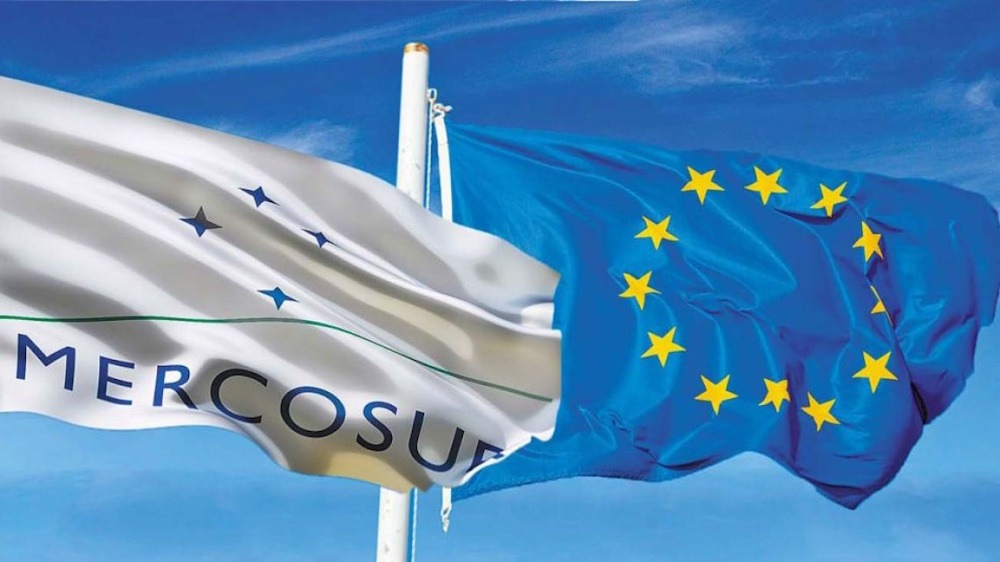
The European Union’s substantial trade agreement with the South American bloc Mercosur is set to provisionally take effect on Friday, notwithstanding an ongoing court ruling regarding its legality. The establishment of one of the largest free-trade zones globally was finalized in January, following over 25 years of sporadic negotiations. The combined economic output of the EU and Mercosur represents 30 percent of global GDP, encompassing over 700 million consumers. The agreement, which removes tariffs on over 90 percent of trade between the two parties, has sparked significant debate in Europe, particularly with France at the forefront of opposition due to worries that certain farmers may experience adverse effects. However, supported by a majority of EU nations, including Spain and Germany, Brussels proceeded with its efforts to diversify trade amid challenges posed by the United States and China. European Commission chief Ursula von der Leyen on Friday praised the commencement of the deal’s implementation, asserting on X: “Provisional application will show the agreement’s tangible benefits.” She stated that “as of now… tariffs start falling,” European companies “are gaining access to new markets” and investors are “benefiting from the predictability they need.”
The agreement benefits European exports of cars, wine, and cheese, while facilitating the entry of South American beef, poultry, sugar, rice, honey, and soybeans into Europe. The initial impacts of the implementation are immediate, as stated by Brussels, with Von der Leyen characterizing them as “real and already noticeable.” Starting this Friday, tariffs on automobiles, pharmaceuticals, and wine exported from the EU to Argentina, Brazil, Paraguay, and Uruguay will be “eliminated or significantly reduced,” she noted. European Commissioner for Trade Maros Sefcovic remarked that “it is a great day” due to a “historic” agreement. French MEP Manon Aubry expresses a differing viewpoint. “In reality, it is a very somber day,” she stated. European farmers “are going to face unfair competition from hundreds of thousands of tonnes of agricultural products that will flood the European market, with second-rate health and environmental standards,” warned the left-wing Euro lawmaker.
Von der Leyen stated that “legitimate” sensitivities within the EU had been addressed. On this occasion, von der Leyen and European Council President António Costa were scheduled to engage in online discussions with leaders from the Mercosur countries, encompassing Argentina and Brazil. “From May 1, Mercosur and the European Union will begin to unite in one of the largest free trade areas on the planet … at a time of protectionism, we are strengthening multilateralism,” stated Brazilian President Luiz Inácio Lula da Silva. The implementation of the agreement follows the European Parliament’s decision to refer the matter to the EU’s highest court in January, rather than approving it outright.
France made an unsuccessful effort to obstruct the deal due to concerns for its farmers, who are apprehensive about being undermined by less expensive products from the agricultural stronghold of Brazil and its neighboring countries. The firm resistance from France regarding the pact has led to a public divide with Germany, which relies heavily on exports, thereby creating a conflict between the two largest nations in the EU. Germany’s Foreign Minister Johann Wadephul on Friday issued a social media post praising the implementation of the Mercosur deal. This enhances our resilience and upholds a rules-based trading system,” he stated in a post on the X social network. While pursuing the conclusion of the Mercosur deal, the EU has concurrently advanced negotiations with other significant markets, including India, Australia, and Indonesia.
