
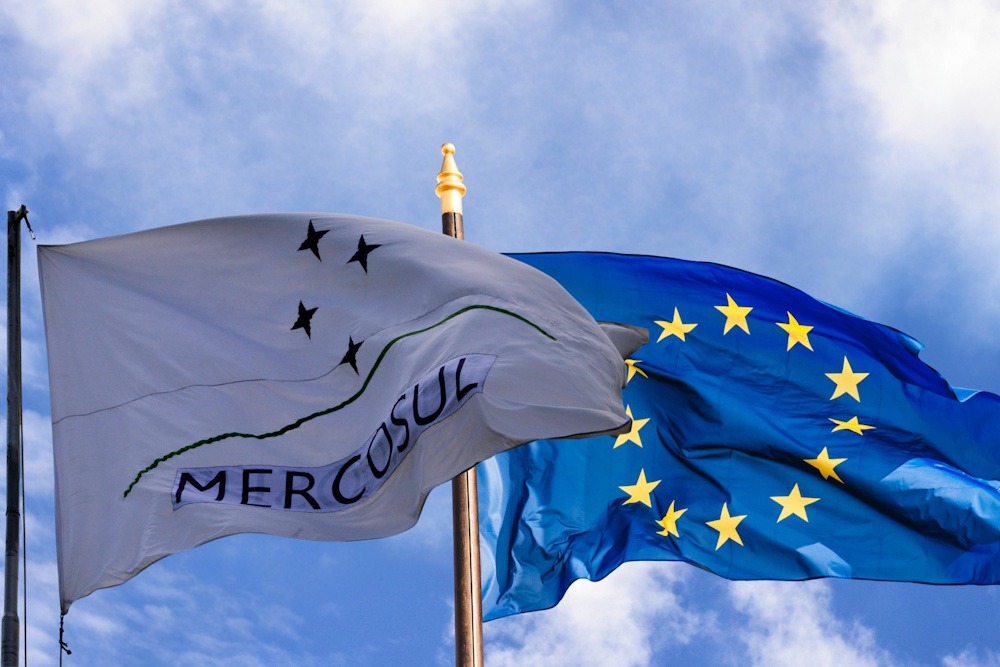
May 1 represented a significant milestone in South American history, as a segment of the trade agreement between the regional bloc Mercosur and the European Union, which had been under negotiation for more than twenty years, finally came into effect. The agreement represents a significant advancement in enhancing Mercosur’s export capabilities, facilitating Argentina, Brazil, Uruguay, and Paraguay’s entry into or expansion within European markets, particularly in the agricultural sector. This will enable those countries to obtain industrial machinery, cars, pharmaceuticals, and various other manufactured goods from Europe. The agreement established the most extensive free-trade zone globally, accounting for approximately 20% of the world’s GDP. While it presents a significant opportunity for the South American region, it is not without its challenges and hurdles.
After extensive negotiations, Mercosur and the EU have opted to divide the agreement into two separate parts. The initial component is a trade-exclusive segment that removes tariffs on the majority of goods exchanged between the two blocs, while also providing preferential, reduced tariffs for select Mercosur products such as beef, soy, honey, and rice, allowing for exports to Europe through a quota system. A broader association agreement is also included, encompassing provisions concerning environmental protection, sustainable development, and human rights. The interim trade-only segment, which received approval from the EU and Mercosur countries, became provisionally operational on May 1. The broader association agreement requires approval from the European Parliament as well as the national parliaments of EU member states to become effective. “The agreement presents a significant opportunity for Mercosur to enhance its structural competitiveness as a bloc, as it will enable us to compete in highly regulated markets while advancing sound trade practices,” Esteban Actis stated. Furthermore, this represents a strategic geopolitical maneuver, enabling both blocs to diversify their markets and supply chains “in a fragmented world that is tending more and more towards protectionism,” stated Actis. To fully capitalize on the advantages of the agreement, Mercosur nations must address several challenges: aligning with stringent European regulations, reconciling internal differences within their bloc, and adhering to EU climate protection standards that could conflict with existing laws. Furthermore, a negative vote from the European Parliament regarding the deal could potentially lead to its collapse.
One of the primary obstacles for Mercosur in advancing the trade-only agreement will be adherence to the EU’s stringent trade regulations, necessitating a process of adaptation that, in certain instances, could extend over several years. This is a requisite measure that producers must undertake to capitalize on the agreement. Actis articulated that although specific sectors, particularly small and medium enterprises, currently lack the financial robustness to navigate these changes, advancing towards improved quality standards is expected to yield long-term advantages for the region’s economy. “The European market imposes rigorous regulations and standards, and failure to comply results in exclusion,” Actis stated. “This will undoubtedly exert pressure to enhance the quality of Mercosur’s export offerings, which is a highly favorable development.” In Argentina, adherence to such stringent standards necessitates that public oversight agencies play a crucial role. Nonetheless, a significant number of these entities are experiencing reductions in funding or outright closures; concurrently, the Javier Milei administration is pursuing a path of deregulation concerning quality controls. Issues are surfacing: in March, Bulgaria declined a sunflower shipment from Argentina due to pesticide residue levels that exceeded the allowable limit by a factor of five. At that moment, employees from the SENASA agrifood quality control service cautioned that the disbandment of the agency might result in an increase in occurrences of that nature.
The trade agreement instituted export quotas on specific products, notably beef, which remain subject to tariffs, albeit at a preferential rate of 7.5%. A restricted quantity, varying by product, is permitted to enter the EU. Any amount exceeding that threshold incurs the standard, significantly elevated rate. The quotas will not be pre-allocated to the Mercosur countries; instead, they will function on a first-come, first-served basis. The implication here is that the initial firm to effectively market its product within the EU will have the advantage of utilizing the quota without restriction, until a competitor enters the market and continues to sell the identical product, at which point the quota will be depleted. Mercosur is set to receive a quota of 99,000 tons of beef, accompanied by reduced tariffs, anticipated to be accessible in June. The competition to be the first to sell is expected to be intense. Brazil possesses a competitive advantage in this and various other sectors, attributable to its strong industrial base and export potential. Smaller companies from the region face a competitive disadvantage, as they are likely to find it challenging to secure the quotas in competition with those possessing larger organizational structures. A consensus on the allocation of quotas among member nations would address this issue. Actis emphasizes that for the deal to be fully leveraged, Mercosur must urgently enhance internal coordination within the bloc and foster increased dialogue among member governments. This is particularly critical given the current lack of communication between Argentina and Brazil, stemming from the political and ideological rifts between Milei’s far-right administration and center-left President Lula da Silva.
In spite of significant resistance from various European nations with well-established agricultural industries, the agreement received final approval in January, and its trade-only component was implemented provisionally, bypassing the necessary endorsement from the European Parliament. The other half of the deal encompasses a more extensive association agreement that incorporates trade alongside investment, political cooperation, sustainable development, and environmental protection provisions. The ratification process requires approval from both the European Parliament and the national parliaments of EU member states, a procedure that may extend over several years. However, the execution of the more extensive portion of the agreement has been delayed following the European Parliament’s decision to refer the deal to the European Court of Justice for a legal assessment concerning its compatibility with current EU legislation. The decision is anticipated to require a timeframe of one to two years. Should the court determine that the agreement contravenes EU legislation, amendments would be necessary, thereby suspending the trade-only segment and postponing the full implementation of the deal. Regardless of the necessity for amendment, it will subsequently proceed to a vote in the European Parliament. If the body rejects it, the entire agreement would collapse. Actis notes that the implications of the European Parliament passing the measure, only for it to be rejected by the national parliaments of EU countries, remain uncertain.
The agreement is generating concerns regarding the potential conflict between the deal and the opportunities it presents and Europe’s stringent environmental protection regulations. In February, a coalition of environmental NGOs issued a statement cautioning that a proposed amendment to legislation safeguarding glaciers in Argentina — intended to permit mining in regions where it is presently prohibited — jeopardizes the Mercosur-EU agreement due to its conflict with climate protection provisions. “The Mercosur-EU agreement imposes a ban on flexibilizing environmental protection standards to promote investments, which is exactly what the glaciers law reform did,” stated Cristian Fernández. “The norms aimed at deregularizing environmental protection laws clash with EU regulations and international accords, like the Paris Agreement,” Fernández stated.He noted that although the Argentine government seeks to facilitate production and exportation, it is engendering “a paradox” where producers “encounter a barrier” due to the EU’s stringent regulations, resulting in increased uncertainty. The comprehensive agreement — which has yet to be finalized — also incorporates a provision mandating that Mercosur adhere to the Paris Agreement, a legally binding international treaty established in 2015 aimed at addressing climate change. President Milei’s skepticism regarding climate change and environmental protection is noteworthy; “this explains why Argentina has not left the Paris Agreement,” Actis noted. In early 2025, Milei indicated that he was considering the possibility of withdrawing the country from the Paris Agreement. As of May of this year, there remains a lack of official confirmation regarding the government’s advancement on this matter. “Beyond the Argentine government’s stance on climate change, compliance with European requirements regarding sustainable trade and production practices will be necessary,” the analyst stated. “Should they fail to do so, the nation will encounter difficulties in accessing the markets.”
