
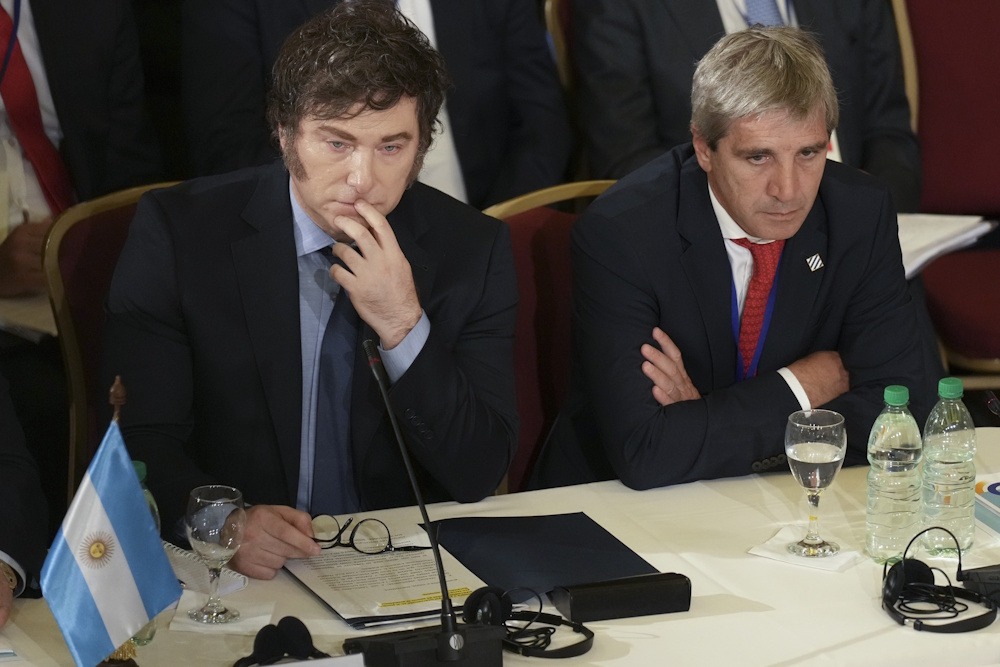
Global financial volatility — particularly the fluctuations in the U.S. Treasury market, a key indicator of the global economy — poses a significant threat to one of the Argentine government’s primary objectives: re-entering international debt markets. “The current level of long-term U.S. bond yields is significant as it signifies a transition in the global cost of capital,” Auxtin Maquieyra informed. “When the risk-free rate increases, all financial assets globally must undergo repricing: equities, corporate credit, emerging-market debt, and sovereign bonds,” he added. This past week, 10-year Treasury yields reached their peak level since early 2025. The 30-year yield is currently at its highest level since 2007, right before the onset of the global financial crisis. Nicolás Kohn indicated that “the global dynamic could have a local impact, mainly through the rise in Treasury yields.” If that occurs, investors may retreat from risk assets, potentially exerting downward pressure on the valuations of emerging-market bonds, including those of Argentina. Maquieyra observed that nations with elevated credit risk, such as Argentina, “are more exposed, because the rate they have to pay doesn’t depend only on country risk, but also on the starting point of the U.S. rate” — particularly the 10-year Treasury. In other words, even if Argentina’s own risk remained unchanged, “a rise in Treasury yields automatically means a higher cost of external financing.” Maquieyra indicated that the potential impact on Argentina could arise from two distinct avenues.
The first would be a direct rise in the discount rate: “If the risk-free bond pays more, Argentine bonds need to offer an even higher rate to remain attractive.” The second could arise from an increase in country risk, “as global capital tends to rotate toward safer assets when those start paying higher yields.” The Milei administration’s primary strategy is to reduce the nation’s risk profile. That would facilitate Argentina’s access to international markets for refinancing its foreign debt, eliminating the need to depend on multilateral lenders or utilise international reserves for maturity payments. JPMorgan’s EMBI+ index currently places Argentina at 524 basis points. That implies that if Milei’s administration sought to issue debt internationally, it would be required to offer an interest rate ranging from 9% to 10% annually — significantly higher than the rates paid by its neighbouring countries. For comparison, Brazil’s country risk is at 181 basis points, while Chile’s is at 83, and Uruguay’s — the lowest in Latin America — is at 63. Late last year, the economy ministry considered the prospect of issuing foreign debt, capitalising on the significant decline in country risk following its electoral victory in November. It even enlisted former YPF CFO Alejandro Lew to spearhead those initiatives.
Ultimately, the government abandoned the plan, a decision that concurrently marked Lew’s departure just four months following his appointment. “Argentina has market access, but we seek lower rates, and until we achieve that, we will explore alternative mechanisms that are more cost-effective,” Milei stated in recent remarks. Thus far, the government has chosen to issue dollar bonds within the domestic debt market and to utilise resources from its recent agreements with the World Bank and the Inter-American Development Bank. Brazil is experiencing the repercussions of international volatility in sovereign bonds, having observed a withdrawal of foreign capital in recent weeks. Delphos Investment data indicates that Brazil experienced outflows exceeding US$4.3 billion within a single month. One domestic trigger was the recent decline in the polls of right-wing candidate Flavio Bolsonaro. The decline occurred after disclosures regarding his associations with Daniel Vorcaro, the former CEO of Banco Master, who is currently under scrutiny for allegations of bribery and fraud linked to the bank’s downfall, a situation that has the potential to evolve into the most significant banking fraud case in Brazil’s history.
The news compelled investors to recalibrate their expectations in anticipation of the presidential elections in October. The development could adversely impact Argentina, given that Brazil is its primary trading partner, preceding China, the European Union, and the United States. Honorio Zabaleta indicated that the principal issue for Argentina may emerge if financial volatility negatively impacts the Brazilian real, thereby exerting pressure on Argentina’s exchange rate. The development could trigger a “imbalance on the external front,” as Milei’s government would experience a decline in competitiveness relative to the neighbouring currency. For the time being, that scenario has yet to materialise. “The Brazilian real has maintained its stability, moving from 4.9 to 5 per U.S. dollar,” Zabaleta noted. “A devaluation akin to that of 2024 would raise greater concerns. At that time, the real U.S. dollar exchange rate approached 6.2, significantly influencing Argentina’s current account balance. For now, it is a matter of hoping that the stock correction does not extend to Brazil’s exchange rate,” he added.
