
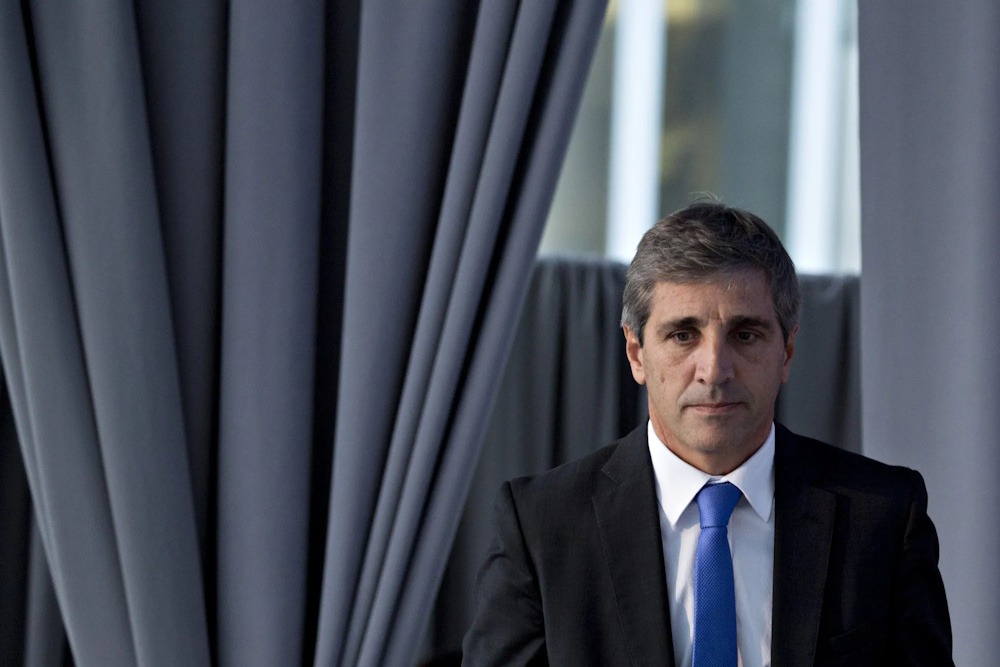
Argentina’s leading economic officials stated that the nation has managed recent external shocks without compromising its exchange-rate regime or causing significant financial stress, contending that this outcome represents a notable shift from previous crises and demonstrates the resilience of the current policy framework. The message was conveyed by Central Bank Governor Santiago Bausili and Economy Minister Luis Caputo during their presentation at an Atlantic Council event in Washington DC on Thursday. Historically, instances of external pressure have frequently culminated in a disruption of Argentina’s currency system, a domestic financial upheaval, or a combination of both, according to the officials. This time, they contended, the framework has remained intact. Bausili indicated that this represents one of the most evident indicators that President Javier Milei’s stabilization program is departing from previous Argentine cycles. “Most of the time in Argentina, whenever you encountered a situation like that, the system was broken and the regime – in particular the FX regime – was altered,” stated the Central Bank chief. “In this instance, we emerged more resilient.” Bausili stated that Argentina’s Central Bank is not poised to ease its policy in light of rising unemployment, which reached 7.5 percent by the end of 2025, alongside inflation that has been on the rise since the middle of the previous year. In March, consumer prices experienced an increase of 3.4 percent, following a rise of 2.9 percent in February, resulting in an annual inflation rate of 32.6 percent.
The governor indicated that the recent increase in inflation ought to be interpreted as a consequence of relative-price adjustments, rather than as an indication that the overall disinflation process has come to a halt. “Our focus in terms of monetary policy remains on underlying inflation trends and not trying to adjust to shocks in relative prices,” stated the governor, referencing petrol and beef prices as illustrative cases. “We continue to maintain a tight monetary policy stance and we will continue to do so until we reach a level where our domestic inflation converges to the international inflation level,” he declared. The International Monetary Fund has confirmed a staff-level agreement with Argentina regarding the latest review of its US$20-billion loan programme earlier this week, urging the Milei administration to prioritize the accumulation of Central Bank reserves. Bausili stated on Thursday that a reserve build-up, which many investors were skeptical about last year, is currently occurring “at a much faster pace than I think anybody anticipated,” highlighting that the Central Bank purchases were “‘almost at the US$6 billion mark’ by mid-April, since the start of the year.” He articulated accumulation as an additional indicator that the government’s macroeconomic framework is beginning to establish credibility. Total reserves amounted to US$45.4 billion as of April 13, based on data from the Central Bank. The IMF aims for Argentina’s net international reserves to rise by a minimum of US$8 billion this year, with the monetary authority expected to acquire at least US$10 billion in 2026. Caputo echoed Bausili’s remarks, contending that Argentina was experiencing volatility due to a more robust external environment than previously encountered.
The minister contended that this enhanced position can be attributed, in part, to the nation’s rise as an energy exporter, highlighting the increasing oil and gas production from the Vaca Muerta formation, which has contributed to a shift in the energy balance towards surplus. The nation has become more resilient to global shocks, he noted. Argentina has transitioned away from being one of the most susceptible to global shocks, as it now exhibits a fiscal surplus, enhanced credibility, and improved access to markets for essential resources, according to Caputo. He emphasized the significance of Argentina’s “oil, natural gas, food, critical minerals.” In reference to the framework outlined during IMF meetings, he stated that Argentina is “for the first time in the right quadrant” of nations positioned favorably – those characterized by fiscal surpluses and energy exports. Caputo stated that the government’s overarching strategy is now focused on transforming macroeconomic order into competitiveness by “lowering taxes, lowering regulations, and improving logistics,” as opposed to depending on what he referred to as the “old-fashioned ways” of prior administrations, which, in his view, executed mega-devaluations to conceal more profound productivity issues. The minister highlighted the recent labor reform bill passed by Congress under the Milei administration, the government’s initiative to integrate undeclared dollar savings into the formal financial system, and a new infrastructure agenda encompassing roads, rail, and ports.
Caputo disclosed that the government has auctioned over 9,000 kilometres of roads and intends to introduce an additional 12,000 kilometres, contending that logistics and infrastructure in Argentina will appear “totally different” within a two-year timeframe. The administration has firmly asserted its commitment to the current trajectory, declaring: “We are not going to move one centimetre from this path.” The narrative emerging from Washington suggests that Argentina is starting to diverge from its historical pattern of crises. The two officials contended that, instead of external volatility leading to a currency rupture or wider financial distress, the existing framework has effectively absorbed the shock and maintained stability. For Caputo and Bausili, two of Milei’s key lieutenants, this represents the most definitive indication thus far that the stabilization plan is beginning to acquire credibility.
