
Argentina’s Gross Domestic Product experienced a year-on-year growth of 2.3% in the first quarter of 2026, alongside a 0.7% increase compared to the last quarter of 2025, marking a “new all-time high” for a first quarter, as stated by Economy Minister Luis Caputo. Growth was primarily fuelled by private consumption, which achieved a record high. Investment experienced a significant decline, decreasing by 11.6% year-on-year and 1.7% in comparison to the prior quarter, as reported on Tuesday by the national statistics agency INDEC. The report also indicated that exports increased by 9.8% in the first quarter relative to the same period in 2025, positioning them as the most robust component of demand. However, exports experienced a decline of 3.1% compared to the final quarter of the previous year. On the supply side, the sectors that contributed most to GDP growth were agriculture and livestock, which expanded by 18.1%, and mining — including the energy sector — which experienced a growth of 12.3%.
Financial services experienced an increase of 7.5%. Private consumption, the largest component of GDP — which involves the acquisition of goods and services, both domestic and imported — experienced a year-on-year increase of 2.7%. INDEC stated that the expansion was “largely driven by higher imports of goods,” which encompassed vehicles and various consumer products. While GDP achieved a record high for a first quarter in absolute terms, the per capita measure continued to fall short of the levels observed during the majority of the 2011–2018 timeframe, standing 4.6% below the peak seen in early 2012. Public spending decreased by 0.9%, and imports saw a decline of 7.5%. Manufacturing experienced a contraction of 1.7%, representing the most significant decline among sectors, whereas commerce saw a decrease of 0.3%. Agriculture, mining, and financial services — the three sectors driving the recovery — contributed 1.84 percentage points to the economy’s 2.3% year-on-year growth.
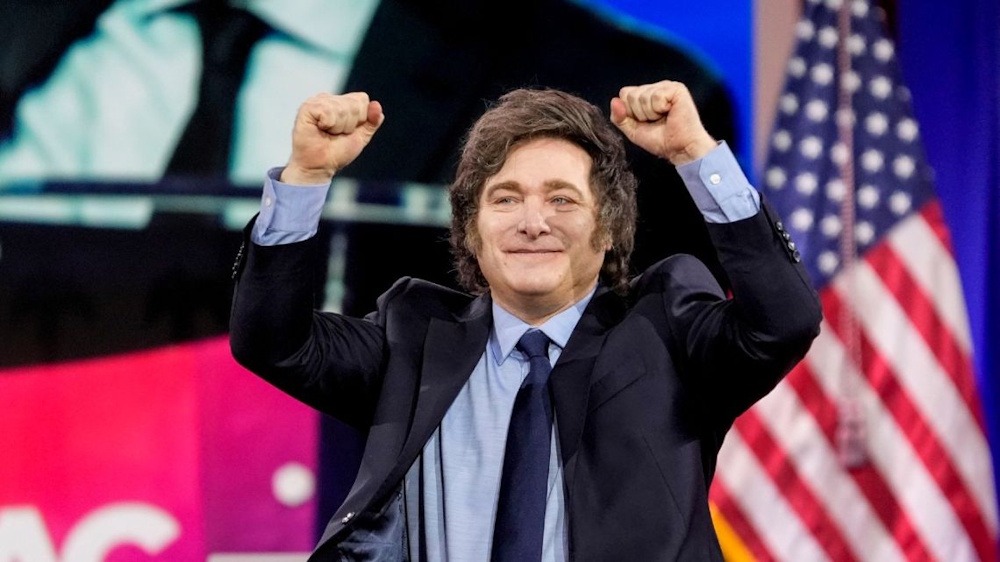
Meanwhile, manufacturing, commerce, and construction — which collectively account for almost one-third of economic activity and 44% of registered private-sector employment — continue to lag behind their 2023 levels. President Javier Milei expressed his enthusiasm for the GDP figures during a speech at an event organised by the right-leaning think tank Fundación Faro. Newly appointed presidential spokesperson Adrián Ravier occupied a front-row seat next to Cabinet Chief Manuel Adorni, who is currently under scrutiny due to allegations of illicit enrichment. “Among the absurdities we have had to endure recently, journalists and ‘serious analysts’ claimed the economy was trapped in a deep depression and that consumer spending had collapsed,” Milei stated. “But today all those misconceptions have been clarified. The first-quarter GDP figures were released, indicating a growth of 2.3% compared to the same period last year,” he added.
The president’s remarks were made just hours prior to his departure for Spain, where he intends to engage with business leaders and advocate for investment opportunities in Argentina. Milei is also scheduled to deliver a lecture on economics at the Universidad CEU San Pablo, where he will receive an award from the institution. The visit marks Milei’s sixth trip to Spain since assuming office. He is anticipated to stay in Madrid until Saturday and, similar to past visits, has no meetings arranged with socialist Prime Minister Pedro Sánchez — with whom he has had a public dispute — or King Felipe VI. On June 30, Milei is scheduled to participate in the Mercosur leaders’ summit in Paraguay, which is part of the regional trade bloc. He is also anticipated to journey to the United States for the Independence Day festivities on July 4.
