
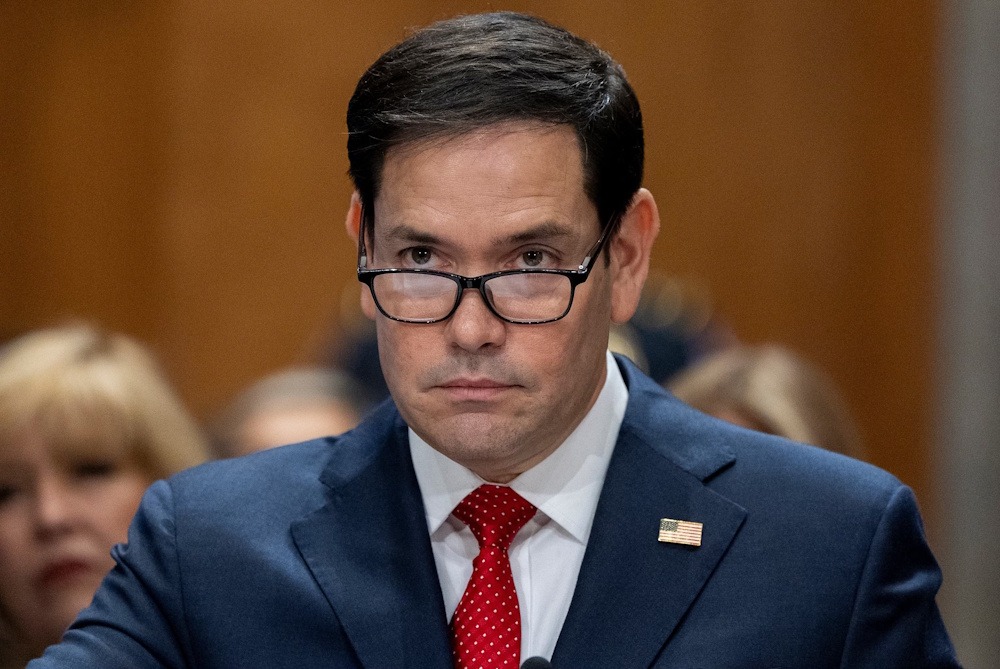
U.S. Secretary of State Marco Rubio acknowledged on Wednesday that he has engaged in “conversations” regarding Argentina and other nations about the possibility of accepting immigrants whom the Trump administration has chosen to deport. Rubio, however, clarified that the two governments do not have “anything lined up” yet. “I recognize that media leaks have been a topic of discussion, and while some may arise from less than noble intentions, Argentina remains a valuable partner overall. Ultimately, we hold significant faith and confidence in our relationship with President Milei and his team,” stated Rubio. He characterized Argentina as a significant partner across multiple domains and underscored the robustness of the bilateral relationship. Marco Rubio addressed a press conference inaugurating a summit organized by the State Department, which convened numerous nations with the objective of forming a coalition to reconstruct global supply chains for critical minerals independent of China. His remarks follow a report, which indicated that both nations are negotiating an arrangement that would permit the United States to deport immigrants from various countries to Argentina. The negotiations occur amid the Trump administration’s implementation of a comprehensive and assertive deportation strategy, which involves the deployment of immigration officers to various U.S. cities.
Argentine media reports indicate that Foreign Minister Pablo Quirno, attending the summit in Washington DC, has refrained from addressing inquiries regarding the negotiations concerning immigrants. This week in Washington, DC, ministers from more than 50 nations are convening for the United States’ summit focused on critical minerals. The meeting marks the inaugural session of the new Critical Minerals Ministerial, a U.S. initiative designed to forge alliances that seek to mitigate China’s dominance over global critical mineral supply chains. Officials are aiming to enhance and diversify their countries’ reserves of critical minerals, which are integral to the production of batteries, clocks, wiring, military hardware, and semiconductors, among other technological products vital for the defense sector and the advancement of artificial intelligence. Marco Rubio has put forward frameworks intended to act as “platforms for coordinating policies” aimed at guaranteeing that nations can secure ample and cost-effective access to essential minerals.
Argentina received an invitation to the summit owing to its extensive reserves of critical minerals. The sector has been a focal point of President Milei’s economic strategy, with his administration identifying it as crucial for fostering economic growth. Recent developments suggest that Argentina is shifting from a long-standing resistance to mining and other activities viewed as detrimental to the environment, towards a strategy that prioritizes the pressing need for economic development and growth. President Javier Milei has introduced legislation aimed at amending existing laws that safeguard glaciers, seeking to reduce restrictions on mining activities. Mendoza has approved the first copper mining project in the province in two decades, a development that environmental activists argue may pose a risk of contaminating the water in the Uspallata area.
In Washington, DC, Minister Quirno confirmed a new investment of US$14 billion by Anglo-Swiss multinational commodity trading and mineral company Glencore, under the new RIGI investment regime. Secretary of State Rubio underscored the significance of Argentina’s role in the strategy. He highlighted the nation’s potential “to be a key partner in minerals critical to the world, not just the United States.” He underscored its geological characteristics and geographic positioning as a prominent player on the world stage. “Furthermore, its location in the Western Hemisphere has strategic value not only for Argentina but also, obviously, for the United States,” he concluded.