
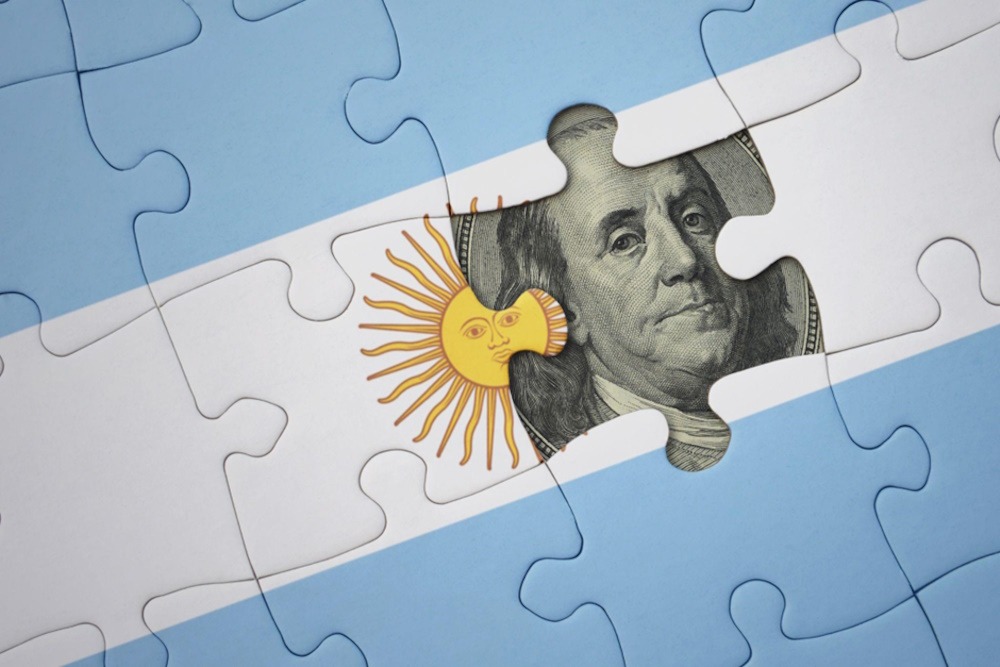
Argentina’s government asserts that the country “is fertile ground for any investment imaginable and that firms should jump on board to benefit from the “revolutions” that are shaking up key national industries. During the ‘Argentina Week’ promotional event in New York on Thursday, Cabinet Chief Manuel Adorni stated that the nation is now “free from the political constraints” that were previously “repressing” opportunities for investors. “Over the next few years, the areas of mining, energy, knowledge industry, banking, capital markets, technology and agribusiness will undergo revolution after revolution until they reach global standards,” pitched Adorni.“Argentina is fertile ground for any investment imaginable,” he continued. Argentina Week consisted of a three-day roadshow orchestrated by the government in New York. During a series of events, government officials, provincial governors, and local business leaders presented the nation to potential investors. “This event showcased Argentina’s capacity to integrate into the global landscape.” A nation that is once more broadening its frontiers on the global stage, while simultaneously extending its reach within its own territory. “A federal country where all the provinces that today seem withered are once again flourishing, free from the political constraints that, until now, or until we took office, had been repressing them,” stated Adorni.
“The reforms are underway, the invitation is very clear: join us in this new stage.” He concluded “This event is not a point of arrival, it is only the beginning.” Foreign Minister Pablo Quirno, who gained significant attention online for his eloquent speech in English, characterized Argentina as a promising landscape for those with a business acumen.“After two years of profound transformations and building solid macroeconomic foundations, today it is positioned as one of the great investment opportunities globally,” he declared.”Our nation’s competitive strengths in key sectors of high demand enable us to establish ourselves as a dependable partner in the reshaping of global value chains,” Quirno stated. The officials provided their insights at an event on the concluding day of the three-day gathering in the United States, which commenced on Tuesday with a characteristically provocative address by President Javier Milei. During the formal opening of the roadshow on Tuesday, Milei, 55, directed his focus towards two prominent business figures: Paolo Rocca, the Italian-Argentine billionaire leading the multinational industrial conglomerate Techint, and Javier Madanes Quintanilla, an Argentine industrialist whose business interests encompass the now-defunct tyre manufacturer Fate and investments in aluminium production.
The President characterized them as “empresarios prebendarios” – suggesting they benefit from exclusive access and ties to the government. “We have individuals with malicious intent, but also those who exhibit creativity in their harmful actions,” Milei stated. “It is widely recognized that in the past few weeks, I have engaged in direct confrontations with Paolo Rocca, Javier Madanes Quintanilla, and the textile sector. However, due to the absence of a prominent representative, I find myself unable to direct my criticisms at them specifically.” Milei expanded on his critique, alleging that they conspired with “thieving politicians” and “attacked many Argentines” through graft and protectionism. “Rocca and Madanes, in collusion with corrupt politicians, harmed numerous Argentines – but that chapter has closed.” The period characterized by corrupt political practices has come to an end. Who supports corruption? “These are uncomfortable questions to ask, but I’m willing to ask them for a better Argentina,” stated Milei. Government sources minimized the notion that Milei’s criticism would deter foreign investors. “It didn’t truly connect with the American audience.” He cited two particular instances solely as illustrations. “They listened, but it is essentially a matter of local politics,” remarked a member of the delegation who journeyed to New York. Milei emphasized his political and economic alignment with the United States and Israel during his time in New York. The leader justified their stance regarding the Middle East, labeling Iran as a “enemy” of Argentina and expressing pride in being “the most Zionist President in the world.” Addressing a predominantly Jewish orthodox audience at Yeshiva University in New York on Monday, the leader of La Libertad Avanza asserted that “we are going to win” while discussing the current conflict involving Iran.
There have been two bombings targeting us, one at the AMIA [Jewish community centre] and another at the Israeli Embassy. Consequently, we can categorize them as adversaries. “I also have a strategic alliance with the United States and Israel,” Milei stated, referring to two deadly bombings in Buenos Aires in 1994 and 1992, respectively. In his address to investors, President Milei articulated a robust defense of his assertive economic liberalization strategy, which encompasses the elimination of import restrictions. His comments arise in the context of escalating tensions between his administration and Argentina’s industrial elite regarding trade policy, competition with foreign firms, and the economic sustainability of large domestic manufacturers in a progressively open market. Officials from the government, in informal discussions with local media, expressed their contentment with the “positive” event and assured that future editions would be forthcoming. The support that Milei garnered from provincial governors was particularly noteworthy, with 11 governors from various political backgrounds making the trip to New York for the roadshow. Marcelo Orrego (San Juan), Raúl Jalil (Catamarca), Carlos Sadir (Jujuy), Gustavo Sáenz (Salta), Claudio Vidal (Santa Cruz), Rolando Figueroa (Neuquén), Martín Llaryora (Córdoba), Alberto Weretilneck (Río Negro), Alfredo Cornejo (Mendoza), Ignacio Torres (Chubut), and Juan Pablo Valdés (Corrientes) were the individuals mentioned.
“Each of them acknowledges that they have found in the government a guarantor of the conditions that allow the provinces to monetise the projects developed within their territories,” one libertarian source stated to the Noticias Argentinas news agency. Officials indicated that the roadshow highlighted government reforms and emphasized investment opportunities in key sectors including energy, mining, infrastructure, and technology. “It enabled us to engage with creditors and markets, facilitating the gathering of debt funds, international banks, and credit-rating agencies at a single event,” a source remarked, highlighting “considerable interest.” Officials at Casa Rosada express optimism regarding the potential influx of foreign investment. Throughout the week-long roadshow, Latin American ecommerce leader Mercado Libre revealed plans to invest US$3.4 billion this year to enhance its operations in Argentina. The firm stated that the investment will result in the creation of 1,900 new jobs. The event’s success was, however, overshadowed by domestic developments. Cabinet Chief Manuel Adorni, a prominent figure at the event, attracted attention for unexpected reasons when it was revealed that his wife, Bettina Angeletti, had accompanied Argentina’s delegation on the presidential plane.