
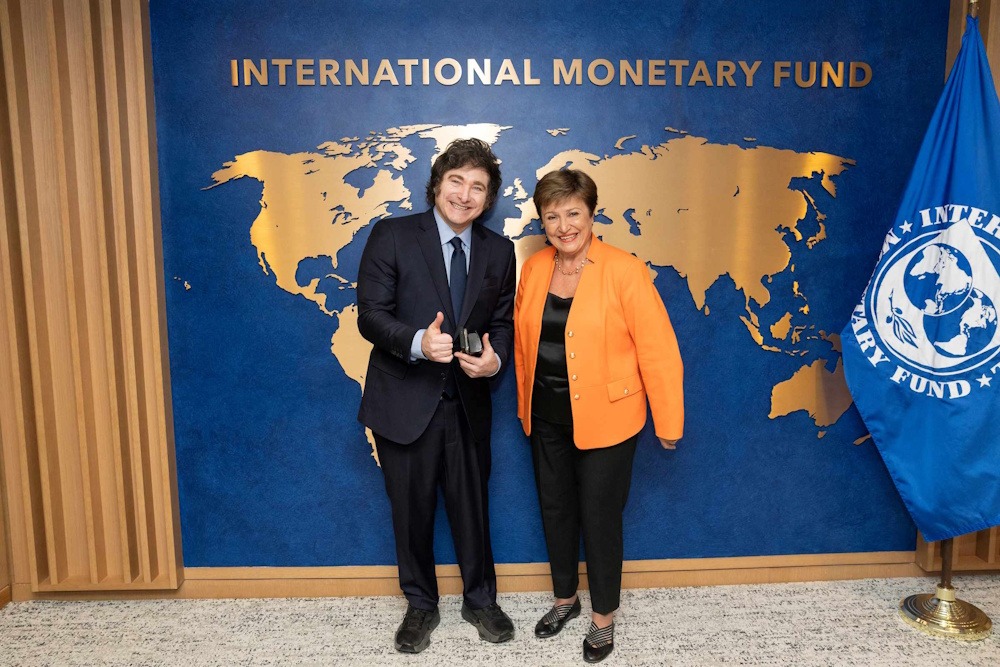
On Wednesday, the Argentine government finalized a staff-level agreement with the International Monetary Fund. If sanctioned by the lender’s board, it would facilitate access to approximately US$1 billion. On the same day, Economy Minister Luis Caputo traveled to Washington D.C. to participate in the IMF Spring Meetings and engage with the organization’s leader, Kristalina Georgieva. This marks the second review of the US$20 billion loan agreement established by Javier Milei’s administration with the lender last year, adding to the existing US$45 billion debt incurred by the country in 2018 under Mauricio Macri’s administration.
The fund’s statement acknowledged several of Milei’s initiatives, including the labor reform, trade agreements, and legislation permitting corporates “to repatriate dividends for the first time in six years.” The communiqué stated “Reform momentum has significantly strengthened in recent months.” The administration has obtained congressional approval for the 2026 Budget along with essential legislation designed to formalize residents’ holdings of financial assets, improve labor market flexibility, ratify significant trade agreements, and facilitate investments in mining.
The fund also noted the Central Bank’s acquisitions of U.S. dollars, which it reported have surpassed US$5.5 billion to date this year. “Argentina continues to manage spillovers from the Middle East war effectively, supported by ongoing improvements in its fundamentals and its position as a net energy exporter,” the statement said. The fund indicated that Argentina is restructuring its U.S. dollar obligations through the issuance of dollar-denominated domestic-law debt and the divestiture of state-owned assets, in addition to securing central bank repos and external loans, which may be supported by international financial institutions.
The strategy aims to restore the country’s access to international capital markets “over time.” The statement indicated that the country achieved “significant progress” in deregulating and liberalizing the economy, and that forthcoming reforms would “unlock the potential of Argentina’s strategic sectors in agriculture, energy, mining, and the knowledge economy.” The Fund stated, “IMF staff welcomes the strong and constructive engagement with the authorities and their continued commitment to the program, including the implementation of corrective measures to address earlier setbacks.”
