
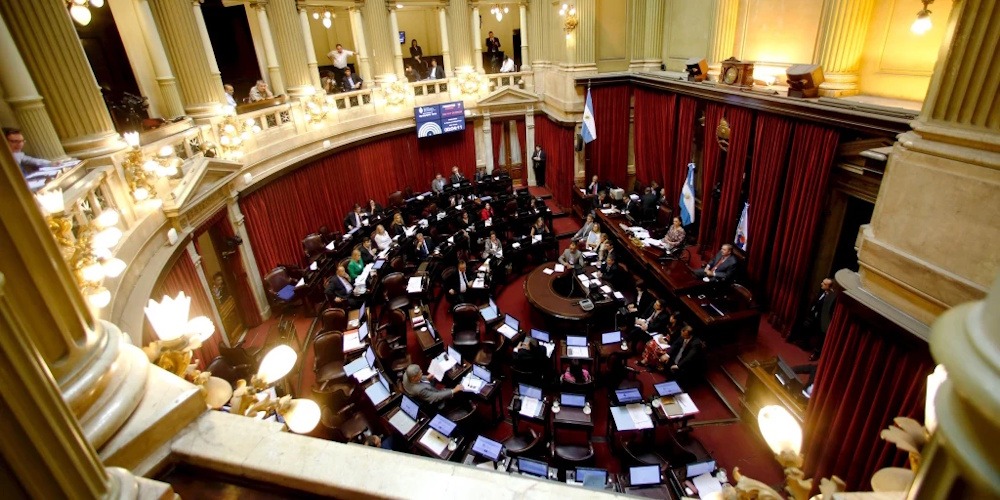
To encourage Argentines to withdraw their savings from the shadow economy and into the legitimate sector with less oversight, the Senate authorised changes to the government’s Fiscal Innocence bill. Less regulation and more tax breaks are part of the overhaul. Last December, the Fiscal Innocence bill was first passed. To prevent punishing residents for hiding their undeclared savings in banks, it used the concept of innocence and raised the bar for tax evasion. In an effort to entice much-needed monies into the banking system, President Javier Milei and Economy Minister Luis Caputo suggested tweaks to make the new system more appealing after enrolment fell short of expectations. The amendments were approved by the Lower House in late August, and on Thursday nite, they were finally approved by the Senate with 44 votes for and 23 against. Several provincial groups and La Libertad Avanza’s ally blocs-PRO and UCR-supported the measure. The updated version of the law, known as Fiscal Innocence II, is less strict regarding “significant discrepancies” found when registering sums and lifts income thresholds for those wishing to enter the Simplified Income Tax Regime created in December.
Following its approval in the Senate, presidential spokesperson Adrián Ravier stated: “The bill maintains the spirit of the current regime and incorporates technical amendments, developed in collaboration with tax specialists, to strengthen legal certainty and give Argentines greater confidence in putting their savings to work.” The official added “With clear rules, savings return to the formal economy and are transformed into credit to finance Argentina’s growth.” About $170 billion is presently not part of the official economy, according to the government. Provinces that grow sugarcane, maize, and soybeans will profit from a biofuels law revision that the Senate recently approved. A transition time is set up for non-integrated firms and the required blending levels for biodiesel and bioethanol are raised in the bill. In order for it to become legislation, the Lower House must now consider it. Taxpayers are no longer obligated to submit an asset statement at the start or conclusion of each tax year as a result of the new law’s alternative way of calculating income tax. Officials should assume the person isn’t trying to avoid paying their fair share of taxes.
Assuming all things are in order, the ARCA tax authority will accept 2024 and 2023 asset declarations as valid in addition to 2025. It will be up to ARCA to prove its suspicions about tax avoidance if it arises. However, the bill specifies a date of December 31, 2027, even though Minister Caputo first touted it as a permanent system to formalise stored dollars without risk. A further modification is the expansion of eligibility for the Simplified Income Tax Regime to high-net-worth individuals and families with incomes surpassing AR$10 billion (US$65,359,400) or net worth exceeding AR$1 billion (US$653,600). On the other hand, if their prior income statements are accurate and not subject to scrutiny, they will miss out on ARCA’s benefits. In addition, ARCA will now only declare that a “significant discrepancy” exists between the taxpayer’s returns and the tax authority’s data when there is a difference of 15% or when the discrepancy represents 5% or more of what is considered tax evasion under the Criminal Tax Law. That amounts to about AR$5 million (US$3,200).
To keep the tax benefits, taxpayers must revise their returns and pay the tax plus interest if the difference is more than that amount. The plan also lessens the burden of reporting one’s own income and assets and makes it clear that members of Congress, judges, and the executive branch (including the president) will not be able to take advantage of the streamlined tax system. Officials now serving or who have held public office within the last five years are also prohibited from using this system according to the bill. Members of La Libertad Avanza have joined the system in recent months, taking advantage of the law’s original provision that enabled public officials to do so. To make the change to the Fiscal Innocence statute effective, the government must now pass the bill.
