

A cryptocurrency deposit can become a balance shown in US dollars because the payment is converted into the currency used by the account. The cryptocurrency identifies what was transferred; USD identifies what was credited. Using Bitcoin to fund a casino account therefore does not necessarily mean the account holds Bitcoin. The payment method and the account balance describe different parts of the same transaction.
That distinction helps explain the information shown during a payment. A wallet records the cryptocurrency sent, while the receiving service records the value it credits. Both records can describe the same transfer accurately, even though their amounts use different units. Following those units gives a clearer account of what happened than treating every number beside a dollar symbol as the same kind of balance.
The currency used inside the account
Casino payments involve a transfer into an account and a record of the funds available within it. Those two parts can use different currencies, with conversion connecting them. Cryptocurrency can fund an account at a real money online casino site that records deposits in US dollars. Under this arrangement, the transferred cryptocurrency becomes US currency, and the resulting credit is measured in dollars. The funding asset describes how value reaches the account; USD provides the common unit for the account balance and subsequent activity.
This gives the account a common basis for its records. Once a deposit has been converted, its origin in cryptocurrency does not make the credited funds a continuing holding of that cryptocurrency. The balance belongs to the account’s own system of credits and debits. Reading it in dollars means following that account activity, rather than treating the figure as the current market valuation of the coins originally sent.
A dollar balance and a dollar valuation
A dollar denomination and a dollar valuation answer different questions. Denomination identifies the unit in which an amount is recorded. Valuation expresses what an asset is worth in another currency. The distinction applies even when the same currency symbol appears in both places, which is why the label attached to an amount deserves attention.
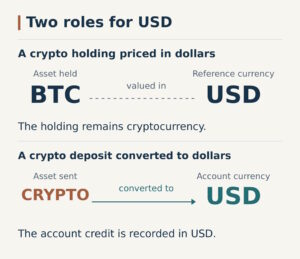
A Bitcoin holding remains a quantity of Bitcoin even when its value is expressed in dollars. Multiplying the quantity of coins by a price stated in dollars per Bitcoin produces a dollar valuation. The calculation provides another way to describe the holding while leaving its Bitcoin quantity unchanged. As the quoted price changes, the dollar valuation changes with it.
A converted casino deposit follows a different arrangement. The conversion results in a dollar credit, rather than leaving the account balance as a cryptocurrency quantity with a dollar equivalent beside it. Subsequent movements in the cryptocurrency’s quoted price do not, by themselves, reprice that dollar credit. Changes to the casino balance instead reflect activity recorded within the account.
The exchange rate connects the cryptocurrency quantity to its conversion value in dollars. The resulting dollar credit then has its own meaning: an amount recorded in the account currency. A rate answers how the two units relate, while the USD label identifies the unit used after conversion. Establishing the precise conversion value requires the rate actually applied to that completed payment.
Crypto payments beyond the casino account
The separation between the asset paid and the currency received also appears in documented retail payment arrangements. On June 12, 2025, Shopify introduced USDC payments with local-currency payouts by default. Its announcement described customers paying with USDC on the Base network, while merchants received their local currency unless they chose to receive USDC into their own wallet.
USDC is a stablecoin designed to track the US dollar, but it remains a digital token. The dollar reference concerns its intended value; it does not make a USDC payout identical to receiving ordinary currency. Shopify separates those options by letting the merchant choose between a local-currency payout and receipt of USDC in a wallet. The customer’s funding asset can remain USDC in either case. The merchant’s selection determines what arrives on the receiving side, so the payment asset alone does not specify the form of funds ultimately received.
Visa described another arrangement in its April 30, 2025 announcement of stablecoin-linked cards developed with Bridge. Bridge converts funds from a cardholder’s stablecoin balance into fiat currency, meaning national money, such as dollars, allowing the merchant to receive local currency through the card payment. The source of the customer’s funds and the merchant’s receipt are connected through conversion.
The two arrangements give conversion different roles. Shopify offers a choice between receiving local currency and receiving USDC. In the card arrangement Visa described, Bridge handles the conversion needed to pay the merchant in local currency. Paying from a stablecoin balance therefore does not establish that the merchant receives stablecoins or keeps a cryptocurrency balance.
Reading the balance in its own currency
For a converted casino deposit, the useful sequence is the cryptocurrency amount sent, the conversion into dollars, and the dollar credit recorded in the account. Each describes a distinct part of the payment. A cryptocurrency quantity belongs to the transfer record; the resulting USD amount belongs to the account record.
For someone who tracks everyday expenses in another currency, reading a USD balance adds a separate exchange-rate question. Its equivalent in that other currency depends on the relationship between the two currencies. That translation is a valuation of the dollar amount; it does not change the account’s denomination. The balance remains a dollar figure, with its value in another currency calculated separately.
