
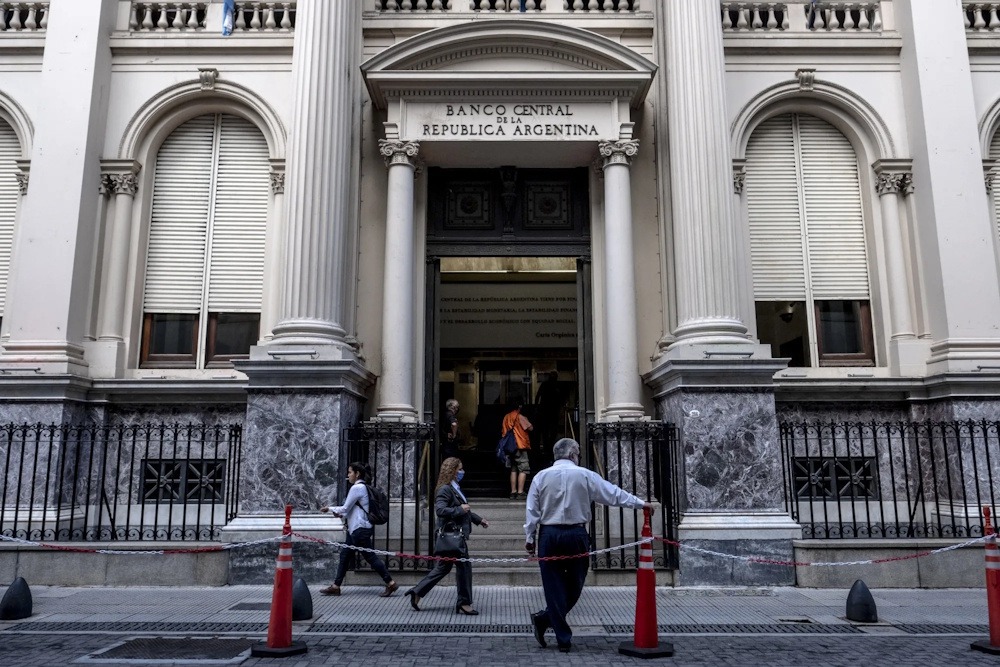
Argentina has obtained a loan amounting to US$3 billion from a consortium of international banks, aimed at addressing an imminent foreign debt obligation and restoring the nation’s dwindling financial reserves. The Central Bank announced a one-year repurchase agreement – or repo – with lenders at a rate of 7.4 percent, according to a statement released early Wednesday. According to sources, six international banks participated in the deal. Banco Santander SA, Banco Bilbao Vizcaya Argentaria SA, and Deutsche Bank AG contributed approximately US$680 million each, according to sources, while Goldman Sachs Group Inc provided US$510 million, JPMorgan Chase & Co. contributed US$340 million, and Bank of China Ltd. added around US$100 million. Representatives from JPMorgan, Goldman, BBVA, and Santander refrained from providing comments. A spokesperson for Deutsche Bank did not provide an immediate comment, and a representative from Bank of China has yet to respond to the inquiry.
President Javier Milei’s administration was seeking to assemble sufficient dollars to fulfill a US$4.3-billion payment due Friday, while choosing not to re-enter international bond markets at this time. The government issued dollar-denominated local bonds maturing in 2035 and 2038, referred to as Bonares, to the banks as collateral. A discount of 40 percent was applied to the bonds, indicating that Argentina needed to relinquish approximately US$5 billion in value to obtain US$3 billion in liquidity, according to sources. The Economy Ministry did not provide an immediate response to a request for comment. Argentina’s sovereign debt experienced an increase across the curve before subsequently reducing those gains. Global bonds maturing in 2035, recognized for their liquidity, experienced an increase of up to 0.4 cent, yet were observed trading flat at approximately 74.5 cents on the dollar at 12:30 PM in Buenos Aires. The yield decreased to 9.8 percent.
On Monday, Argentina’s Treasury acquired over half of the proceeds from a US$700-million privatization of hydroelectric power plants, as reported by a source with knowledge of the situation. The Central Bank has executed its inaugural dollar acquisition in nine months, purchasing US$21 million in the foreign-exchange market, as stated in an official announcement. On Tuesday, it acquired an additional US$83 million. “The government isn’t just looking to cover upcoming maturities, but also to bolster reserves and build a roughly US$1.5-billion bridge to get through the peak harvest months,” stated Ramiro Blázquez. “This rationale is understandable, as the ability to acquire substantial dollars in the spot market will be constrained until the harvest is realized, particularly given the persistent inflationary pressures and the policymakers’ intent to prevent exacerbating the situation with a depreciated peso.” Economy Minister Luis Caputo indicated several weeks prior that banks had proposed up to US$7 billion in repo funding, alongside various other alternatives under consideration. In the course of its preparations, the Economy Ministry executed a debt swap with the Central Bank last week. The transaction facilitates the accumulation of collateral in dollar-denominated sovereign bonds, which can be utilized within a repo framework, consistent with earlier activities associated with the Central Bank. “The 7.4 percent rate is very positive, and the one-year tenor shows the economic team is confident reserve accumulation will gain traction this year,” stated Walter Stoeppelwerth. “The market is responding to the Central Bank’s recent dollar purchases, indicating a stronger commitment than the repo itself, which is already reflected in the pricing.”
The repo deal, which extends beyond the immediate maturities and is short-term in nature, underscores the necessity for Argentina to reestablish market access this year. In mid-2025, the Milei administration entered into a two-year, US$2-billion repo loan with international banks, which is scheduled to mature next year. This agreement follows a similar US$1-billion, two-year deal signed earlier that year, thereby increasing the total of short-term obligations. Attention will soon shift to Argentina’s prospective re-entry into international markets. Officials indicated that addressing the January maturities was a crucial measure for further reducing country risk, which currently stands at a multi-year low, and for facilitating more affordable funding in the future. New financing from Wall Street contributes to Milei’s momentum following his party’s victory in Argentina’s midterm elections in October, marking a resurgence after a significant market selloff prior to the vote that prompted a US$20-billion bailout from the Trump administration. The president’s libertarian party has ascended to become the predominant faction in Congress, whereas the leadership within the Peronist opposition continues to exhibit fragmentation. Milei leveraged his political capital to enact Argentina’s inaugural annual budget during his Presidency in December, thereby solidifying his fiscal surplus. He also enacted a tax amnesty law and is set to advance next month with a labor reform bill that will challenge his negotiating skills with influential governors and centrist coalitions he requires. According to the Central Bank’s most recent survey of economists, analysts project that Argentina’s economy will experience a growth rate of 3.4 percent this year, following an estimated growth of 4.4 percent in 2025.