
In the province of San Juan, one of the most arid regions in Argentina, water transcends its role as a mere resource; it embodies a profound symbol. A widely circulated narrative recounts the story of Deolinda Correa. Her baby miraculously survived, giving rise to Deolinda’s legend, La Difunta. The customary practice involves placing a bottle of water at her shrine; this tableau illustrates the ongoing strain in this foothills area, characterized by the scarcity and high value of water resources. Paradoxically, it is this same geography that today fosters the growth of a rapidly expanding crop: pistachios. The nut flourishes under these optimal climatic conditions characterized by frigid winters and arid, sweltering summers, alongside an expanding international market. The area dedicated to pistachio cultivation has expanded from approximately 1,000 hectares in 2013 to an estimated range of 7,500 to 8,500 hectares at present, as reported. San Juan presently represents approximately 90% of the cultivated area.
The north-western region of Argentina has endured over ten years of significant hydrological drought, a situation worsened by climate change and suboptimal resource management practices. The availability of water is primarily contingent upon the winter snowmelt, a source that is currently under threat. Data from the Argentine Institute of Snow Research and Glaciology indicates that exposed ice levels in the Desert Andes have decreased by 17% over the past 15 years, while snow patches have diminished by 23%. Additionally, water levels in monitored glaciers have declined by an equivalent of seven metres. The Centre for Research, Development and Innovation for Water Management in Arid Areas asserts that the adjacent San Juan and Jáchal river basins exhibit snow levels “well below the average for the past 25 years.” The outlook is critical, according to Leandro Salvioli. “In San Juan, annual precipitation ranges from 80 to 100 millimetres, while the incidence and duration of droughts are increasing.” We are increasingly penetrating the aquifer to locate water that dates back 10 to 12,000 years. “If we do not build water awareness, we are heading straight for a wall,” he states. The scarcity is further compounded by an absence of strong oversight. While the official count stands at 5,370 authorised water wells, Salvioli posits that the actual number, including unauthorised sites, may be as high as 15,000, contributing to the issue of overexploitation.
Pistachios exhibit superior resilience to water scarcity compared to other crops, attributable to the depth of their root systems. However, technicians indicate that commercial yields still necessitate substantial quantities of water. “It is very interesting for arid areas, but to perform well it needs water, and that is the challenge,” explains Gonzalo Sánchez Cañete, a researcher San Juan. The primary production companies indicate that the sector has made investments in technologies aimed at optimizing resources, including continuous soil moisture measurement and drip irrigation systems. The latter has the potential to reduce water consumption by as much as 80% when compared to alternative irrigation methods. In the San Juan department of 25 de Mayo, recognized as the country’s largest pistachio hub, the company Pistachos de los Andes has been in operation for nearly two decades. The management encompasses approximately 300 hectares, yielding between 2,800 and 3,000 kilograms per hectare annually. The facility includes a nursery that yields approximately 100,000 plants each year, as stated by agricultural engineer Pablo García, who oversees production at the location.
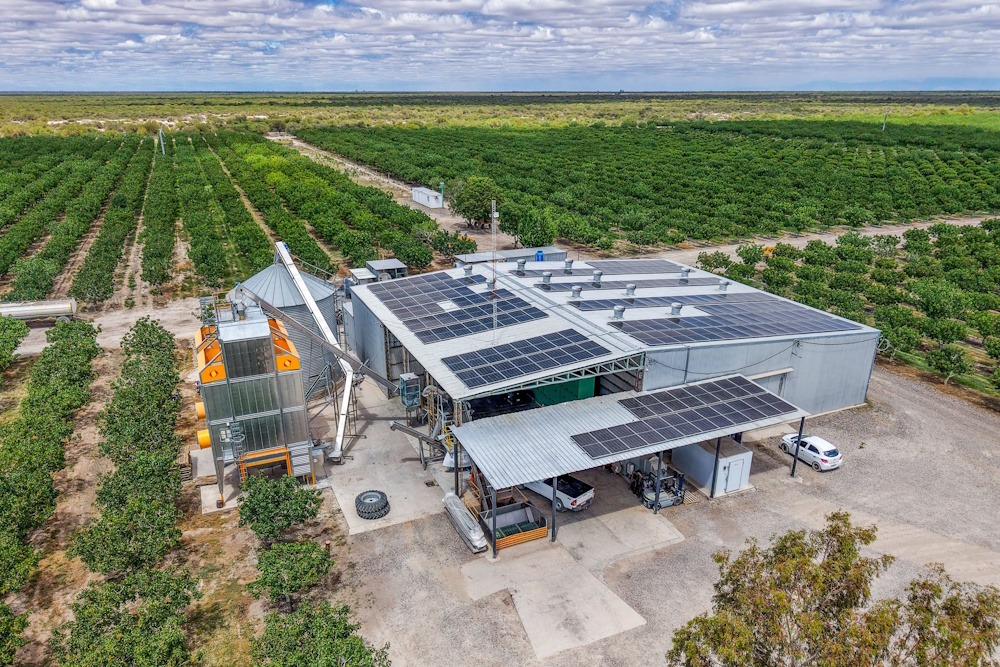
The farm presents itself as an oasis amidst the desert, characterized by orderly, verdant plots of trees that stand in stark contrast to the surrounding dry and arid terrain. Brenda Sánchez has been employed at the nursery for a duration of two years. “Plants require careful and affectionate treatment due to their fragility. “Water is scarce around here, so we know we have to take good care of it,” she states. Considerable capital has been allocated to technological advancements, encompassing a substrate for seedlings sourced from Finland and frost protection mills acquired from New Zealand. This technology distinguishes itself in a context characterized by small, vulnerable settlements. Numerous residents persist in constructing their dwellings using mud and wood, adhering to the traditional practices of the Indigenous Huarpe community in the region. An aerial perspective showcasing the solar panels positioned atop the main building of Pistachos de los Andes. The owner states that the company operates within a circular economy framework, generates no waste, and utilizes solar energy “We are a circular-economy company,” states Marcelo Nemirovsky. “We do not produce waste and we utilize solar energy.” “We utilize water with remarkable efficiency; drip irrigation ensures that not a single drop is wasted.” The company consumes approximately 7,000 to 8,000 cubic metres of water annually per hectare, which is roughly comparable to the volume of three Olympic-sized swimming pools. The provincial agriculture secretary Miguel Moreno asserts that the pistachio sector exemplifies effective water management, with 97% of its operations employing modern technology. Nevertheless, specialists concur that the discourse surrounding water utilization in a desert area – where cultivable land constitutes merely 3% of the province’s total surface – is poised to intensify. The desire to inhabit and create in a desert exhibits a certain capriciousness. “Humans should adapt to that, not the other way around,” argues Salvioli.
The surge in Argentina’s pistachio production reflects a broader global trend. According to a report by the United States Department of Agriculture, global production is projected to increase by 7% this year, reaching 1.2 million tonnes. The United States occupies a leading position in the market, succeeded by Turkey, Iran, and Syria. Consumption is on the rise, particularly in Turkey. International prices experienced a 17% increase this year, reaching USD 23 per kilo, thereby earning the moniker “green gold.” In Argentina, the pistachio sector is integrated within a nut industry that spans roughly 22,000 hectares, with walnuts at the forefront, succeeded by pecans, almonds, and hazelnuts, as indicated by the most recent official data. The government estimates that the current area is approximately 30,000 hectares. The manual quality control of pistachio seeds at Pistachos de los Andes precedes their vacuum-packing and subsequent sale. Worldwide, production is projected to increase by 7% this year, reaching 1.2 million tonnes. For some of the country’s oldest nut producers, such as Prodeman, which specializes in peanuts and has recently entered the pistachio market, the opportunity represents a strategic move towards diversification in response to a global trend favoring healthier consumption patterns. “The demand for nuts is growing because the younger generations are eating healthier,” states Gustavo Cavigliasso. “Initially, our focus is on fortifying the domestic market, while maintaining an openness to exports.” In March of this year, Argentina’s pistachio producers experienced a significant uplift following China’s approval for the importation of Argentine nuts, culminating in the dispatch of the inaugural shipment of pecans this month. China imports approximately 170,000 tonnes of pistachios each year, a quantity that significantly surpasses the total output of Argentina. Experts have identified this as potentially significant; however, its immediate impact is deemed unlikely. “The trade link with China is excellent and growing, but today Argentine pistachios are far from being able to supply such a market,” explains Ernesto Taboada, director of the Chinese-Argentine Council. “Chinese buyers will seek numerous containers, rather than a single bag.” The primary obstacle lies in rapidly attaining the requisite scale.
The maturation period for the trees spans 8 to 10 years. “We are interested in selling to them, of course, but we don’t have the volume yet,” acknowledges Nemirovsky. “To reach China, we first have to grow, and that takes time.” Moreno, the agriculture secretary, recognizes the challenges: “The opening up of China will have an impact, but it is still impossible to cover that market.” China is regarded as a substantial market capable of absorbing Argentine pistachios, contingent upon the sector’s ability to scale up production. Argentinian pistachio farmers are navigating the prospects of growth while contending with the constraints of production in one of the driest regions of the country. As tensions between agricultural expansion and water crises become increasingly apparent, experts caution that the sector’s future hinges on its capacity to adapt. Data indicates that the aquifer critical to San Juan’s production is being depleted at a rate that exceeds its natural replenishment capacity. As Salvioli states, “it is a resource that cannot be renewed.” Concurrently, the pistachio sector endeavors to establish itself as a model of efficiency. The Agriculture Ministry reports that 97% of plantations utilize drip irrigation systems. The leading firms employ sensors, continuous monitoring, and renewable energy sources to minimize consumption. Nonetheless, advanced technology represents merely a partial solution. According to researcher Cañete, “The question is not only how much water they use, but where it comes from and how much is left for others.” The challenge lies in achieving equilibrium: to cultivate a crop that fosters employment and boosts exports, all while safeguarding a resource that is fundamental to existence. Salvioli highlights that the absence of regulation in well drilling coupled with the aggressive extraction of water intensifies the issue: “An increasingly scarce resource is being abused.”