
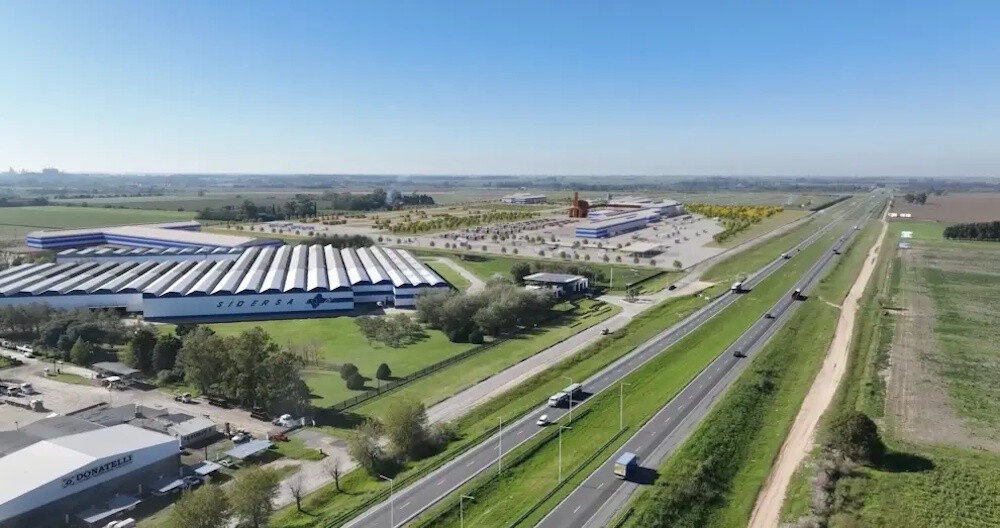
San Nicolás de los Arroyos, located in northeast Argentina, is a riverside town characterised by its longstanding tradition in steelmaking that spans several decades. The noise of heavy machinery emanating from a 15-hectare site signifies the emergence of its next era. A new steelworks, with an investment of US$300 million, is under construction, possessing the capacity to produce 360,000 tonnes of greener (low-emissions) steel each year. In local workshops, the initial operators are undergoing training to operate both an electric furnace and the systems for processing recycled scrap that will supply it. When it begins operations in late 2027, the plant will mark the inaugural steelmaking facility for Sidersa, an Argentine company that has, until now, focused on the marketing and distribution of steel products. Sidersa has committed to generating over 300 direct jobs and 3,500 indirect jobs in a community historically associated with the soot and towering chimneys of conventional steel production. But these plans, partly funded by a bank of the Chinese state, require less carbon. Sidersa describes the plant as a symbol of the “green” steel that “the world will want” and Argentina can offer.
Given that the steel sector contributes 7-9% of global CO2 emissions, there is an increasing necessity for the industry and policymakers to pursue a transition toward more sustainable processes. Producing steel from recycled scrap in electric arc furnaces, as Sidersa plans to do, reduces emissions by around 70% on average compared to conventional steelmaking, which uses iron ore in coal-fired blast furnaces. This is not a new technology for Argentina; what distinguishes this project is the magnitude of the investment and the political environment in which it is occurring. However, just how green this steel will be depends on the source of the electricity and the necessary scrap metal. The process selected for Sidersa’s San Nicolás plant bypasses the coal-dependent, emissions-heavy blast furnace phase. In Argentina, electric arc furnaces represented approximately 57% of steel production in 2023, based on data gathered by the Inter-American Development Bank. However, the utilisation of an electric furnace does not inherently render steel production environmentally sustainable. Firstly, the cleanliness of such a furnace is contingent upon the quality of the grid that supplies its power. The steelworks will be supplied, at least initially, by the national grid, which is currently dominated by gas-fired thermal power stations. Sidersa has indicated that it is contemplating the potential of powering the facility directly from renewable sources in the future.
In 2025, variable renewable energy sources, including wind, solar, small-scale hydropower, biomass, and biogas, accounted for 18.9% of Argentina’s electricity demand. When large hydroelectric plants are included, that figure surpasses 40%. However, the high-voltage grid is at capacity. “The electricity grid in Argentina has been saturated for over a decade,” Adrién Sergenty tells. “The company will have to decide whether to build its own facilities or partner with a nearby renewable energy generator that can guarantee its supply directly.” Secondly, there is the basic raw material: scrap metal. The global scrap metal market is facing growing shortages and export restrictions. “Our surveys show there is sufficient availability on the domestic market to supply us 100% with domestic scrap metal,” Alejandro Galdeano tells. However, scrap metal collection in Latin America involves informal networks and transport logistics that present distinct environmental challenges, including the open-air burning of cables to recover copper and the uncontrolled disposal of non-valuable materials.
Sidersa states it is formulating a supply plan that considers both major suppliers and partnerships with various local authorities nationwide. It seeks to create collection points for scrap metals that empower local communities to eliminate waste from their environments. A steel expert elucidates that the project’s feasibility hinges not solely on the selected technology or the availability of renewable energy, but also on the prevailing economic and commercial landscape. The expert indicates that the plant will achieve its projected production level solely if there is consistent demand within the domestic market. The specialist adds that achieving the scale of production estimated by Sidersa would require “some sort of miracle.” It is believed that the only feasible path forward would involve either a remarkable surge in domestic steel demand or a decline in market share among international rivals, including Acindar, Sipar Acero, or Acerbrás. If Sidersa can successfully produce lower-emissions steel, it could provide a competitive advantage in exporting to jurisdictions with high environmental standards, such as Europe. Since the beginning of this year, the European Union’s Carbon Border Adjustment Mechanism has been implemented for iron and steel imports, correlating their price with the carbon emissions inherent in those products. Currently, production is predominantly concentrated on Sidersa’s domestic market.
San Nicolás has ample justification to approach with caution the lofty commitments put forth by corporations. The city is home to the historic General Savio steelworks complex, operated by Ternium Argentina. The company is facing legal challenges over its management of waste and effluents. In 2023, a report by experts, conducted in the context of an environmental injunction, underscored the absence of a permit for the discharge of industrial liquid effluents and identified the presence of heavy metals in the local groundwater. Sidersa is also facing an environmental dispute over the construction of the plant. The NGO United for Life and the Environment has levelled accusations of causing “enormous environmental damage” through the illegal extraction of tosca, a material utilised for levelling and laying foundations on industrial sites, from a quarry adjacent to the Ramallo stream, all without the necessary provincial or municipal authorisation. The courts have opened civil and criminal cases. Construction activity persists.
According to Sidersa, these allegations relate to a supplier that claims the rubble was extracted from quarries authorized by Buenos Aires, the provincial authority of San Nicolás. The company asserts that the extraction was conducted in accordance with legal requirements and with the requisite authorisation, as outlined in the contract. “We regret the lawsuit that has been filed, to which we are responding through the appropriate legal channels,” Lucrecia Payer, Sidersa’s director of institutional relations, tells source. Sidersa initially sought funding from the Inter-American Development Bank’s private arm, IDB Invest, and the World Bank Group’s International Finance Corporation. These agreements ultimately did not materialise. Ultimately, the company opted to finance two-thirds of the investment itself, shrinking the amount of external finance needed. Sidersa ultimately obtained a loan amounting to US$100 million from ICBC Argentina. This local subsidiary of the Chinese state-owned Industrial and Commercial Bank of China is enabling the acquisition of imported machinery for the new plant. The San Nicolás plant has emerged as the inaugural industrial initiative to take advantage of Argentina’s Large Investment Incentive Regime (RIGI, by its Spanish initials). This law, approved in 2024, aims to draw substantial capital by providing tax incentives and assurances of regulatory stability for a duration of up to 30 years.
For the ruling party, it serves as a crucial instrument for delivering predictability to investors in a nation where historically volatile economic conditions have rendered certainty elusive. However, detractors, including the think-tank Fundar, argue that the initiative provides substantial advantages to major corporations without imposing particular requirements in exchange. For instance, environmental protections. “Each concession could be linked to a specific objective, and if that objective is not met, the concession should be withdrawn,” says Guido Zack. “This is how it is done in other countries such as Chile, Brazil or Norway; such schemes only work when the public sector, as well as granting benefits, demands clear commitments regarding the development of local suppliers, production targets and employment […] and, in the current climate, also in renewable energy.” As of September, the project reached a completion rate of 27%, with expectations set for the initial steel production to occur in the first half of 2028. The outlook is ambitious. It remains to be seen whether Sidersa will successfully source its raw materials predominantly from scrap and low-emission electricity available in the Argentine market, and whether the benefits provided by the RIGI program will render a steelmaking technology with a reduced environmental footprint economically viable.
