
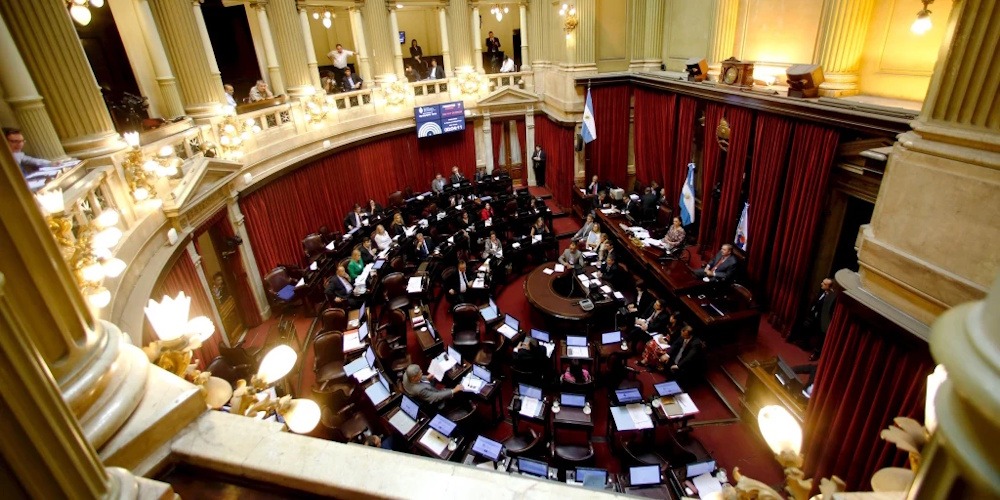
On Thursday, the Argentine Senate granted final approval to the trade agreement between Mercosur and the European Union. The final tally indicated substantial backing, with 69 votes cast in favor, 3 opposed, and 3 abstentions recorded. Argentina has now become the second nation to ratify the agreement, following Uruguay’s approval of the identical initiative just hours prior. Congress is presently engaged in an extraordinary session prior to the commencement of the regular sessions on March 1. The execution of the agreement, finalized in January, is presently postponed as the European Parliament has recently referred the accord to the EU’s highest judicial authority to ascertain its conformity with prevailing EU treaties.
Senate sessions persist as discussions unfold ahead of the vote on the glaciers reform, a legislative proposal designed to permit mining in regions adjacent to glaciers. On Thursday, a contingent of Greenpeace activists was apprehended while staging a protest on the steps of Congress. At approximately 7:30 a.m., they scaled the barrier in front of Congress and subsequently took their seats on plastic or cardboard toilet seats, all while adorned in suits and a presidential sash. Congress security and police intervened, resulting in the arrest of at least 12 activists. A cameraman was also arrested and injured by police while he was registering the crackdown. Members of the press present at the scene were also impacted by tear gas. After 26 years of negotiations, representatives from the Mercosur nations and the European Commission formalized the EU-Mercosur trade agreement during a ceremony held in Asunción, Paraguay, on January 17.
The agreement establishes the largest free-trade area globally, encompassing over 715 million individuals. Regional leaders on both sides of the Atlantic have endorsed it as a significant demonstration of multilateral cooperation, peace, and free trade, particularly in an era when global powers like the U.S. are increasingly leaning towards protectionism and a perspective shaped by spheres of influence. For all components of the agreement to take effect, they require ratification by the legislative bodies of each participating nation. The trade provisions are anticipated to be implemented sooner due to a more straightforward approvals process. Although commonly referred to as a trade deal, the free trade provisions constitute a component of a more extensive association agreement. The agreement will encompass a progressive decrease in tariffs affecting over 90% of bilateral trade between the blocs, alongside a set of commitments pertaining to political cooperation, investment, and environmental considerations.
The European Union’s delegation to Argentina is set to convene an EU-Argentina Trade and Investment Forum on June 1-2, aimed at examining investment prospects and delving into value chain opportunities. Farmers and politicians in European nations, including France and Poland, expressed concerns that the agreement poses a threat of inundating their markets with inexpensive agricultural products. Critics in South America contend that the agreement will promote the export of raw materials to Europe while facilitating the import of sophisticated, value-added manufactured goods in exchange, thereby perpetuating a “colonial” dynamic.