
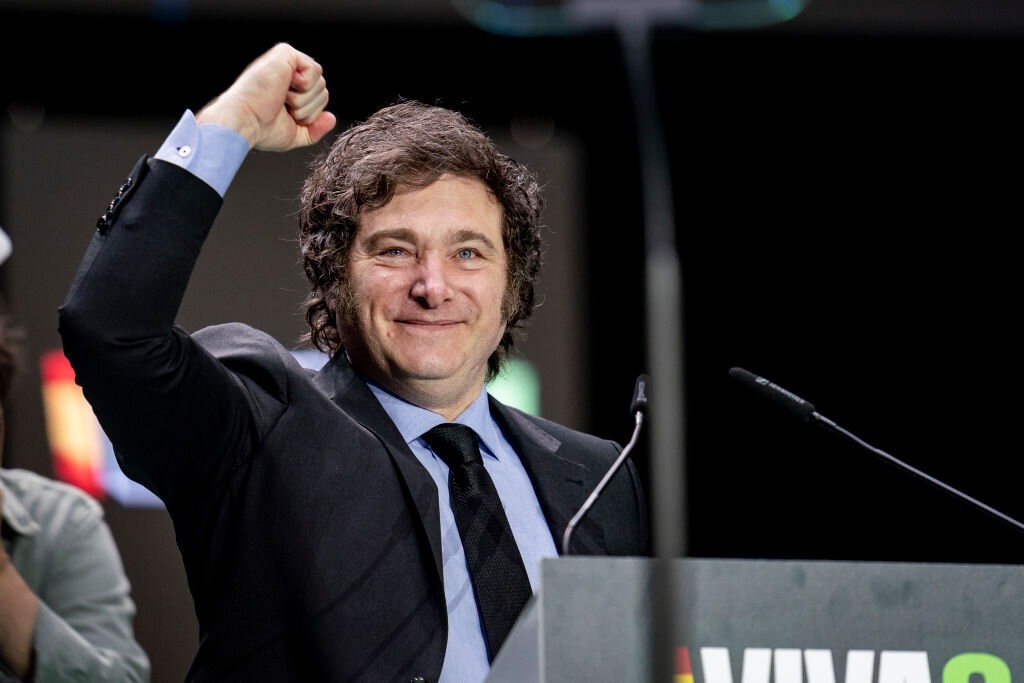
President Javier Milei expresses his intention to establish the “strategic alliance” with the United States, under the leadership of ally President Donald Trump, as a “state policy.” During a state of the nation address to Congress on Sunday night, the leader of La Libertad Avanza stated, “the South Atlantic is the strategic battleground of the coming decades,” contending that Argentina must be a “player” in the region. Trade routes, natural resources, maritime sovereignty, and the increasing involvement of entities that do not align with our values. Whoever holds the reins will govern a crucial segment of international commerce. “Argentina has to be that actor,” he argued. “We must create the century of the Americas: Make Americas Great Again, from Alaska to Tierra del Fuego,” declared Milei. The critical minerals essential for the West’s needs are readily available to us. We possess the energy resources – gas, oil, nuclear power, and renewable energy – necessary to support extensive production chains.
He emphasized Argentina’s strategic position at the southern tip of the Americas, highlighting its “access to two oceans and a presence in Antarctica.” Milei’s administration has aligned itself with the United States and Trump, endorsing Washington’s military actions against Iran that commenced on Saturday, thereby placing Argentina on heightened alert. Argentina hosts the largest Jewish community in Latin America, which has attributed responsibility for the 1994 bombing of a Jewish community center in Buenos Aires, resulting in 85 fatalities, to Iran and Hezbollah. Milei dedicated a significant portion of his address to highlighting his administration’s macroeconomic achievements over the last two years, especially in the fight against inflation, and expressed his intention to advance his reforms further. He announced an ambitious package of 90 reforms in his address, which was characterized by verbal clashes with opposition lawmakers, stating he would “redesign” Argentina “for the next 50 years, with Western morality as state policy.” The anticipated reforms aim to tackle various sectors, including the economy, taxation, the criminal code, the electoral framework, education, justice, and defense. He stated that there will be “nine uninterrupted months of structural reforms that will reshape the institutional architecture of the New Argentina.”
The President dedicated the initial segment of his address to denouncing the “failed state” he claimed to have inherited upon assuming office in a nation “ensnared in an inscrutable web of regulations.” He also defended trade liberalization as a fundamental component of his initiative. “After decades of protection, we ended up with a small, expensive industry, dependent on subsidies and with meagre salaries in dollars,” he stated, criticizing local business leaders who have recently condemned him for liberalizing imports, which they argue is detrimental to domestic production. Milei frequently faced interruptions from opposition lawmakers, to whom he retorted with a barrage of insults, labeling them as “thieves,” “criminals,” and “ignoramuses.” The address signified the commencement of the new legislative cycle following a tumultuous 2025, characterized by corruption allegations involving officials and instances of currency volatility.
However, Milei, who assumed office in December 2023, commences this parliamentary year with a position of political strength, reinforced by his electoral triumph in the midterm elections held in October. Last week, the nation’s Congress approved Milei’s key labor reform, marking a significant win for the self-identified “anarcho capitalist” leader in his efforts to enhance employment by relaxing regulations on working hours, terminations, and overtime compensation. Milei’s proposed “labour modernisation law” permits working days extending to 12 hours, diminishes severance pay, restricts the right to strike, and reduces employer taxes, among other stipulations. The legislation has prompted a significant mobilization of individuals in the streets over the last fortnight, as many perceive it to signify a regression in the rights of workers.”Milei can only move forward,” political scientist Pablo Touzón stated to AFP. “His political movement is quite punk,” thus “the reform agenda is necessary for him” to sustain his economic model.