
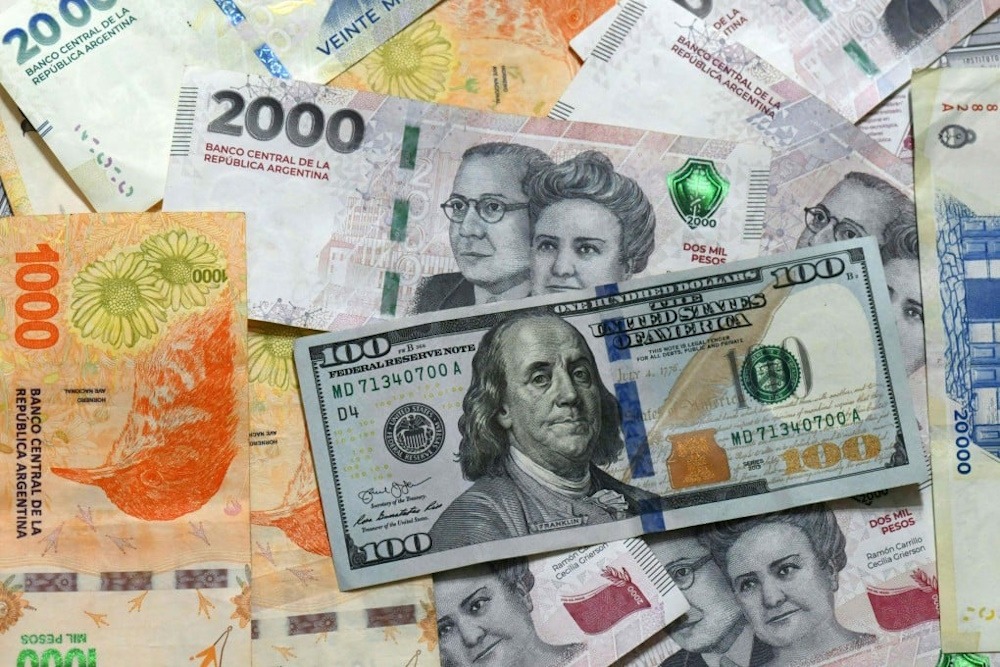
Each morning at Argentina’s Central Bank, the traders on the foreign exchange desk embark on a straightforward objective: to prevent the peso from fluctuating excessively in either direction. Recently, the peso has demonstrated relative stability, weakening by less than one percent in November, marking its smallest monthly fluctuation of the year, despite being the weakest currency among emerging markets. It has exhibited stability throughout December as well. Rather than focusing on a particular exchange rate, traders seek to mitigate volatility on a daily basis, striving to avert sell-offs as much as they do sharp rallies, as per an individual with direct insight into the situation. The Central Bank’s FX desk is poised to assume a more significant function as President Javier Milei aims to bolster reserves at the institution, a goal he has deferred during his initial two years in office. However, it represents merely one component of a broader policy shift in which the monetary authority will engage both within and beyond the market. The objective is to accumulate reserves while avoiding overwhelming investors with a surge of currency bids that could weaken the peso and potentially exacerbate inflation, which has notably decreased and helped maintain Milei’s popularity relative to his counterparts.
Beginning next year, traders at Argentina’s Central Bank will purchase as much as five percent of the daily trading volume in the nation’s currency market. However, with volume hovering at low levels near $300 million a day and fluctuating rapidly, the presence of officials may be more pronounced in so-called block trades outside the market, where the government purchases dollars directly from institutions without injecting pesos into circulation. That dynamic was evident on Monday when the Treasury acquired US$320 million “off screen,” or outside the market, overshadowing all trading volume within Argentina’s currency market for that day, as noted by Central Bank Governor Santiago Bausili. He noted that the Treasury’s dollar purchases are associated with Argentina’s impending bond payments of US$4.5 billion in January. As of December 12, official data indicate that net dollar holdings in Argentina’s Treasury increased to US$1.7 billion, a development attributed to foreign exchange purchases and the issuance of local bonds. Including Monday’s purchase disclosed by Bausili would position the current stock valuation at approximately US$2 billion, which is roughly half of the amount required to meet the bond payments due in January.
“All of this is because they have to find a way to reconcile some control over the exchange rate with the need to buy dollars for the Treasury,” stated Gabriel Caamaño. In a dual-currency economy such as Argentina’s, where residents save in dollars while earning and spending in pesos, volatility presents a significant challenge. The potential for diminished demand for pesos may lead to a shift towards dollars, jeopardizing Milei’s efforts to reduce inflation, currently at 31 percent annually, to single-digit levels. An increasing number of analysts are cautioning that Milei’s recent policy shift, although broadly regarded as beneficial, may also exacerbate inflationary pressures. In addition to increasing dollar reserves in the market and, conversely, selling pesos, the Central Bank will allow the trading range of the peso to widen more rapidly. This approach will ease its control, potentially leading to greater volatility that may affect price levels.
“Currently, the exchange rate serves as the sole instrument available to manage inflation, particularly in light of their intention to reduce interest rates,” stated Walter Stoeppelwerth. “Inflation remains a significant concern, yet the market exhibits a notable degree of complacency regarding this issue.” In an effort to stabilize the peso and control inflation, the government is implementing additional block trades off the market, engaging directly in transactions with commercial banks and debt issuers. Selling directly to the government frequently presents a more advantageous option compared to engaging with the conventional foreign exchange market, characterized by its limited volume. In this context, a substantial offer can swiftly impact the peso’s value, resulting in sellers receiving fewer pesos than initially anticipated. The government provides a uniform price. The government is acquiring hard currency from external sources, primarily stemming from a recent surge in corporate and provincial debt issuances following Milei’s significant midterm election triumph, which has injected essential dollar liquidity into the economy. In recent weeks, over a dozen debt issuers, including energy firms like Vista Energy, Tecpetrol, and YPF, along with various provinces, have commenced the provision of dollars to Argentina’s market. According to Argentine regulations, debt issuers are required to convert the proceeds from their bond sales into pesos prior to the due date of the first coupon payment. Córdoba Province, for instance, is confronted with a coupon due on January 2 and must liquidate its dollars prior to December 26 to ensure timely and complete payment. Prior to the impending deadlines, issuers are motivated to sell due to the necessity for pesos to finance investment projects, coupled with the comparatively attractive yields available in Argentina. As Milei aims to accumulate foreign reserves, these sellers external to the FX market may play a crucial role in maintaining stability within it.