
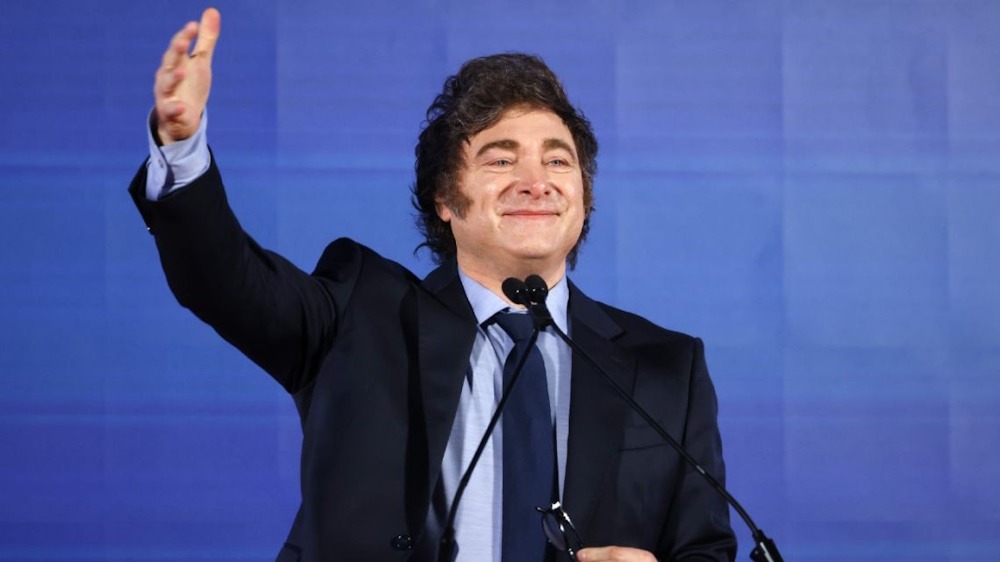
President Javier Milei derided his detractors on Friday following the release of data, which indicated that Argentina’s economic activity grew by 4.4 percent in 2025. The year-on-year increase in gross domestic product in 2025 was propelled by increases in private consumption (7.9 percent), public consumption (0.2 percent), exports (7.6 percent), and gross fixed capital formation (16.4 percent), according to report. Milei lauded the figure as evidence that his economic policies are effective. In a social media post, he criticized the prevailing “narrative” surrounding his administration, targeting dishonest “business cronies” and “corrupt politicians” with a tone of derision. “Data first!” stated the head of state. Last year, the sectors that exhibited notable growth included financial intermediation at 24.7 percent year-on-year, mining and quarrying at 8.0 percent, and hotels and restaurants at 7.4 percent. Conversely, the fishing sector experienced a significant contraction of 15.2 percent year-on-year. “Private consumption was the main component of demand, accounting for 70 percent of GDP, followed by gross fixed capital formation (16.0 percent of GDP), exports (15.6 percent of GDP) and public consumption (14.9 percent of GDP),” the statistics agency stated in its report.
Economy Minister Luis Caputo indicated that in the fourth quarter of 2025, GDP increased by 0.6 percent in seasonally adjusted terms relative to the preceding quarter and 2.1 percent on a year-on-year basis. In a social media post, he noted that “in constant prices, it reached a historic high in 2025, standing 1.1 percent above the 2022 average (the previous peak).” In seasonally adjusted quarter-on-quarter terms, exports rose by five percent, while private consumption saw an increase of 1.7 percent in the fourth quarter. Public consumption decreased by 1.0 percent, while gross fixed capital formation saw a decline of 2.8 percent. The Centro de Estudios Políticos y Económicos economic think tank stated, “the underlying reading is clear: the economy is growing,” while also acknowledging that it rests on “fragile foundations.”
“Momentum depends largely on the external sector, investment is beginning to show signs of weakness, and not all sectors are keeping pace,” cautioned the think tank. “If this trend continues, the start of 2026 could present a scenario of slower growth,” it added. The latest Market Expectations Survey indicates that analysts anticipate GDP growth of one percent in the first quarter of 2026, followed by a projection of 0.9 percent in the second quarter. The Budget Bill outlines the government’s projection of an annual economic growth rate of five percent. “For 2026, participants in the REM expect, on average, a level of real GDP 3.4 percent higher than the 2025 average (+0.2 percentage points compared to the previous survey),” stated the monetary authority.
Estimates from consultancy Orlando Ferreres & Asociados indicate that economic activity in January 2026 experienced a year-on-year decline of one percent, while showing a month-on-month increase of 0.4 percent. In a second report issued Friday, INDEC indicated that supermarket sales – a crucial metric for consumption – experienced a decline of 1.5 percent from the prior month in January, reflecting a year-on-year decrease of 1.2 percent.