
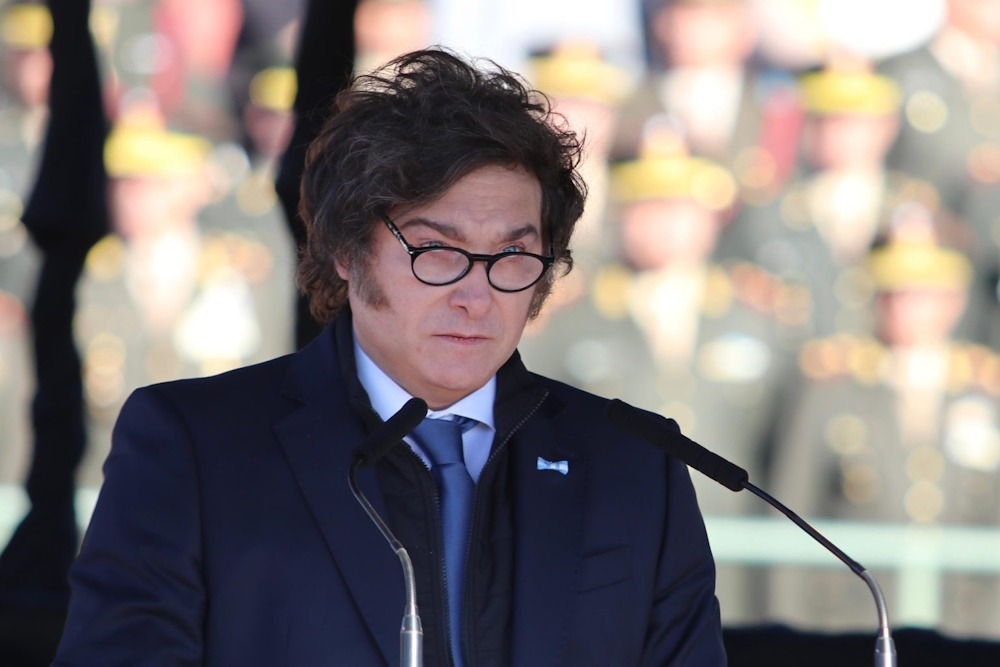
President Javier Milei stated that Argentina is “much better than in 2023,” the year he ascended to power. However, he acknowledged that in recent months there has been a decline in economic activity coupled with rising inflation, and he requested additional patience for the success of his economic program. In a recent assault on the media, the libertarian leader charged that journalists are constructing “a narrative” by focusing solely on the unfavorable economic statistics of his administration. “It is unsustainable that 100% of television news tickers insist that ‘everything is wrong’ when we have the lowest poverty level in the last seven years,” Milei stated in an X post.
Data indicates that poverty experienced a decline of 3 percentage points in the latter half of 2025, reaching a level of 28%. During the initial six months of 2024, the percentage had attained 53%. Leaders of economic observatories and consultant agencies contend that the significant decline may not correlate with a tangible enhancement in individuals’ living conditions, but instead reflects a stabilization of inflation and other economic indicators that influence measurements. “Does that imply that all individuals are in an improved position?” No. Milei stated, “And it would be intellectually dishonest to claim otherwise,” in reference to the poverty numbers. “That is precisely why we must persevere: to stabilize the economy and, with it, the lives of all Argentines.” He stated “That is why we ask for patience.” We are on the right track. Altering our trajectory would jeopardize the accomplishments we have secured.
Milei recognized that the past few months “have been hard,” attributing the difficulties to Kirchnerists — individuals associated with or defending the administrations of Cristina and Néstor Kirchner — asserting that they “tried to make the economy explode” in 2025, coinciding with the approach of the legislative elections, during which multiple political scandals emerged involving government officials. “That (attack) was not free; it resulted in elevated interest rates, diminished economic activity, and increased inflation.” The president stated “But the results are visible: the economy is starting to take off.” In January, Argentina’s economic activity experienced a year-on-year growth of 1.9%, according to a report released by INDEC in late March. The agriculture, livestock, hunting, and forestry sector exhibited the most significant positive influence on the year-over-year change of the index, with mining and quarrying following closely behind.
According to political essay writer Adrian Genesir in a recent column for the Herald, those sectors generate value, exports, and investment; however, they do not create employment, which explains why individuals may not be experiencing the economic improvement directly. “The sectors that do employ people have been moving in the opposite direction,” Genesir stated, referencing commerce, manufacturing, and construction. “This illustrates that in a year where the economy expanded by 4.4%, unemployment nonetheless increased, reaching 7.5% by the conclusion of 2025.” Hernán Lechter stated that “the sectors driving growth account for only 9.2% of registered private-sector employment.” He stated on X “The worst-performing sectors account for 44.7% of registered private-sector jobs.”