
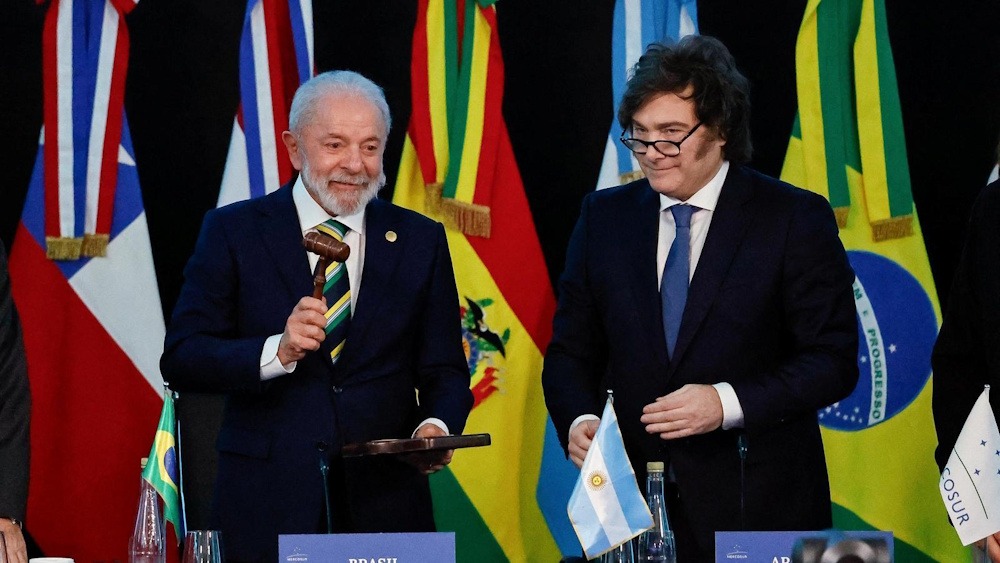
President Javier Milei engaged in a confrontation with Brazilian President Luiz Inácio Lula da Silva during the regional Mercosur summit regarding the situation in Venezuela, coinciding with US President Donald Trump intensifying pressure on Caracas. Sparring remarks from Lula and Milei emerged during a gathering of the South American bloc, where discussions included a prospective trade agreement with the European Union. However, the tensions surrounding Venezuela – which was a member of Mercosur until its suspension in 2016 – have come to the forefront, with Lula cautioning that armed conflict could lead to a “humanitarian catastrophe,” while Milei has expressed admiration for Trump’s aggressive stance on the crisis. The US military has increased its presence in the Caribbean over recent months and has conducted air strikes against purported drug boats in both the region and the Pacific, asserting that it is addressing narcotics trafficking. Venezuelan strongman Nicolás Maduro asserts that the campaign is indicative of a broader initiative aimed at effectuating regime change in Caracas, while Trump indicated this week that he could not dismiss the potential for conflict.
“An armed intervention in Venezuela would be a humanitarian catastrophe for the hemisphere and a dangerous precedent for the world,” Lula stated. However, Milei – a staunch supporter of Trump – subsequently offered his perspective on the matter, stating, “Argentina welcomes the pressure from the United States and Donald Trump to free the Venezuelan people.” The period for a cautious stance regarding this issue has elapsed. The US government has leveled accusations against Maduro, asserting that he heads the “Cartel of the Suns” (“Cartel de los Soles”), an alleged narco-trafficking organization, a claim he refutes. Trump has announced a blockade on oil tankers subject to sanctions that are departing from or arriving in Venezuela. Argentina, Brazil, Paraguay, and Uruguay anticipated that they would finalize an agreement with the EU on Saturday to establish the world’s largest free trade zone, a sentiment shared by EU Chief Ursula von der Leyen and the majority of the European bloc’s member states. Nevertheless, the agreement encountered significant resistance from agricultural stakeholders, particularly in France and Italy, and has consequently been deferred until January. “Without political will and courage on the part of leaders, it will not be possible to conclude negotiations that have dragged on for 26 years,” Lula stated in his opening remarks.
“We possess the opportunity to convey a significant message to the world advocating for multilateralism, while simultaneously strengthening our strategic stance in an increasingly competitive global landscape,” Lula stated to the audience. “However, Europe has yet to reach a decision.” The leftist leader indicated that he had received correspondence from EU leaders conveying their assurance that the deal would gain approval in January. A source within the European Commission, along with two unnamed diplomats, indicated that the anticipated signing date has been scheduled for January 12 in Paraguay. Negotiations initially commenced regarding a deal in 1999, and there is widespread concern that this may represent the final opportunity. Paraguayan Foreign Minister Rubén Ramírez stated that neither he nor his Brazilian counterpart Mauro Vieira had knowledge of any “official communication” regarding the issue. The agreement is poised to enhance the European Union’s capacity to export a greater volume of vehicles, machinery, wines, and spirits to Latin America. In exchange, it would enable the influx of South American meat, sugar, rice, honey, and soybeans into Europe. Several EU countries, including Germany and Spain, express enthusiasm regarding a pact that has the potential to enhance exports amid ongoing global trade tensions. However, the proposed deal has raised concerns among farmers who worry about being undermined by an influx of less expensive products from the agricultural powerhouse Brazil and its neighboring countries. In addition to Lula and Milei, the summit in Foz do Iguaçu was attended by Uruguayan President Yamandú Orsii and Paraguay’s Santiago Peña, a location notable for its proximity to one of the world’s largest waterfall systems along the Argentine border.
Bolivia has recently attained full membership in Mercosur; however, it remains outside the associated trade agreement. Milei utilized his address at the Mercosur to advocate for “comprehensive institutional reform.” The La Libertad Avanza leader reiterated that “flexibility is an asset, not a threat,” advocating once more for the liberalisation of the bloc’s rules. “It is up to this bloc to decide whether to move with this tailwind or cling to the mast of the past to fight against the change that our countries need and demand,” the head of state stated, alluding to the recent victory of his far-right ally in Chile, José Antonio Kast, who won this month’s run-off election and will assume office next March. Milei expressed concerns that “there is no common market, no effective free movement, no macroeconomic coordination,” nor “sufficient openness to the world” within Mercosur. Argentina’s leader championed “comprehensive institutional reform,” aiming to “reduce the economic cost” of the bloc, asserting: “Integration should serve free trade, not bureaucracy.” The president stated that when Mercosur “tries to move forward in a monolithic manner, opportunities are lost,” referencing the example of the stalled EU deal. After decades of negotiations, a trade agreement remains elusive. “The elapsed time does not align with the requirements of our nations,” he stated, directly addressing the agreement.