
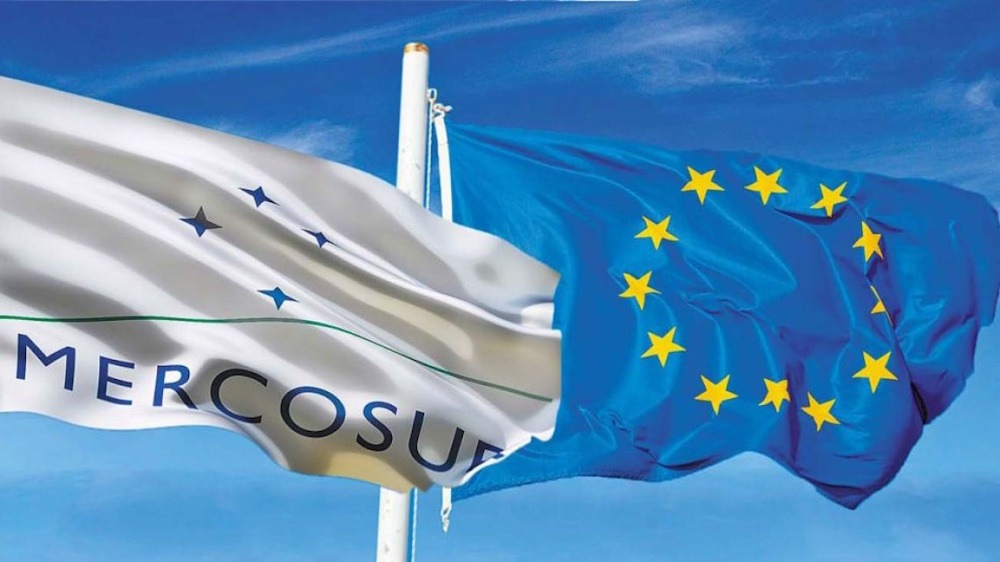
The European Union is set to provisionally implement its trade agreement with the Mercosur bloc of South American nations, despite apprehensions expressed by certain legislators who have referred the agreement to the union’s highest judicial authority for evaluation. Ursula von der Leyen, president of the European Commission, defended the decision, “gives Europe a strategic first mover advantage in a world of sharp competition and short horizons” asserting that the agreement. “Provisional application is, by its nature, provisional,” von der Leyen stated. “The agreement can only be fully concluded once the European Parliament has given its consent.”
French President Emmanuel Macron, who has expressed skepticism regarding the agreement, characterized the decision as a “bad surprise” during an event in Paris on Friday. The trade minister of the country, Nicolas Forissier, articulated in a statement that the development “constitutes a questionable method and a legitimate source of concern for our farmers as well as for our fellow citizens.” The agreement has encountered strong resistance in Europe, especially from nations with substantial agricultural sectors, notably France; however, a majority of EU member states have supported it, facilitating its ratification.
The announcement follows the ratification of the deal by Argentina and Uruguay, a development that received commendation from European Council President António Costa. Brazil and Paraguay represent the additional members of the Mercosur bloc that have entered into the agreement with the EU. The EU and Mercosur finalized one of the largest free-trade agreements globally in January, concluding a protracted negotiation process that spanned 25 years. The agreement will establish a unified market encompassing 780 million consumers, thereby reinforcing Europe’s position in a resource-abundant area that is becoming increasingly competitive between the United States and China.
The agreement continues to encounter an obstacle at the European Union’s highest court, following a decision by legislators in the bloc’s parliament to refer it for judicial examination. Nevertheless, Bernd Lange, the head of the parliament’s influential trade committee, characterized the decision to implement the deal provisionally as “the right one.” The European Commission has stated that the provisional application by the EU will commence on the first day of the second month subsequent to the formal diplomatic communication exchanged between the EU and Uruguay. The agreement would subsequently extend to all Mercosur nations that have ratified the accord.