
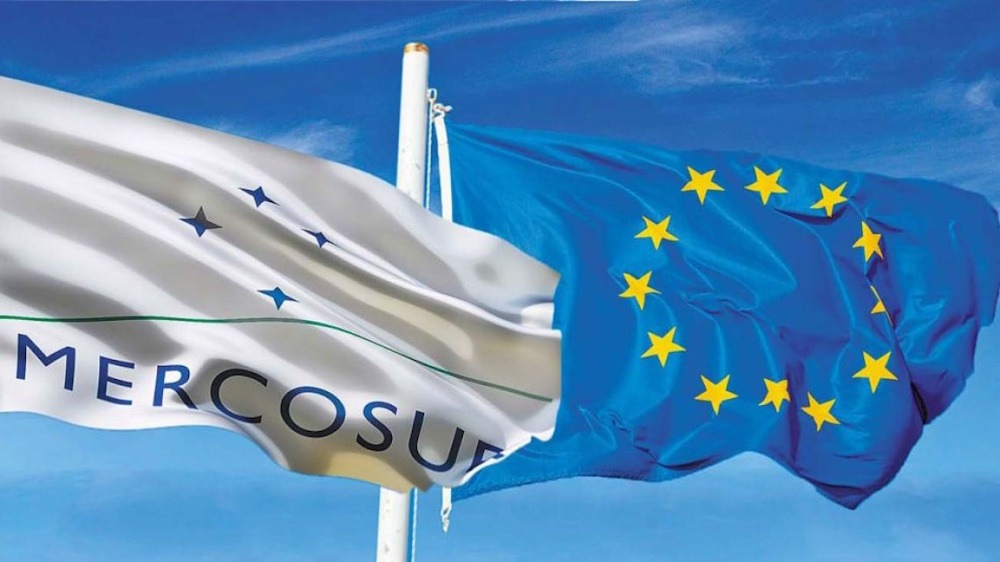
On Friday, representatives of the European Union’s member states convened in Brussels and cast their votes in favor of a free trade agreement with the Mercosur bloc, which comprises Argentina, Brazil, Paraguay, and Uruguay. A significant number of the EU’s 27 member states approved the agreement following 26 years of negotiations. This sets the stage for the establishment of the largest free-trade area globally, encompassing over 715 million people (447 million in the EU and 270 million in Mercosur). European Commission President Ursula von der Leyen is anticipated to visit Asunción on Monday to formalize the treaty signing. Paraguay is presently in charge of the pro tempore presidency of the South American bloc.
Nevertheless, the trade agreement must subsequently receive ratification from the national parliaments of both EU and Mercosur member states before it can take effect in each respective country. Supportive states, spearheaded by Germany and Spain, have consistently contended that the agreement will facilitate access to new markets; conversely, the deal’s detractors, primarily France, have cautioned that it would subject EU farmers to inequitable competition from agricultural imports originating in Latin America.
France, Hungary, Ireland, Poland, and Austria opposed the agreement with Mercosur. However, they were unable to assemble the “blocking minority” — which constitutes 35% or more of the bloc’s population — required to halt the agreement. Observers indicate that the pivotal factor for the approval was the backing of Italy. In December, Italian Prime Minister Giorgia Meloni exhibited hesitation and postponed the vote; however, she has now endorsed the agreement following the EU’s commitment to additional measures aimed at supporting European farmers. A significant demonstration took place in Brussels, where farmers obstructed roads in anticipation of the vote. Tractor convoys have similarly caused significant disruptions to traffic throughout Belgium, France, and Greece. On Thursday, leaders from France, Hungary, and Ireland declared their intention to oppose the deal. French President Emmanuel Macron stated that despite the concessions obtained during the negotiations regarding the accord, there remained a “unanimous political rejection of the agreement” in France.
Hungary’s Foreign Minister Péter Szijjártó remarked that the agreement would “open Europe to unlimited imports of South American agricultural products at the expense of the livelihoods of Hungarian farmers.” Nonetheless, the nations that opposed the agreement on Friday did not constitute a “blocking minority,” a designation that would necessitate the involvement of at least four EU member states accounting for a minimum of 35% of the population. Although five countries expressed opposition to the deal, their total populations account for merely approximately 29% of the European Union’s population. The European Commission’s vote, initially anticipated for December, faced a delay due to fluctuating support from Italy. Italy’s population stands at 59 million, and the opposition’s numbers would have sufficed to establish a blocking minority. The vote was cast in favor on Friday.