
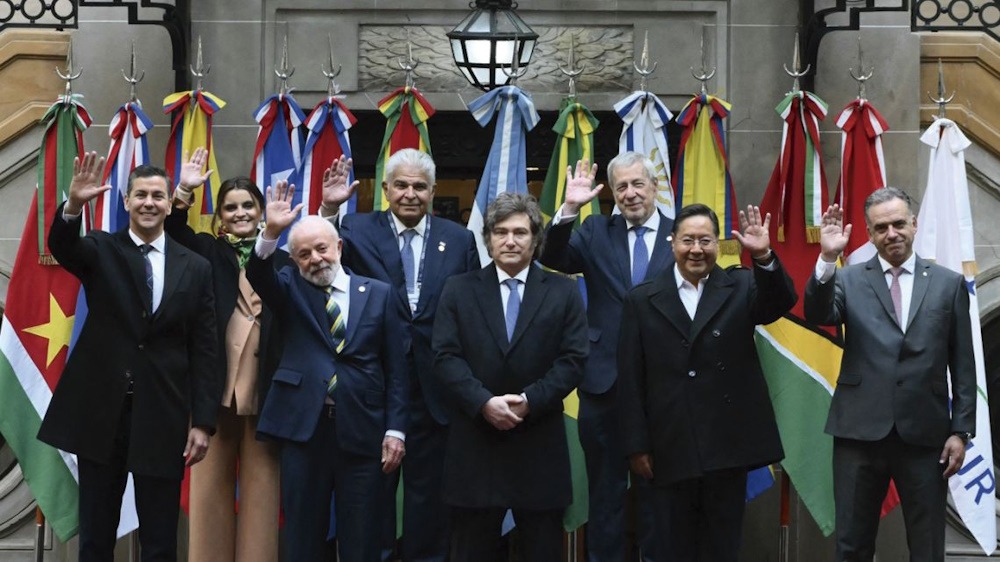
After 26 years of negotiations marked by numerous setbacks that jeopardized its success, representatives from the Mercosur countries and the European Commission formalized the EU-Mercosur trade agreement during a ceremony held in Asunción, Paraguay, on Saturday. The agreement establishes the largest free-trade area globally, encompassing over 715 million individuals. Regional leaders on both sides of the Atlantic have endorsed it as a significant demonstration of multilateral cooperation, peace, and free trade, particularly as global powers like the U.S. shift towards protectionism and a perspective shaped by spheres of influence. Nonetheless, the agreement has encountered resistance stemming from concerns regarding price suppression and potential detrimental effects on local industries in South America. In his capacity as the rotating leader of Mercosur, Paraguayan President Santiago Peña remarked to the audience: “We could have reached an even better deal, we could have got more benefits for our presidents. For that reason, I would like to challenge you all: let us look to the future with greater courage, with greater audacity, and let us expand even further our perfectible union in a complex world, in which old certainties are wavering before our eyes.” He urged that South America and Europe should be “not just spectators, but the main actors in the history of humanity.” In a significant development, Maroš Šefčovič, the European Commissioner for Trade and Economic Security, formalized the agreement with the foreign ministers of the Mercosur nations shortly before 2 p.m. during a ceremony held at the Central Bank of Paraguay.
For all components of the agreement to take effect, they must now receive approval from the parliaments of each participating nation. However, the trade provisions are anticipated to be implemented sooner due to a more straightforward approval process. European Commission President Ursula Von der Leyen stated during the ceremony that “almost 20% of the global GDP is being traded here.” This is remarkable. This conveys a distinctly unequivocal message to the global community. […] We will collaborate in unprecedented ways, as we are convinced that this represents the most effective approach to ensure the prosperity of our citizens and our nations. “And when two regions like ours speak with one voice on global issues, the world will be listening.” Exports from Mercosur to the EU are projected to increase by 9 billion euros annually, as noted. Argentine President Javier Milei marked the occasion of the agreement’s signing, indicating his intention to submit it to Congress for ratification in the extraordinary sessions scheduled for February. However, he also reiterated the necessity for trade to be subjected to minimal barriers. “The incorporation of mechanisms that restrict that access, such as safeguarding quotas or equivalent measures, will significantly reduce the economic impact of the agreement, which would go against its essential goal,” he stated. Argentine President Javier Milei addresses attendees at the signing ceremony for the EU-Mercosur Association Agreement in Asunción, Paraguay, on January 17, 2026. This and cover image: provided by the delegation of the EU to Argentina.
“As a harbinger of a dystopian future, Argentina recognizes that isolation and protectionism, upheld by rhetoric rather than tangible outcomes, are primary drivers of economic stagnation and escalating poverty.” The European Union’s delegation to Argentina is set to convene an EU-Argentina Trade and Investment Forum on June 1-2, aimed at examining investment prospects and delving into value chain opportunities. Brazilian President Luiz Inácio Lula da Silva was absent from the signing, delegating the responsibility to Foreign Minister Mauro Vieira. Peña remarked in a press conference that Lula’s absence created “a bitter taste,” as the agreement would not have materialized without his involvement. However, he recognized that his Brazilian counterpart faced a complicated schedule due to the impending elections in the country. On stage were President Yamandú Orsi of Uruguay, European Council President António Costa, President Rodrigo Paz of Bolivia, and President José Mulino of Panama. Bolivia is not currently a party to the deal as it only attained full Mercosur membership in 2024, coinciding with Panama’s status change to associate member in the same year. Paz committed to advocating for Bolivia’s prompt accession to the agreement. Although commonly referred to as a trade deal, the free trade provisions are actually components of a more comprehensive association agreement. The agreement will encompass a gradual decrease in tariffs affecting over 90% of bilateral trade between the blocs, alongside a range of commitments pertaining to political cooperation, investment, and environmental considerations.
Farmers and politicians in European nations, including France and Poland, express concerns that the agreement may inundate their markets with inexpensive agricultural products. Critics in South America contend that the agreement will promote the export of raw materials to Europe while facilitating the import of sophisticated, value-added manufactured goods in exchange, thereby perpetuating a “colonial” dynamic. The parties have sought to mitigate these concerns by progressively reducing tariffs on industrial goods imports in South America over an extended timeframe. They also negotiated safeguards in European agricultural markets should prices start to experience volatility. The leaders of the blocs had anticipated finalizing the deal prior to the conclusion of 2025; however, emerging uncertainties, primarily concerning political backing from Italy, resulted in a postponement of one month. The EU-Mercosur agreement was initially reached in principle in 2019; however, its implementation faced a delay of an additional five years as European negotiators pursued enhanced commitments from their South American counterparts, particularly concerning environmental standards and the issue of Amazon deforestation. Analysts indicate that advancements have been achieved following Brazil’s governmental transition from the far-right Jair Bolsonaro, who actively dismantled protections for the world’s largest rainforest, to Da Silva. The leaders ultimately declared that they had finalized an agreement on December 6, 2024.