
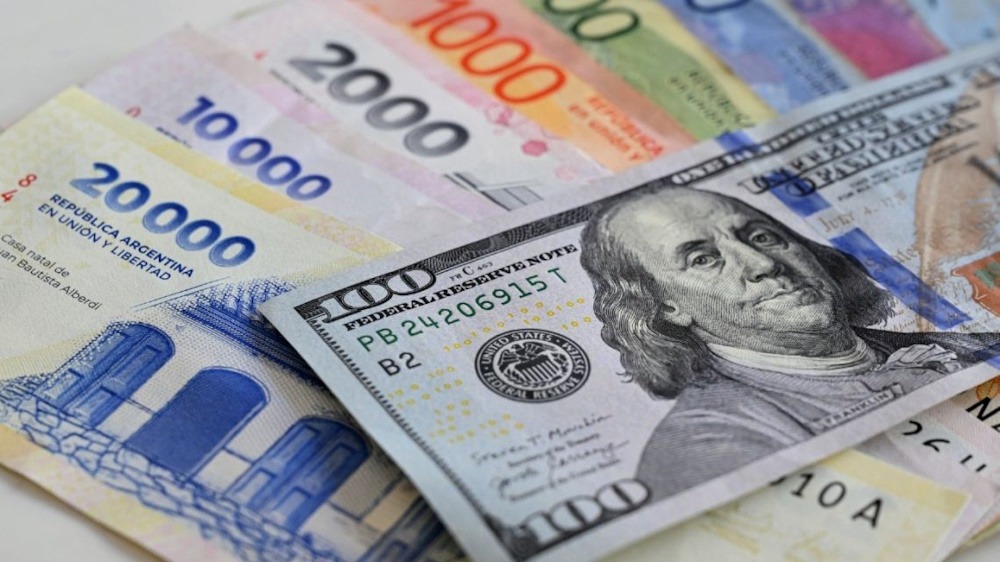
While Javier Milei’s administration has consistently highlighted the removal of currency controls, this assertion pertains solely to retail transactions involving the official dollar. Even today, various restrictions persist regarding the acquisition of foreign currency. Consequently, a variety of dollar exchange rates persist in parallel. One of the most recognised is the so-called blue dollar, the U.S. currency exchanged in Argentina’s informal market. However, it is not the most significant exchange rate, as its circulation is confined to transactions occurring outside the legal framework. The official wholesale dollar stands as the pivotal rate for assessing demand levels and financial tensions, functioning as a benchmark for foreign trade prices and the issuance of dollar-denominated bonds. The second most important is known as the CCL dollar (cash-with-liquidation), a rate that operates in the stock market and also facilitates the transfer of funds abroad.
During periods of stringent currency controls, the disparity between various dollar exchange rates frequently surpassed 100%. Historically, markets have interpreted this spread as an indication of expectations for future increases in exchange rates. The challenge facing Milei’s administration is that, following a prolonged interval where the exchange rates were nearly aligned, the spread has started to increase once more in recent trading sessions. The CCL dollar has appreciated nearly 13% thus far in 2026, currently valued at AR$1,716, whereas the wholesale dollar has increased by only 7%, now standing at AR$1,559. As a result, analysts explained in a report to clients that the gap “widened to its highest level since late September and early October 2025, when it had exceeded 10% ahead of the midterm elections.” They also noted that, as the October 2027 presidential election approaches, “these spreads are likely to continue showing signs of pressure.” The issue, however, is more intricate for the Argentine economy. The wholesale exchange rate at its current levels is exerting considerable pressure on numerous Argentine exports, as the peso’s relative appreciation against the dollar diminishes the competitiveness of locally produced goods in international markets.
For instance, a study conducted by consulting firm LCG indicates that following Lula da Silva’s victory in Brazil’s presidential runoff, the Argentine peso has appreciated by 13% against the Brazilian real, attaining its highest value since April 2025. “In addition to the real’s depreciation, this is the result of a wholesale dollar that has risen just 6% so far this year, compared with cumulative inflation of 26%,” the report explained. This is having negative effects on many productive sectors, including regional economies and integrated industrial sectors such as the automotive industry. These sectors “may require more adequate margins to better manage the transition toward a more open economy.” This situation poses a challenge for Milei’s government, since the Central Bank of Argentina’s main way of narrowing the exchange-rate gap would be to ease currency restrictions – “something highly unlikely in an election year,” according to PPI’s report.
In a related assessment, FIX SCR – Fitch Ratings’ local subsidiary in Argentina, Uruguay and Paraguay – argued that 2027 would bring “greater uncertainty, reflected in increased volatility,” particularly in the foreign exchange market. The firm anticipates a shift toward dollar-denominated assets in the run-up to the elections, which would exert pressure on the exchange rate, BCRA reserves, and interest rates as authorities strive to maintain demand for pesos. Although analysts expect Milei to be reelected “without too many surprises” under their baseline scenario, they anticipate renewed foreign-exchange “noise,” following a pattern similar to 2025, which would result in a moderate increase in inflation. Under this scenario, the wholesale dollar would reach AR$2,032 by December 2027, indicating an increase of over 28% from current levels.
