
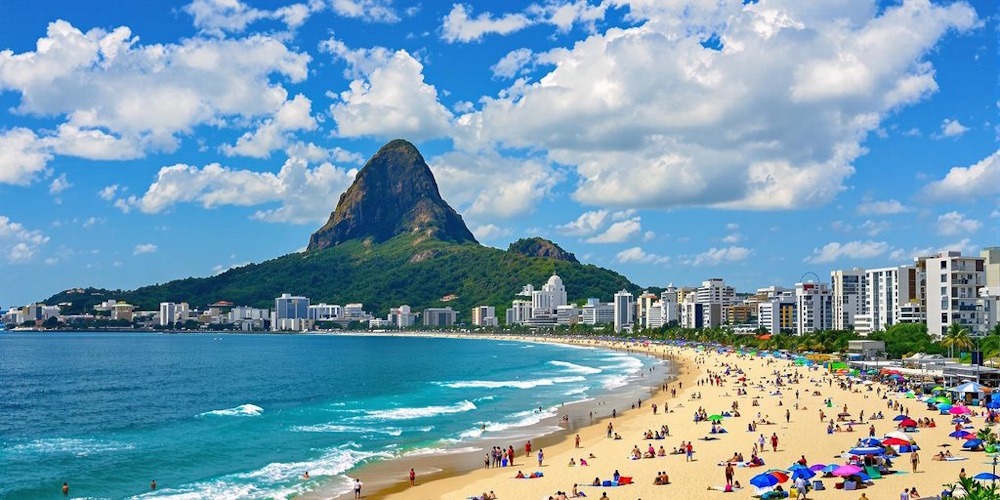
Recent data indicates that Argentines are increasingly opting for the beaches of Brazil over traditional local holiday resorts. President Javier Milei’s administration has altered the methodology for assessing visitor levels, asserting that the domestic coastline is experiencing a surge. This assertion has faced backlash from tourism professionals who contend that the industry is struggling significantly. Recent figures from Brazilian tourist authorities indicate that there was a 72% increase in the number of Argentines visiting Brazil in 2025, totaling 3.4 million compared to the previous year. In both years, the largest contingent of tourists in Brazil was comprised of Argentines. Critics of the Milei administration argue that the artificially strong peso results in lower costs for holidays abroad compared to local destinations, thereby negatively impacting Argentine businesses. In the meantime, officials have lauded what they describe as a robust season along the coastline of Buenos Aires province.
“It’s the best summer season in at least 25 years,” stated Javier Lanari. “The primary tourist destinations in Argentina are experiencing a significant influx of visitors.” Tourism Secretary Daniel Scioli noted that hotels in Mar del Plata, Argentina’s primary coastal destination, reached full occupancy on January 1, and shared a photograph depicting a beach in the city teeming with visitors. However, the photograph was subsequently disclosed to be over ten years old. Tourism is shifting from Argentina to Brazil in response to changing exchange rates. “The season in Mar del Plata has been poor overall,” stated Juan Manuel Cheppi. “When the government mentioned ‘full occupancy’ in early January, it was alluding to particular dates within the first week.” While hotels were fully booked during that week, he noted that the overall situation for the season presents a contrasting picture.
Mar del Plata’s tourist board reports that hotel occupancy during the second weekend of January ranges from 60 to 65%, a significant decline from the 100% occupancy celebrated by Scioli over the New Year. The average duration of stay decreased to 3.5 nights, marking the lowest level since the inception of record-keeping, while tourism expenditure declined by approximately 30% relative to 2025. “Those numbers clearly show that Mar del Plata is experiencing its worst hotel activity in 21 years,” stated Cheppi. In November, Argentina experienced a 3% decline in visitors, while there was a 15% increase in the number of Argentines traveling abroad compared to the previous year, as reported by the INDEC statistical bureau. Brazil emerged as the leading destination, attracting 167,000 visitors from Argentina. “The primary rationale is economic — the framework adopted by Milei’s administration has resulted in a significant reduction in purchasing power, increased the cost of domestic tourism, and created relative prices that distinctly advantage foreign tourism,” Cheppi conveyed. “Record numbers of Argentines traveling to Brazil indicate that the issue lies not in insufficient tourist demand, but in the erosion of competitiveness within the domestic market.” The national government is closely monitoring the methodologies employed in measuring outbound and inbound tourism statistics.
The Tourism Secretariat has reduced funding to the INDEC starting in January, which implies a decrease in the frequency and depth of tourism statistics measurement compared to previous practices. “The Institute will make every effort to keep as many sector indicators as possible available to users,” it stated. Furthermore, local media have indicated that Scioli intends to introduce an index of his own, circumventing the INDEC. Cheppi indicates that the tension “reveals that even within the government, they know that the official numbers do not support the optimistic narrative.” Furthermore, Scioli expressed gratitude to the Central Bank for its revision of the methodology used to compute the tourism balance — specifically, the differential, quantified in U.S. dollars, between incoming and outgoing tourism. Since June, the Central Bank has categorized “digital services,” including payments on streaming or e-commerce platforms, distinctly from traditional tourist expenditures, such as travel, tickets, and credit card expenses abroad. The previous approach would result in a negative tourism balance of US$10 billion, whereas the revised strategy yields a negative balance of US$7 billion, as stated by the Tourism Secretary on X.