
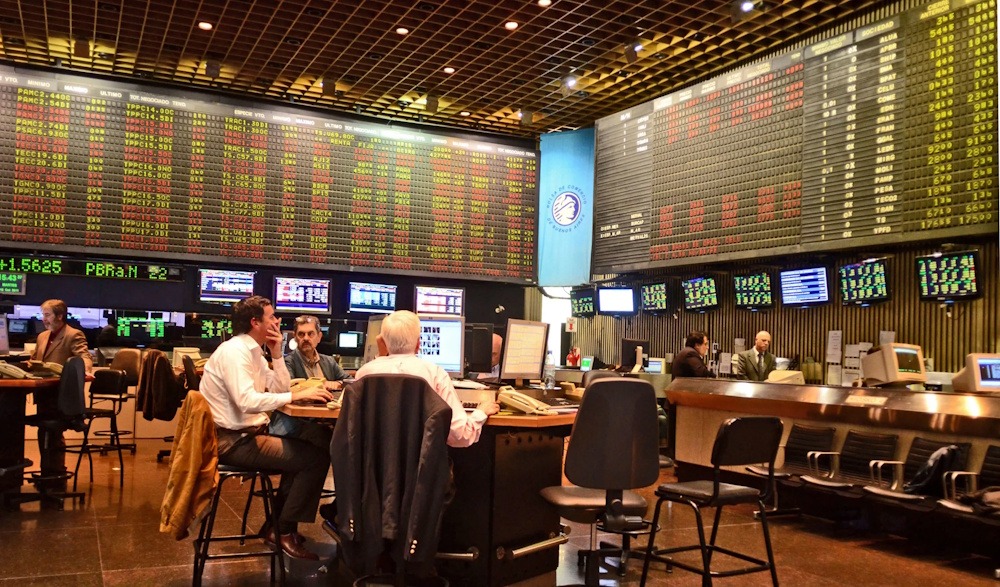
Argentine stocks are lagging behind the broader rally in Latin American equities this year, as the previous market enthusiasm surrounding President Javier Milei’s electoral successes diminishes amid worries regarding disappointing corporate earnings. Following the surge in shares after Milei’s midterm election victory in October, the benchmark Merval index stabilized and subsequently experienced an eight percent decline this year. In contrast, the MSCI Latin America index has experienced a rally exceeding 20 percent during the same timeframe, marking its most robust beginning to a year since 1994. Investors have praised Milei for reducing fiscal expenditures and curbing Argentina’s excessive inflation; however, these achievements have not yet resulted in a sustainable increase in profits. Despite the economy’s recovery from the 2024 recession, growth has not achieved sufficient momentum to support a vigorous earnings cycle – presenting a challenge for equities that are already priced at elevated multiples, analysts indicate. “Stocks require unequivocal indicators of a subsequent phase – enduring economic expansion, recovery in earnings, and enhanced regulatory certainty,” stated Carolina Volman. “Equities remain in anticipation of a growth cycle that could underpin a more sustainable increase in multiples.”
Even billionaire Stanley Druckenmiller has divested his Duquesne Family Office’s stake in a prominent Argentina exchange traded fund following its peak, redirecting capital to Brazil instead. Corporate earnings experienced a downturn due to financial volatility in Argentina last year, exacerbated by declining commodity prices. The turbulence preceding the October elections has led to the weakest results for publicly traded banks since the pandemic, with major lenders like Grupo Financiero Galicia and Macro reporting losses in the third quarter of the year. Concurrently, the nation’s loan delinquency rate has surged to its highest level in a minimum of 15 years, coinciding with a significant contraction in lending activities. Even energy companies, the primary beneficiaries of Milei’s new export-oriented growth model, reported mixed results. YPF, under state control, recorded a minor loss in the third quarter amid falling global oil prices, whereas Pampa Energía experienced an approximate 50 percent decrease in profits over the first nine months of 2025. MercadoLibre Inc experienced its most significant intraday decline since 2024 on Wednesday, following a fourth-quarter net income that fell short of analysts’ expectations. “The market rallied very aggressively after the midterms and valuations became a little too punchy toward the end of last year,” stated Ola El-Shawarby. The firms within the Merval index exhibit a forward price-to-earnings ratio of 19.8, surpassing Brazil’s Ibovespa at 13.4, Chile’s IPSA at 15.6, and Mexico’s BMV at 15.9, as per data.
According to Ezequiel Fernández Argentine companies are no longer considered “particularly cheap.” “Validating these valuations necessitates a strong belief in robust earnings growth this year.” Attention has shifted to fourth quarter earnings, which began to be released this week, alongside the projections for economic growth. In regard to the latter, the outlook appears unfavorable. The economy is projected to grow by two percent in 2026, a revision from the earlier estimate of 3.2 percent, as Argentina begins the year with “slower momentum,” as noted. The prevailing pessimism persisted despite a recovery in growth observed in December. In response to the prevailing sluggish growth, the government is putting forth tax incentives intended to draw foreign investment, alongside legislation aimed at motivating Argentines to transition their undeclared savings into the formal economy. It is also nearing congressional approval for Milei’s flagship labor reform bill, which aims to relax the notoriously stringent regulations governing hiring and firing practices. However, there are also particular market factors that are exerting pressure on Argentine stocks. Emerging markets have seen inflows exceeding US$50 billion year to date, marking the most robust period in years, as noted by VanEck’s El-Shawarby. A significant portion of that capital has been directed towards exchange-traded funds that replicate benchmark weightings, thereby favoring larger and more liquid markets like Brazil and Mexico.
Argentina’s equity market is comparatively small when assessed against regional counterparts and exhibits a degree of illiquidity, which constrains its capacity to accommodate substantial passive investments. The absence from significant benchmarks exacerbates that limitation. A possible catalyst could be a reclassification by MSCI, which would probably necessitate a long-term removal of capital controls and enhanced access for foreign investors. In 2024, net inflows into the MSCI Argentina ETF amounted to approximately US$630 million, marking the most substantial annual influx in over ten years, driven by Milei’s stabilization efforts that spurred a preemptive rally. However, sustaining the momentum proved to be a challenge. Approximately US$200 million exited in 2025, and the outflows did not promptly reverse, despite Milei’s midterm victory triggering gains. Analysts indicate that the elimination of capital controls, a crucial move for possible re-entry into significant emerging-market indexes, is still quite far off. “We maintain an optimistic outlook on domestic equities,” Fernández stated, “though it may necessitate a longer period of patience than we initially anticipated.”