
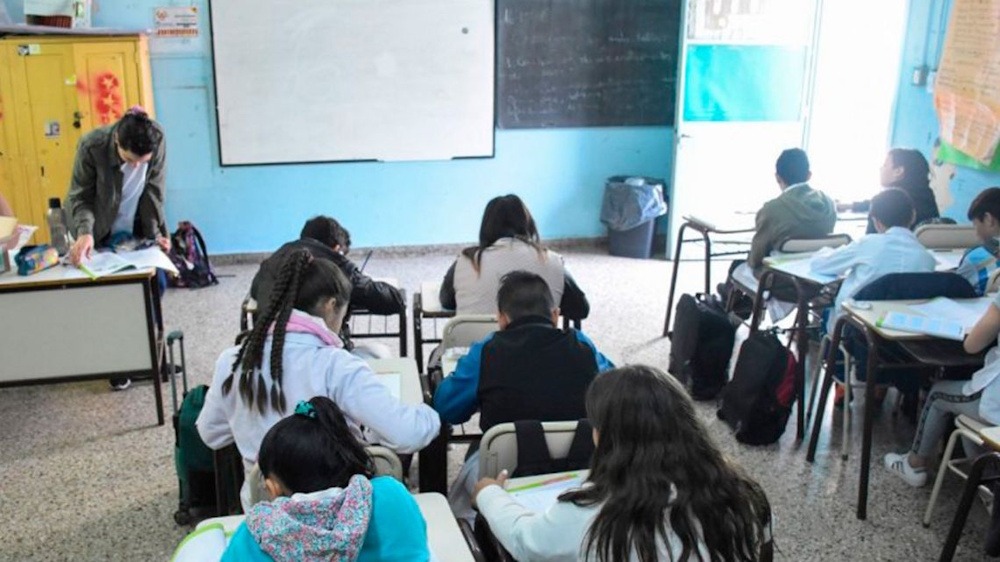
A recent report indicates that Argentina is projected to experience a decline of 1.2 million primary school pupils by 2030 compared to 2023, underscoring the nation’s demographic deceleration. The report, entitled ‘Present and future in the number of students per teacher and grade,’ was developed by María Sol Alzú and Martín Nistal from Argentinos por la Educación, with contributions from economist Martín De Simone. Utilizing projections from the National Population Directorate provided by the Interior Ministry, alongside data from the official Education Secretariat, it anticipates a 27 percent decline in primary enrolment by the decade’s conclusion. The contraction will exhibit uneven distribution. Buenos Aires Province experiences the most significant decrease in absolute numbers, with a reduction of 510,433 pupils, representing a decline of 30.5 percent. Buenos Aires City experiences a decline of 34 percent, translating to a reduction of 92,540 students, while Santa Fe observes a 24.5 percent decrease, resulting in 87,770 fewer pupils.
In comparative analysis, the provinces of Tierra del Fuego (decreasing by 36.1 percent), Santa Cruz (decreasing by 34.9 percent), and Buenos Aires City (decreasing by 34 percent) are experiencing the most significant downturns. The provinces of Santiago del Estero, Misiones, and Corrientes are anticipated to experience more moderate, yet still considerable, declines of approximately 20 percent. If the number of teaching staff remains constant, Argentina’s current average of 16 pupils per primary teacher – already near the OECD average of 14 – is projected to decrease to 12 by 2030. Certain provinces, such as Catamarca, Buenos Aires City, and La Pampa, may experience pupil-to-teacher ratios as low as seven to eight. Buenos Aires Province, Mendoza, Córdoba, and Misiones are projected to maintain elevated levels, ranging from 13 to 15. In a regional context, Argentina’s current figures surpass those of Uruguay (15), yet fall short of Mexico (24), Colombia (23), Ecuador (22), and Brazil (18).
The report projects that sustaining existing ratios would necessitate a reduction of 50,043 classes across the country and the redistribution of 71,250 teaching positions by the year 2030. The annual value of those positions is estimated at 966.3 billion pesos, which constitutes approximately 15 percent of the 2025 Education budget. The declining birthrate, as noted by the study’s authors, embodies both risks and opportunities. The decline in the birthrate in Argentina may yield a variety of implications, encompassing both adverse and beneficial outcomes. “In the education system, however, it opens an opportunity: without increasing the total expenditure, it is possible to allocate more resources per student,” De Simone said. “The risk is that this window of opportunity will be wasted if the focus is not placed squarely on learning.”
Researchers caution that the effects will vary significantly between the public and private sectors. Public school budgets are determined through administrative processes, whereas private institutions rely heavily on enrolment figures and may face challenges in maintaining extensive infrastructures. The report emphasizes the necessity for medium-term planning and systemic dialogue, advocating for the reorganization of low-enrollment classes, the redirection of teachers towards targeted support programs, and strategic investments in materials, infrastructure, and evaluation. The authors conclude by emphasizing that “demographic transition demands medium-term planning, with dialogue mechanisms among the different players of the education system.”