
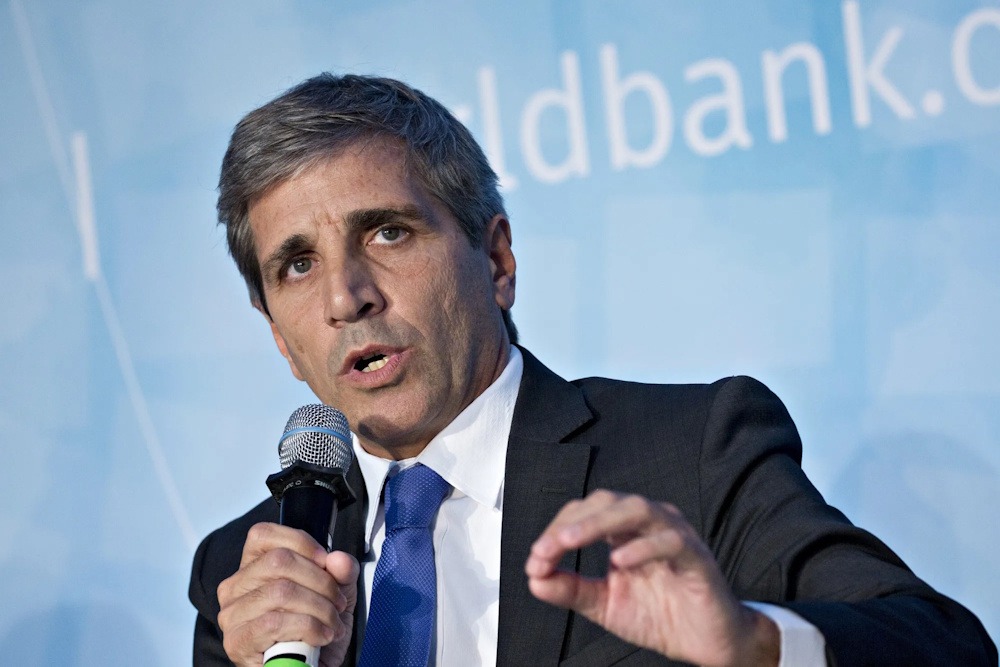
Argentina is in discussions with banks regarding a potential loan of up to US$7 billion, as stated by Economy Minister Luis Caputo on Wednesday, in light of decreasing international reserves and upcoming debt obligations in January. During an event featuring prominent business leaders, the official discussed negotiations amounting to between US$6 billion and US$7 billion with several private institutions. “The banks have presented us with offers of US$6 billion, US$7 billion… and we are currently evaluating how much we will accept. Whether it’s zero, US$1 billion, US$2 billion, US$3 billion, US$4 billion, we’ll see,” Caputo stated. “We aim to guarantee that the January coupon payments do not diminish the reserves,” Caputo stated. Reports indicate that the debt maturities are projected to be approximately US$4.2 billion. In April, Argentina engaged in a new US$20-billion program with the International Monetary Fund. The Washington-based lender has requested the government to undertake “additional efforts” in building international reserves, which, as of December 3, were reported at US$41.9 billion by Argentina’s Central Bank.
Caputo refuted claims regarding Argentina’s negotiations for a US$20-billion loan with private banks, indicating that the figure had subsequently been lowered to US$5 billion. “The likelihood of banks extending a loan of US$20 billion to Argentina is nonexistent. It was a lie,” he stated. In October, US Treasury Secretary Scott Bessent proposed a $20-billion loan following the signing of a separate US financing agreement for Argentina for the same amount. “We weren’t engaging with banks to secure a US$20-billion loan; rather, we were in discussions with the United States … and two other countries,” Caputo stated, elucidating that this was the context of Bessent’s remarks. Caputo did not clarify which additional two countries he was alluding to. He stated that Argentina’s country risk rating, monitored by JP Morgan, is expected to decline in the upcoming weeks, contingent upon the establishment of a deal. It is positioned at 639 points.
Caputo’s remarks instilled confidence among investors and ignited interest in Argentine equities listed on the New York Stock Exchange. Certain shares experienced increases of as much as nine percent, indicative of prevailing confidence. In concluding the summit, President Javier Milei emphasized the significance of fiscal balance and aimed to differentiate his administration from that of former president Mauricio Macri (2015-2019). He contended that under the Cambiemos administration, “fiscal adjustment did not take place – it was never corrected, only corrected through indebtedness.” The President suggested that “economists are part of the problem” facing Argentina.
Milei stated that his primary objective is to eradicate any increase in the cost of living. “We don’t want to see any more inflation in Argentina,” he stated, emphasizing that economic decisions are aimed at solidifying that trajectory. He also expressed criticism towards certain sectors of economic and political power that, in his perspective, oppose the government’s programme, stating he has “to report to 47.5 million Argentines.”