
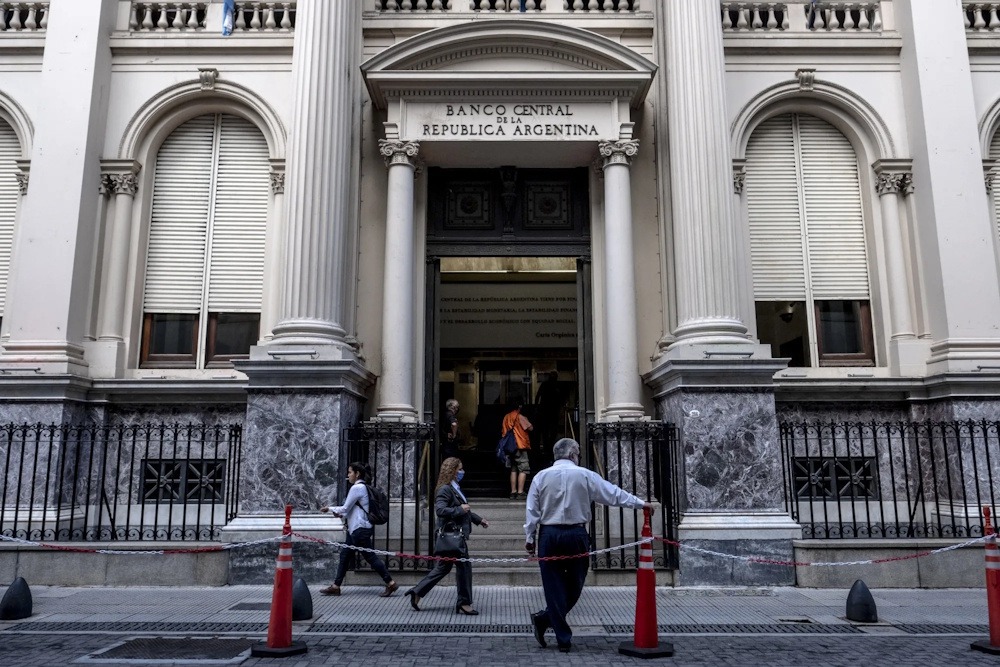
Argentina has relaxed its currency trading restrictions and announced plans to rebuild foreign reserves, capitalizing on the increasing investor confidence in President Javier Milei’s administration to stabilize its precarious financial situation. Starting in 2026, the trading bands for the peso will adjust in accordance with the monthly inflation rate, rather than the existing one percent increment. In November, prices experienced a 2.5 percent increase, indicating that the bands may expand at a rate exceeding twice the current pace in the short term. The Central Bank is set to commence the accumulation of its reserves, with plans to purchase US$10 billion in the upcoming year under a base case scenario, a figure that may increase contingent upon monetary demand, as stated in a release on Monday. Initially, reserve purchases “will be aligned with” up to five percent of the daily volume in Argentina’s currency markets. The monetary authority may also engage in block trades to acquire dollars.
According to Central Bank Governor Santiago Bausili, Argentina’s currency policy of trading bands continues to represent the “best regime” for the economy, with recent adjustments to the bands still consistent with a trajectory toward reduced inflation, as stated. Bausili stated that the International Monetary Fund and the US Treasury were informed of Argentina’s policy changes. The Argentine Treasury’s involvement in the currency market – having acquired US$320 million outside the market on Monday – has been “very tied to meeting debt maturities,” Bausili stated, further noting that once the country regains access to international capital markets, the necessity for dollar purchases will decrease. Argentina’s sovereign bonds experienced a notable increase across the curve following the announcement. Notes maturing in 2035, characterized by high liquidity, experienced an increase of over one cent, reaching nearly 73 cents on the dollar. The yields on the debt currently exceed 10 percent, a threshold that officials have indicated to investors would be acceptable for the issuance of new bonds.
The nation has remained excluded from the market following its third default this century, which occurred during the pandemic. Milei, a proponent of libertarian economic principles, has prioritized regaining access to debt investors by early 2026 since assuming office in 2023. A resurgence would provide the nation with a much-needed influx of dollars to address its foreign debt obligations, which amount to approximately US$4.5 billion due in January, with a comparable sum expected in July, while also aiding in the restoration of its diminished hard-currency reserves. The recent measures respond to investor demands for a more adaptable foreign exchange policy, as analysts have cautioned about the overvaluation of the currency throughout much of Milei’s initial two years in office. Their significance marks the most substantial policy shifts since Argentina concluded its US$20-billion agreement with the International Monetary Fund in April. Officials from the IMF have recently indicated that it will be “challenging” for Argentina to achieve the forthcoming target in the program aimed at accumulating reserves, a situation that would necessitate the approval of an additional waiver by the lender’s board. The government was granted a waiver earlier this year for failing to meet the same target. On Monday, the IMF expressed approval of Argentina’s policy adjustments.
“It’s a positive step in the normalisation direction,” stated Alejandro Cuadrado, noting that the peso could experience some weakening due to the policy change. The announcement was made subsequent to the closure of local markets, with the peso valued at 1,438.5 against the US dollar. Milei is approaching the latter half of his mandate with revitalized momentum following a significant victory in Argentina’s congressional midterm election in October. A new Congress was sworn in last week, with Milei’s libertarians establishing themselves as the predominant faction in the legislature as he seeks to implement significant labor reform and an annual budget. Prior to the vote, Milei’s economic team focused on defending the peso and controlling inflation, even if it meant forgoing the accumulation of reserves. Analysts viewed the policy pivot as a favorable development that is expected to enhance bond prices. “This appears to be an acknowledgment that the existing reserve accumulation strategy has been inadequate, and they are attempting to adjust it to enhance the rate of reserves accumulation,” stated David Austerweil, describing it as “credit positive.” Reserve accumulation of “anywhere between US$10 billion and US$15 billion next year is very positive,” he noted.