
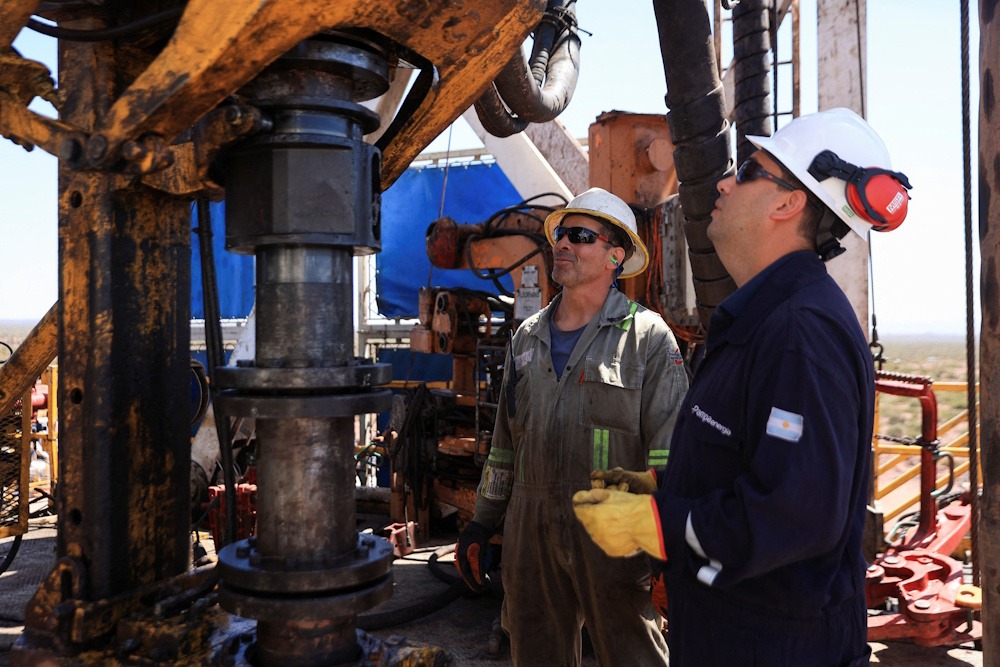
The conflict between the United States and Iran is driving up global oil and gas prices, yet Argentina is starting to reap the rewards. The increasing production from Vaca Muerta is transforming the nation into a net energy exporter, enabling it to capitalize on a global energy crisis that would have previously burdened its economy. Following years of investment and infrastructure challenges, Argentina’s unconventional oil and gas boom is beginning to alter its external position. Rather than merely exacerbating the vulnerabilities of a delicate economy, elevated energy prices are now yielding a substantial export boon and enhancing the trade perspective. In February, Argentina’s oil production increased by 15.8 percent compared to the previous year, reaching 874,000 barrels per day. This growth was primarily fueled by unconventional shale output from Vaca Muerta, as reported by the Economy Ministry. According to the Chamber of Exploration and Hydrocarbon Production, known as EPH, oil production is projected to increase to one million barrels per day by the beginning of 2030.
“The shift is more structural than cyclical, driven by unconventional oil exports from Vaca Muerta,” stated Martín Castellano in an interview. According to Castellano, Argentina has the potential to establish itself as a dependable energy exporter, provided that market participants gain confidence in the stability of the regulatory framework overseeing the oil and gas sector, irrespective of the administration in power. Brazil, akin to Argentina, stands to gain from enhanced export revenues and better external balances as net energy exporters, although some of that advantage may be mitigated by increasing fertilizer and other input costs. The Institute of International Finance estimates that each US$10 rise in oil prices results in approximately US$4 billion in gains for Brazil, which corresponds to roughly 0.2 percent of GDP. The institution estimates that Argentina will require approximately US$1.7 billion, which represents around 0.25 percent of its GDP. The comparison highlights the significant shift in Argentina’s standing – whereas Brazil’s offshore pre-salt production has historically positioned it as a beneficiary of oil shocks, Vaca Muerta is now advancing Argentina into comparable territory. In contrast to a few years prior, a similar increase in prices that would have undermined Argentina’s external position now serves to bolster it.
The transformation is already becoming evident in Argentina’s external accounts. Argentina is projected to achieve an energy surplus exceeding US$14 billion in 2026, an increase from US$12.7 billion in 2025 and US$9.6 billion in the preceding year, as reported. The escalation of oil and gas prices associated with the Iran conflict is expected to further solidify that trend. Brent crude has risen to approximately US$100 a barrel, while WTI stands at about US$101.38 as of March 31 – marking an increase of around 60 percent from the levels observed just prior to the onset of war on February 28. “We believe energy exports should help contain Argentina’s current-account deficit, keeping it to around one percent of GDP in 2026,” Castellano stated. Increased energy prices may additionally bolster other Argentine exports by creating spillover effects on commodities like soybeans and wheat. Nonetheless, there exists a drawback. The increase in global energy prices that enhances Argentina’s export prospects may pose challenges for President Javier Milei in his attempts to reduce inflation. Milei, who assumed office in December 2023 amid Argentina’s struggle with triple-digit inflation, has managed to reduce monthly price increases to below three percent, although a modest uptick has been observed in recent months. Since March 2026, gas and diesel prices have increased by six to nine percent, and the nation’s reliance on imported fertilizers may adversely impact the agricultural sector due to elevated input costs. The IIF indicates that elevated oil prices will pose challenges for headline inflation in Argentina to dip below 30 percent by 2026.
Macroview anticipates that monthly inflation for March will register at three percent, while the annual rate is projected to be 32 percent. Notwithstanding this complication, Argentina is approaching the current oil shock from a significantly more robust position than it has in previous instances. Where elevated energy prices previously primarily exerted pressure on the balance of payments, they now additionally yield a significant increase in exports. While the short-term impact may present a mixed picture, aiding external accounts yet complicating disinflation efforts, the overarching trend is becoming more evident. With the expansion of Vaca Muerta, Argentina is positioning itself as one of the rare nations in the region capable of leveraging disruptions in global energy markets for economic gain.