
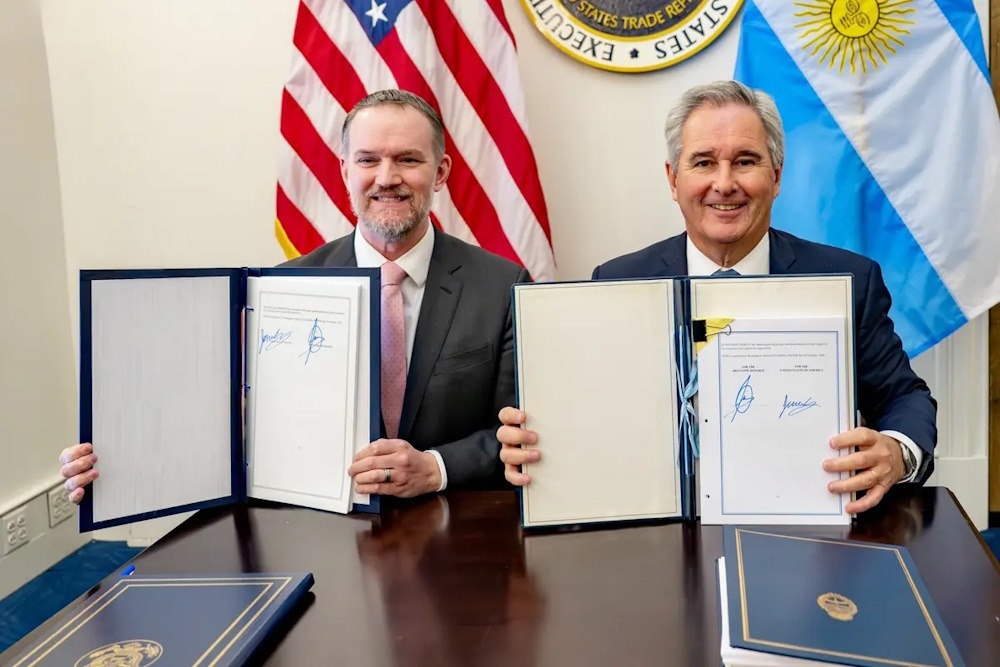
On Thursday, both Argentina and the United States confirmed the signing of an agreement aimed at fostering reciprocal trade and investment between the two nations. “Today Argentina sent a clear signal to the world: we are a reliable partner, open to trade and committed to clear rules, predictability, and strategic cooperation,” stated Argentine Foreign Minister Pablo Quirno on X. A statement from Argentina’s Foreign Ministry indicated that the United States plans to abolish reciprocal tariffs on 1,675 Argentine products, facilitating an increase of US$1 billion in exports. The communiqué indicates that US$800 billion of that amount would be derived from the U.S. providing preferential access to an additional 80,000 tons of Argentine beef this year, bringing the total to 100,000 tons.
The U.S. will also engage with institutions such as the Export-Import Bank of the United States and the U.S. International Development Finance Corporation to facilitate financing for investments in critical sectors in Argentina, in partnership with the U.S. private sector. Argentina will proceed to eliminate tariffs on 221 sectors, including machinery, transportation equipment, medical devices, and chemicals. Additionally, it will reduce tariffs on another 20 areas, primarily auto parts, to 2%, while also granting quotas for vehicles, meat, and various agricultural products. “These commitments aim to enhance systemic competitiveness by reducing or eliminating tariffs on inputs and capital goods and streamlining procedures, which will ensure predictable conditions for the sectors involved,” stated the announcement. Quirno additionally shared an image of the agreement’s cover; however, the contents were subsequently disclosed a few minutes later.
In November, both countries unveiled the framework of the agreement, detailing 11 critical sectors that would be influenced by the deal: tariffs, intellectual property, agricultural market access, labor, and alignment on economic security, among others. The announcement faced significant criticism, with the majority of concessions seemingly imposed on Argentina. On that occasion, a statement by the White House indicated that Buenos Aires was anticipated to “provide preferential market access for U.S. goods exports, including certain medicines, chemicals, machinery, information technologies products, medical devices, motor vehicles, and a wide range of agricultural products.” Argentina would eliminate the need for consular formalities regarding U.S. exports and gradually abolish the statistical tax on U.S. goods. Additionally, the country plans to streamline product registration processes for U.S. beef, beef products, beef offal, and pork products, while also exempting facility registration for imports of U.S. dairy products.
Buenos Aires has also pledged to prohibit the importation of goods “produced by forced or compulsory labor,” a move interpreted by some as a means to restrict specific Chinese imports. Additionally, it aims to tackle “potential distortionary actions” of state-owned enterprises and “industrial subsidies that may affect the bilateral trading relationship.”