
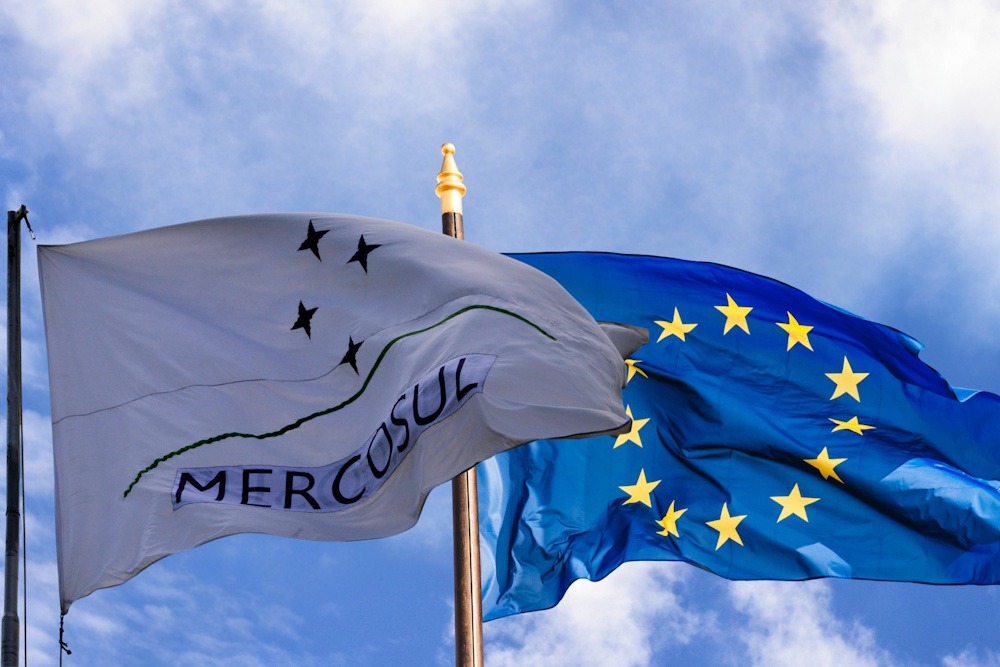
The European Union and the South American bloc Mercosur are poised to finalize an agreement on Saturday, culminating over 25 years of negotiations, aimed at establishing one of the largest free trade areas globally. Despite opposition from European farmers concerned about their financial interests, an agreement reached in Brussels last week is poised to be signed in Asunción, the capital of Paraguay. The combined economic output of the EU and Mercosur represents 30 percent of global GDP, encompassing over 700 million consumers. The agreement abolishes tariffs on over 90 percent of trade between the two nations. The agreement is designed to benefit European exports of automobiles, machinery, wines, and spirits to Mercosur, which will reciprocate by gaining more favorable access for its beef, sugar, rice, honey, and soy products.
The agreement has been in negotiation since 1999 between the EU and the founding members of Mercosur: Argentina, Brazil, Uruguay, and Paraguay, the latter of which currently holds the bloc’s rotating pro-tempore presidency. Bolivia is included as a member; however, it was not one of the founding members of the bloc and will not participate in the agreement. European Commission President Ursula von der Leyen is set to embark on a journey to Rio de Janeiro on Friday, accompanied by European Council head António Costa, before proceeding to Asunción for the signing event. Alongside host president Santiago Peña, Uruguay’s president Yamandú Orsi is set to participate in the signing ceremony. Argentina’s leader Javier Milei is anticipated to be in attendance. Brazil’s Luiz Inacio Lula da Silva has yet to provide confirmation.
Lula last week celebrated a “historic day for multilateralism” following the EU agreement, amidst “an international context of growing protectionism and unilateralism.” The European Commission, responsible for negotiating the text, was unable to secure unanimous support from all member states, with France, a significant player, spearheading an ultimately futile effort to block it. Ireland, Poland, Hungary, and Austria cast their votes against the accord; however, their opposition proved insufficient to impede its passage, as Italy, previously a holdout, ultimately lent its support to the agreement. Argentine trade analyst Luciana Ghiotto conveyed that the agreement was crucial “to show that there is a third way without tying ourselves to the United States or China” amid a period of increased unilateralism. “It is the longest-running negotiation worldwide, and the rush to conclude it has to do with [US President] Donald Trump’s administration and its massive use of tariffs,” she noted.
Contending that the current trade framework was detrimental to his nation, Trump has enacted tariffs on a wide range of goods imported into the United States from various countries since his return to the White House a year ago. According to Alejandro Frenkel, the agreement with Mercosur serves as a means for the EU to reinforce its autonomy and establish itself as a notable player on the global stage. For the South American bloc, this represented an unusual triumph amid a period characterized by “crisis and internal fragmentation” regarding responses to threats posed by Trump towards nations like Venezuela and Cuba. Following the signing on Saturday, the agreement requires ratification by both Mercosur members and the European Parliament, where a favorable majority remains uncertain. European farmers express concern that the agreement may result in an influx of lower-cost South American goods, attributed to production standards deemed less rigorous. In recent days, there have been widespread protests across France, Poland, Ireland, and Belgium, with thousands participating. The European Commission has introduced a crisis fund and implemented safeguards to enable the suspension of preferential tariffs should there be a significant increase in imports that could cause harm.