
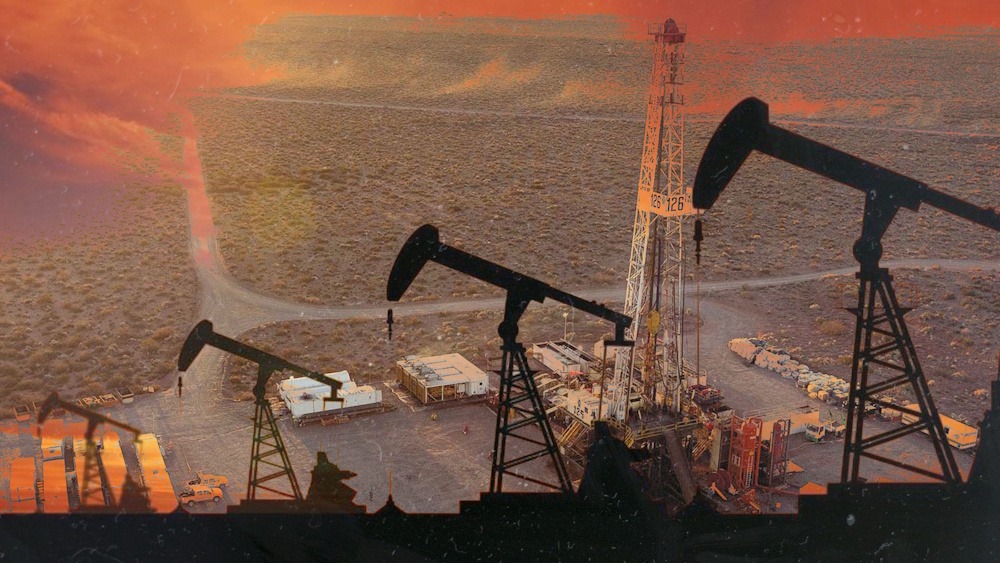
The expansive ravine traversing the city of Neuquén, located in north-western Patagonia, delineates its dual realities. The orderly, suburban avenues in the valley beneath resemble those found in any other Argentine metropolis. However, in the plateau region, there is clear evidence of the nation’s industrialisation. Power lines intersect a landscape of vacant housing lots poised for incoming inhabitants in one of the nation’s most rapidly expanding areas. Driving these changes is Vaca Muerta, one of the world’s largest shale oil and gas deposits, a formation acclaimed across Argentina’s political spectrum as the nation’s economic salvation. Data from the Neuquén Ministry of Energy indicates that over 97% of the province’s oil and more than 90% of its gas are obtained through fracking, a method that entails the high-pressure injection of water, sand, and chemicals to fracture rock formations and facilitate the release of hydrocarbons. Fuelled by heightened production levels in Vaca Muerta, Argentina has achieved a new peak in its daily oil output, surpassing previous records. Fracking represents a contentious method that has been associated with a rise in seismic activity. However, residents highlight an overlooked aspect of the boom: waste. Experts contend that the waste generated from fracking in Argentina is inadequately managed, resulting in environmental pollution and posing potential threats to public health.
Local regulations mandate that it must undergo appropriate processing. However, substantial amounts of waste stand as proof to the opposite. The quality of life in Neuquén is contingent upon the prevailing wind direction. “When it blows this way, the smell gets really strong. It stings your eyes and makes you sneeze constantly,” says Julio Polo. He is a security guard at an urban development surrounding the Neuquén West Industrial Park (PINO, in Spanish), where some companies have treated and stored fracking waste. The odour resembles sulphur, though numerous other chemicals are present in the air and soil. Fracking produces two distinct categories of waste. Contaminated water resurfaces post-fracturing, accompanied by naturally occurring brine, and is subsequently injected into underground disposal wells. This practice has been associated with induced seismicity, as the pressure may reactivate dormant faults. In certain North American nations, as much as 70% of wastewater is repurposed for fracking and various industrial applications. In contrast, Argentina disposes of more than 95% of its wastewater underground, according to Pedro Brisio, a board member of the Neuquén Association of Environmental Professionals, as reported by sources. The solid waste generated from fracking is a moist, earth-toned paste that consists of drilled rock, referred to as cuttings, combined with processed waste and sand. Over several years in Vaca Muerta, subcontractors have accumulated this sludge into prominent mounds, some situated in close proximity to residential areas.
Provincial regulations mandate that this sludge undergo processing through approved methods, which include the utilisation of high-temperature furnaces that incinerate toxic components, ultimately converting it into ash. However, in practice, the capacity for treatment has consistently lagged behind the volumes being generated. Waste is accumulating. International investors hold a substantial interest in the surge propelling this waste. Chinese companies have invested approximately USD 6 billion in Argentina’s fossil fuel sector, including Vaca Muerta, as reported by the news outlet Perfil. This accounts for approximately one-fourth of total Chinese investments in the nation. Pan American Energy, the fourth-largest oil producer in Vaca Muerta, represents a notable investment, jointly owned by Bridas Corporation and BP. Bridas represents a collaboration between the Argentine Bulgheroni family and CNOOC, the state-owned offshore energy behemoth from China. Notably, CNOOC’s investment in Bridas constituted 50% of China’s overall fossil fuel investments in Argentina. As Argentina accelerates its efforts to establish itself as a significant liquefied natural gas exporter, China emerges as one of the primary potential buyers that the Argentinian state-owned energy company YPF is focusing on, in addition to Brazil, India, Japan, and Europe. Fracking and its associated waste represent considerable contributors to pollution in surrounding regions. According to a 2019 study by the Concerned Health Professionals of New York initiative, over 200 pollutants were recorded in the air surrounding fracking operations in the U.S., and more than 1,000 chemicals were identified in fracking fluids. The study also describes the presence of radioactivity in residual water.
In Neuquén province, there exist five secure landfill sites alongside five operational treatment plants, as stated by Leticia Esteves, the minister for tourism, environment, and natural resources of Neuquén. Three treatment plants have been involved in legal disputes concerning pollution cases: E.ET., HP&V, and Comarsa. Esteves said no new landfills will be authorized. “Companies need to invest in alternative waste treatment methods, not only for environmental reasons, but also for logistical reasons,” she added. She emphasized that the existing sites are safe and properly licensed, but acknowledged that they are “sacrifice zones”: “They will never be able to be used for anything else again.” One company facing allegations of environmental pollution is the Sanitation and Materials Recovery Company (Comarsa, in Spanish), which has been operational within the PINO since 2009. The prosecution in the case alleges that it accepted a significantly greater volume of material than it could effectively process in its four furnaces. The outcome, as conveyed by the prosecution to Dialogue Earth, involved approximately 350,000 cubic meters of waste accumulated in the open air on unsealed terrain, exceeding the capacity of the site’s concrete containment barriers. In 2024, Comarsa experienced a loss of its state licence to process drilling waste, which encompasses cuttings. The furnaces were dismantled, and the company was mandated to transport the waste to a designated site approximately 115 kilometres away, situated in an area distanced from urban environments, according to Esteves and the prosecution.
Rafael Colombo, an attorney involved in the litigation against Comarsa, asserts that the buildup of waste has resulted in soil and air contamination, incorporating substances that pose risks to human health, such as benzene, lead, and arsenic. In the latest court hearing held in March, attorneys for Comarsa aimed to minimise the extent of the environmental damage, as indicated by records obtained by Dialogue Earth. It was reported that the company is in the process of removing the waste from the site in Neuquén, with completion anticipated in the near future. They also stated that the soil surrounding the plant was not contaminated. The original furnaces, which have now been closed, have imposed significant costs on the area’s residents. Several individuals who communicated with Dialogue Earth reported analogous experiences: intense odours leading to irritation of the mouth, nose, and eyes, challenges in breathing, and the onset of headaches. All parties attribute this to the Comarsa plant. Several of the plant’s neighbours assert that these symptoms reemerge during periods of elevated temperatures or following precipitation. Carlos, who preferred not to reveal his surname, has lived there all his life and recalls that when the furnaces were in operation, the symptoms were much more severe. “The furnaces burned inefficiently. They emitted black smoke. At night, the smoke is less visible, which is why they often burned more at night,” he claimed, echoing the views of four other residents. Daniel, a teacher who protested the plant in 2016 who also declined to provide his surname, said that the smoke provoked health issues. “That was when babies and children began to suffer the effects of the pollution,” he claimed. “Just imagine, the people living in these informal settlements are young families. The vulnerable group is mainly kids.”
Comarsa’s legal team failed to provide a response to Dialogue Earth’s inquiry for comment. The case is currently pending trial. During this year’s legislative opening, an annual address where political leaders delineate their accomplishments and future objectives, Governor Rolando Figueroa reported the removal of 139,000 tonnes of waste from Comarsa’s facility in Neuquén. Neuquén city is not the sole municipality altered by fracking. Añelo is situated a little more than 100 kilometres away, adjacent to a road that provides direct access to the Vaca Muerta oil and gas field. A steady flow of white vans and heavy goods vehicles traverses the thoroughfare. Añelo wasn’t always like this. “It had around 1,000 inhabitants. It started as a post office that later became a village of livestock farmers, mainly goat farmers. That changed just over 15 years ago,” says Cecilia Romero, a teacher and resident. “From goat barbecues and traditional rural festivals where everyone wore espadrilles, berets, and rode horses, we’ve gone to a line of lorries all day long.” She estimates that around 50,000 people now pass through Añelo every day. In the regional capital, Añelo features a plateau that serves as a settlement for the population arriving to engage in the industry. Despite being adjacent to one of the world’s largest gas fields, these neighbourhoods only had gas installed a few months ago, some residents informed Dialogue Earth. They are situated less than two kilometres from a landfill where solid waste from fracking in Vaca Muerta is processed. Within this facility lies a plant managed by Indarsa, a company under the control of the Urcera Group, which stands as one of the province’s most significant business entities. It manages two of the five landfills in the region, as per documentation from the NGO Center for Research and Prevention of Economic Crime, obtained by Dialogue Earth. During Dialogue Earth’s visit to the region, they observed mounds of sludge reaching heights comparable to a five-story building at the largest of these locations.
The sludge undergoes processing into ash, which is subsequently deposited in that location. Water was observed being sprayed on the mounds to mitigate the impact of the strong Patagonian winds that could disperse dust into the surrounding neighbourhoods; however, this method does not consistently yield successful results. Sludge transported from Comarsa’s facility in Neuquén is also directed to this site. Some residents are concerned about the impact of this waste on water supplies. “We drink bottled water because we know the river water isn’t good. It might be contaminated with oil chemicals,” says one local. However, waste was not the main concern for most Añelo residents. They do not see Vaca Muerta as bringing development or jobs for them. “We’re fighting against outsiders, trained for the oil industry. We are people from Neuquén who grew up in the valley with cattle and goats,” reflects one resident. “So you have to adapt to a situation that has been imposed on you.” Esteves recognises the urgency surrounding the need to address the issue of solid waste generated from fracking expediently. Oil companies will soon be mandated to adopt more advanced techniques for waste treatment, she stated. The intention is for this to be executed at the extraction site itself. The state oil company YPF is currently engaged in the development of a waste treatment facility located 17 kilometres from Añelo. For Esteves, the U.S. is an example of the opportunities being missed in Argentina. “Over there, they are discussing using the ash in the construction of roads and motorways,” she said. Meanwhile, in Argentina, production is on the rise, while the accumulation of waste persists.
