
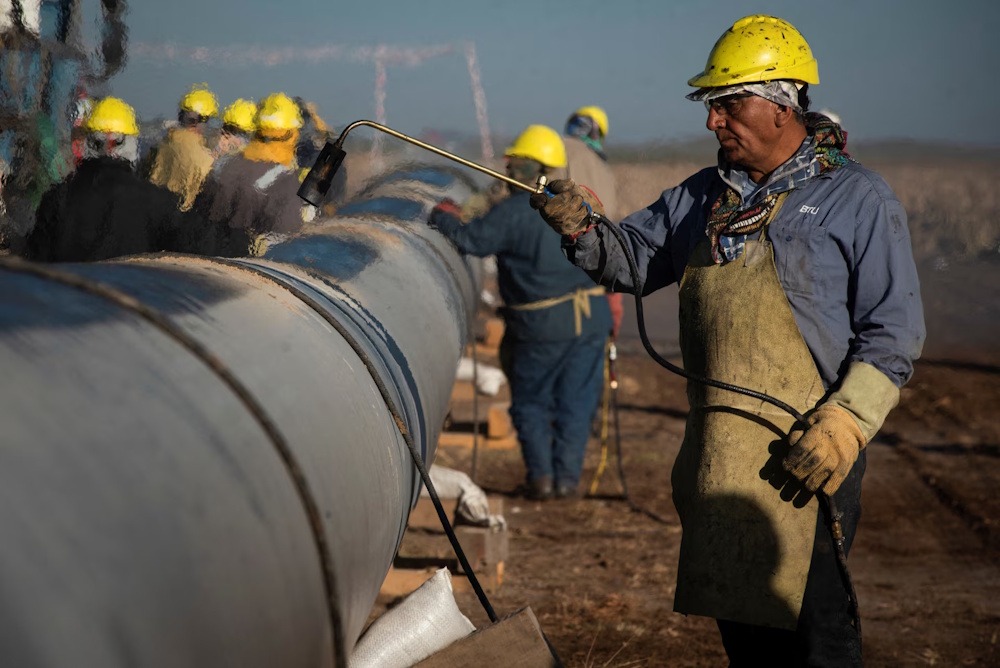
An old, weathered poster proclaims triumph outside the office of the deputy mayor in a small town in Argentina: “We did it … LNG for Sierra Grande.” It alludes to a US$24 billion natural gas export project that is neither developed nor guarantyd in terms of funding. It would not have been possible without President Javier Milei, a symbol of the free market, but a group of large energy corporations is moving forward, and Sierra Grande feels it is about to undergo a metamorphosis. Sierra Grande, a scrubby village that previously flourished as a mining town, lies some 650 miles south of Buenos Aires, the political and economic capital of Argentina. The entrance to the sealed iron pit can only be reached by driving down a creepy dirt road, past a housing development that used to be luxurious but now looks like something out of a post-apocalyptic nightmare. One of the largest energy projects ever planned in Latin America is now slated to begin at this location. Natural gas may be piped from Argentina’s enormous Vaca Muerta shale deposits to the Atlantic coast, liquefied and shipped all over the globe according to a consortium that includes leading local energy producer YPF SA, European oil giant Eni SpA and a division of Abu Dhabi’s Adnoc. The project aims to transform Argentina, a country that has struggled in the past with energy, into a leading supplier on a worldwide scale by producing 12 million tonnes of LNG per year. It is expected to be the largest offshore liquefaction plant globally.
A final decision to proceed is scheduled for November 30th, with JPMorgan Chase & Co and Banco Santander SA spearheading the financing. Milei is likely to use the event as a victory lap, but he will only be able to see the investment through if he remains in office, or if his political changes last. Just over a year remains until the next presidential election. The stakes extend well beyond petrol for a nation that has endured successive economic crises for decades. Exports of Argentine shale might reach $30 billion each year, surpassing the amount of the soybean and maize shipments that have traditionally provided the country with a steady stream of revenue, thanks to the prospect of billions of dollars in export profits from Argentina LNG. It represents a once-in-a-generation opportunity for Sierra Grande in terms of infrastructure and employment. Raising massive quantities of finance, securing purchasers years before the first shipment leaves, and persuading international investors that regulations will remain unchanged when the present administration leaves office are just a few of the obstacles Argentina must face. For quite some time, Argentina’s government has wavered between strongly intervening in the economy and trying to open it up to private companies, only to turn around when faced with mounting political or economic pressure. Companies from other countries are hesitant to invest billions in energy projects with a long payback period because of these sharp reversals.
Because of this, Argentina LNG is one of the most significant challenges that Milei has faced in her efforts to end the trend of investment dwindling in the resource-rich nation. In Sierra Grande, there’s hope that this time will be different. “You’d have to be pretty foolish to ditch a megaproject like this that’s so beneficial for the entire country,” said Demetrio Almeida, who owns a butcher shop that blasted 1980s music from a speaker on the sidewalk, compounding the feel of a place still clinging to its past glories. “Even if Milei loses, I can’t imagine his successor would ever let it fall through. It’s beyond party politics.” After years of infrastructure delays and funding restrictions, Argentina is making a big push to export its enormous shale gas resources from the Vaca Muerta, with Argentina LNG at its core. By combining it with the independent pipeline and crude export terminal being built at Sierra Grande, known as Vaca Muerta Oil South, a new energy corridor would be formed that would extend from Patagonia to the Atlantic coast. Milei has taken steps to facilitate these investments through a suite of policies known as the Incentive Regime for Large Investments in Spanish, which offers tax, customs, and foreign exchange advantages.
Officials have so far approved more than two dozen projects under RIGI, leading Milei to call it “the most significant industrial and development policy tool in Argentina’s history.” Aimed squarely at a history of governments interfering with energy sales abroad and forcing corporations to store earnings in Argentina, the framework provides 30-year protections including export guarantees and greater freedom to keep dollar proceeds offshore. Due to their status as acquired rights similar to property, it would be difficult to remove the protections. However, investors are wary of Argentina’s past and don’t want to take anything for granted. Axl Kicillof, the left-wing economist who led the contentious nationalisation of YPF in 2012, is one candidate who could run against Milei for president next year. Kicillof supports cheaper gas for local business and has blasted RIGI for enabling firms to avoid Argentina’s courts. “Argentina’s gas resource has always been there,” said Ira Joseph. “The political will has more of a checkered past of fast starts and hard stops.” Nicolás Gadano, an energy expert at Buenos Aires consultancy firm Empiria, cites the example two decades ago when Argentina tore up gas export contracts with neighbouring Chile. Still, he doubts a future government would siphon off gas earmarked for Argentina LNG.
“RIGI oil and gas projects will bring in hard currency,” Gadano said. “That’s just as valuable to a freer-market government as it is to a more interventionist one.” After years of deficits that left the economy even more vulnerable, the program has already attracted investment in shale enterprises, which has boosted oil and gas output in the Neuquén Basin, which is home to the Vaca Muerta rock layer. It has also driven record energy trade surpluses. Argentina LNG will not be constructed just through political safeguards. Although the partners are almost ready to provide their final permission, it will be in the days ahead, before all of the funds have been fully committed. Project finance might account for as much as 70% of the cost, according to YPF and Eni. This amount is unusual and would be far larger than the about US$2 billion package that VMOS received. A source close to the situation said that banks are still hesitant to lend money in the run-up to the presidential elections in 2020 and might initially just offer bridging funding. Letters of intent from lenders may be the only thing supporting the investment announcement, according to YPF Chief Executive Officer Horacio Marín. There will be heightened scrutiny of US energy investments abroad following the Democrats’ resounding midterm election victory earlier this month, but a US$6 billion donation is still in the works.
When Argentina LNG enters the market, competition is sure to be fierce. Although initial exports are not expected until approximately 2030, significant expansions are already in motion with key suppliers in the US and elsewhere. If the schedule for Argentina LNG is extended enough, the arrival of its first cargoes could coincide with an influx of new supply, which would put pressure on prices and reduce profits. At least for the time being, some purchasers are diversifying away from Middle Eastern suppliers due to the Iranian war. For example, Argentina recently received an unanticipated boon in obtaining the long-term sales deals that lenders normally demand, as a result of Poland’s recent contract cancellation with Qatar. That could well “speed up the appetite for financing our project,” Marin told Bloomberg TV on November 3. Whether this most recent infusion of money finally provides Sierra Grande with a sustainable economy is far more important than elections, funding, or petrol costs, which are concerns felt thousands of miles away. Concerns about the long-term viability of Milei-style deregulation and its ability to provide benefits to all parties involved continue to be voiced with scepticism. The town stepped in to provide modest jobs as firms vanished following the mine’s closure. “Families were performing miracles just to get by, relying on municipal programmes to meet their daily needs – basically, just to eat,” said Cintia Castillo.
“There are generations that have never experienced a real culture of employment.” In the 1970s, when the iron mine at Sierra Grande attracted labourers from all over the globe, the town experienced spectacular expansion, according to 62-year-old Daniel Pacheco. Like thousands of others, he fled the mine when it closed and found work on an assembly line for cars before going back home. “My question is what happens the day after,” Pacheco said. “Because there are jobs now. But I can assure you that once VMOS is operational, you’re going to have workers cast aside. What do you do with those people?” According to VMOS, construction workers will find new employment opportunities in the LNG facility building industry, and there will be a plethora of contracts to service the port. Another concern that arises as a result of the transformation of this sparsely populated area of Patagonia is: What is lost when industry goes in? Phase one would involve the mooring of two floating vessels in the San Matias Gulf; each vessel would be four American football fields long. A complex system of pipelines, racks, and cryogenic equipment would rise several floors above their hulls, with the purpose of superchilling natural gas into a liquid state for export. Part of the reason the Gulf was selected as Argentina’s new shale-export center is that its deep seas enable the largest tankers to access the area and load with minimal dredging.
In addition to being a place where whales lay their eggs, a significant portion of it is under the protection of the UNESCO World Heritage List. A group of onlookers stood on the beach not long ago as whales swam past with their young, their low cries echoing across the bay. Worried environmental organisations have charted the migration patterns of whales along the shore. VMOS and Argentina LNG have collaborated with local biologists to develop procedures for their projects. These protocols include methods to mitigate the impact on whales, such as reduced ship speeds, and continual monitoring of whales in the Gulf. “I don’t see that it’s a problem,” YPF’s Marín said. “All the companies work with respect for local communities and the environment.” Back in Sierra Grande, optimism is tough to separate from reminders of what happened the last time the town hitched its fortunes to one industry. A stone monument on the main road announcing the “Capital of Iron” is crumbling; near the VMOS construction site, the abandoned iron port rises like a black monolith on the horizon. Cristina Torres, 42, sees the new investment as a chance to avoid repeating that history. She’d worked in a greengrocer’s before taking a cleaning job at VMOS, which eventually led to a role helping assemble the domed roofs on its vast oil-storage tanks – industrial skills she hopes will remain valuable long after construction ends. “I have faith that Sierra Grande is going to prosper,” Torres said.
